



5 min readMar 30, 2026 05:11 PM IST
First published on: Mar 30, 2026 at 05:11 PM IST
A recent article on the revelation of Banksy’s identity (‘We now know who Banksy is. But does that change anything?’, IE, March 26) revisits a familiar tension in the art world: What happens when anonymity — so central to some artists’ mythology — collides with a market that thrives on names? The question, however, extends beyond Banksy. It strikes at an older, unresolved debate in art: What truly determines the value of an artwork: The work itself, or the name authoring it?
To clarify, there are a few metrics in calculating the price value of an artwork, including intrinsic value (based on the cost of material, and time invested), and extrinsic value, which includes values such as “historicity”, launch, and landing markets, and life stage of artist’s market. These do differ when looking at primary, and secondary markets as well. Yet, in practice, these categories often collapse into a single, dominant factor: Authorship (or the brand of the artist). The artist’s name becomes shorthand for quality, relevance, and, crucially, financial security.

But the question remains: Do we value ‘The Starry Night’ as an artwork because of the merit and impact of the work, or because it is a work created by a famous artist, Vincent van Gogh? The question is uncomfortable because it suggests that our aesthetic judgement is rarely pure; it is manufactured by the market.
This slippage — from work to name — now mirrors another domain we understand all too well: Luxury branding. We do not simply buy a well-made shirt; we buy a Dior shirt. The emphasis shifts from material, craftsmanship and cut to the aura of the label. In much the same way, we increasingly seek to acquire “an artist”, rather than an artwork. The distinction is subtle, but consequential. When art is consumed as a brand, its value is decoupled from its making and reattached to its market identity. That is a dangerous shift.
It is dangerous not only because it privileges perception over substance, but also because it entrenches a value system largely shaped by Western market structures; where distance between maker, market, and money is often the norm. The artist becomes an abstracted brand, circulating in financial and institutional networks that are far removed from the act of creation itself. In contrast, much of the Global South has historically retained a more intimate understanding of making. Whether in textile traditions, sculpture, or craft traditions, there is an embedded respect for the skill, labour, and even the sacred dimension of creation. Cultural memory here does not just celebrate the artefact; it reveres the act of making, embodied in figures such as Saraswati, a reminder that creativity itself has long been accorded a near-divine status.
To uncritically import a brand-first model into such contexts risks eroding this sensibility. It pushes attention away from the work and the worker, and towards the optics of ownership. It also exacerbates inequities: As the brand grows, the distance between the creator and the economic value of their work can widen, leaving artists both overexposed and undercompensated.
Meanwhile, the narrative and marketing machinery around art continues to intensify. Artists and dealers would spend more time, effort, and money in marketing their works; adding badges of honour like “in the collections of…”, and “awarded…”, rather than actually uplight the content of the work, maybe by collaborating with people who understand the subject better. In the world of hyper consumption, it has become a catch phrase to say, “I have an XYZ” (XYZ being the hot artist of the season!) A lot of dealers too push this approach, as it is easier for them to get artists to “manufacture” artworks, rather than create more meaningful artworks, which take time. Quick churn can lead to quality burns!
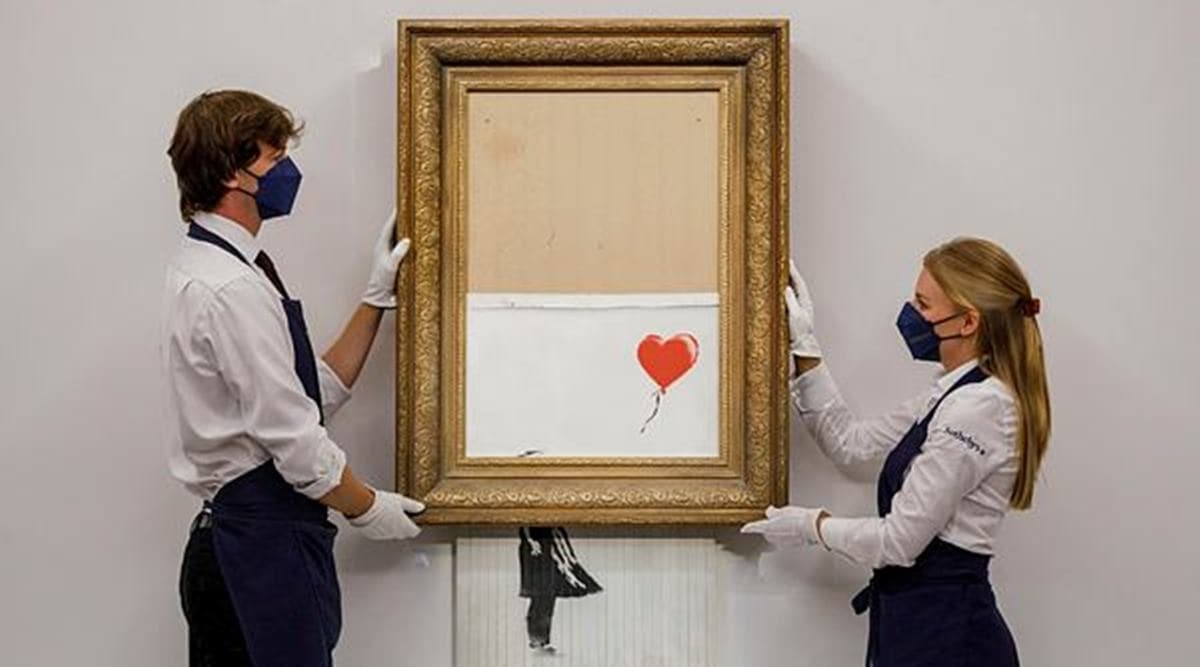
Back to Banksy, I would like to highlight that one of the biggest reasons he, and a lot of graffiti artists remain anonymous is that as a format, graffiti is anti-state, and illegal in most countries. He hasn’t been too pleased with his works reaching auction houses, and has mocked it, like when his ‘Girl with Balloon’ was auto-shredded while it was being auctioned. Banksy, along with a gang of artists like Maurizio Cattelan, mock the market’s insatiable appetite for spectacle and the obnoxious prices that are often paid for it. The point of Cattelan’s work ‘The Comedian’ (a banana duct-taped to a wall) was to mock those who are willing to pay a huge amount for a banana.
What dealers can do in this case, if they care about the artists and the art market, is set rights of resale, or define ownership in a way, where the buyer cannot flip a work for profit. We can help temper excess.
The Banksy moment, whether or not it resolves into a confirmed identity, offers an opening. It asks us to suspend our fixation on authorship and return, however briefly, to the work itself. In an age increasingly defined by brands, that return may be the only way to preserve art as something more than a commodity.
The writer is an art advisor and curator

