



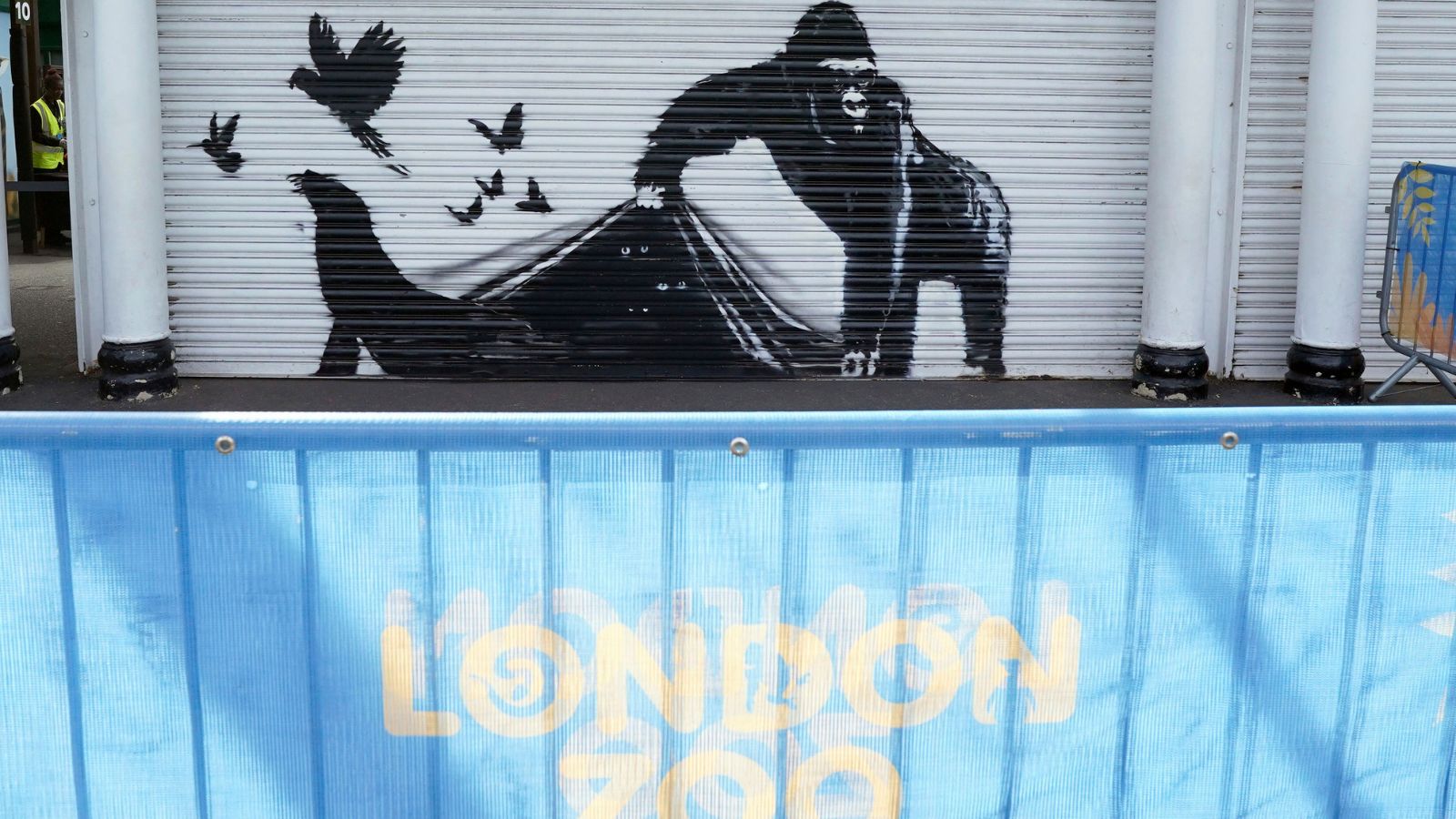
We all have that friend — the Sheldon Cooper to Big Bang Theory’s Howard Wolowitz — who, once shown a magic trick, cannot rest until they have explained to everybody and then some exactly how the rabbit got into the hat. The magician, of course, is appalled, and the spectators, wanting to preserve the wonder, unsuccessfully try to drown out the voice by stuffing their fingers in their ears and humming lalala. This is how I spent the last week, since Banksy — the art world’s most interesting ghost — was unveiled.
Apparently, Banksy, aka Robin Gunningham, made the rookie mistake of letting his ex-manager leave a trail of breadcrumbs post his exit, which led reporters straight to a handwritten confession, a border crossing, and the deeply unromantic discovery that his legal name is now David Jones, if the Reuters investigation is to be believed. Banksy himself has yet to refute or confirm the disclosure.

So, here I am, cycling through stages of what I can only describe as a very bourgeois grief. While I do not know the man who is Banksy, I was rather in love with the idea of a phantom revolutionary, stencilling politically subversive art onto the walls of London, Gaza, and Ukraine in the dead of night, leaving behind nothing but a provocation and his signature.
The ghost could neither be compromised nor could he be photographed leaving a dinner party with the wrong people. It was unlikely to put its foot in its mouth in an ill-timed, poorly worded tweet or feature in a middling documentary. Banksy’s anonymity protected his audience as much as it protected the artist. We were spared the man and his foibles and only got the work. The wise say, with good reason, never meet your idols, for everybody is fallible, except ghosts. And one fears, now that we know his identity, whether the artist will eventually get in the way of the art.
Post this unmasking, the question — with an artist’s freedom and millions of pounds riding on it — is whether this changes anything. If one were to ask the French philosopher Roland Barthes, who famously declared the death of the author, it does not. Barthes believed the meaning of art once out in the world lay in the eye of the beholder, and not on the creator’s biography or intent. After all, whether Banksy remains masked or is unmasked, his message does not change, he remains the artist who drew a judge crushing protesters, chimps debating in Parliament, and a girl reaching for a bright red balloon.
But Barthes, for all his wisdom, discounted the auction house. The value of Banksy’s art de résistance is tangled with his artistic signature. His art is sold at a premium because the name Banksy, for decades, belonged to a faceless man. For so long, his legend has been fuelled by his disappearing act. His art, which questioned the powers that be, appeared on the walls of a Britsh courthouse and war-torn landscapes, seemingly out of nowhere, and was signed by a man who was, for all intents and purposes, a ghost. It helped that the graffiti was beautiful, and often afforded passersby either a good laugh or food for thought. Those who were the butt of the joke had no one to investigate or discredit. The provocation had no owner, so it could not be defused.
Banksy’s anonymity, his international popularity, and his art being seen as Britain’s cultural heritage protected him from legal ramifications, so he — unlike his less- fortunate contemporaries — avoided hefty fines and vandalism charges. In fact, taxpayers’ money was spent on dealing with his arbitrary artwork, which was either preserved on the same spot, moved to a different location, or erased. He famously justified his vandalism by saying that any advert in a public space is “yours to take and re-use” because it does not give you a choice whether to see it or not. It is both ironic and subversive, depending on whom you ask, that he built a career and reputation imposing his art, in a way his own advertisement, on public buildings without seeking permission either.
As his popularity increased, Banksy became a privileged figure protected by non-disclosure agreements, wealthy collectors profiting from the enigmatic author’s art, and the convenient fog of mystery. Besides, public sentiment was firmly with him, given that he used the proceeds from his multi-million-dollar artwork to help people suffering from the injustices he raised his stencils against. It was also convenient that the left enjoyed his politics, while the wealthy enjoyed the resale value of his art, and Banksy himself enjoyed immunity from the law and the patronage of the rich and privileged.
And so, although one loves to cheer for a Robin Hood-type figure that sells politically subversive art to the rich and distributes the proceeds among the needy, one cannot reasonably object to the journalism that revealed his identity on the grounds that the truth is inconvenient. The reporters who pieced this together did their job, and did it well. One can, however, be permitted to privately mourn the potential loss of a revolutionary maverick who dared to punch up. Will he now pay his pending fines? Will he be able to paint another cheeky mural without reprisal?
I console myself with the thought that if anyone can figure out how to remain a thorn in the side of the establishment with a legal name and a tax bill, it is probably him. The man is resourceful. Besides, while this Banksy has been compromised and risks being muzzled, the idea has transcended the man. Unmasking one David Jones may “kill” one Banksy, but several Banksys lie in wait. Not all of them will become as famous as he, but they will continue to speak truth to power.
However, it is equally true that nobody should be above the law, particularly those with political and cultural clout. These two conflicting feelings about the unveiling of the artist sit uncomfortably together, but there they are.
The genie is out of the bottle, and I am still conflicted about whether to applaud or curse the colleagues who explained the trick. On balance, I suppose one can do both.
The writer is deputy copy editor, The Indian Express. aishwarya.khosla@expressindia.com

