



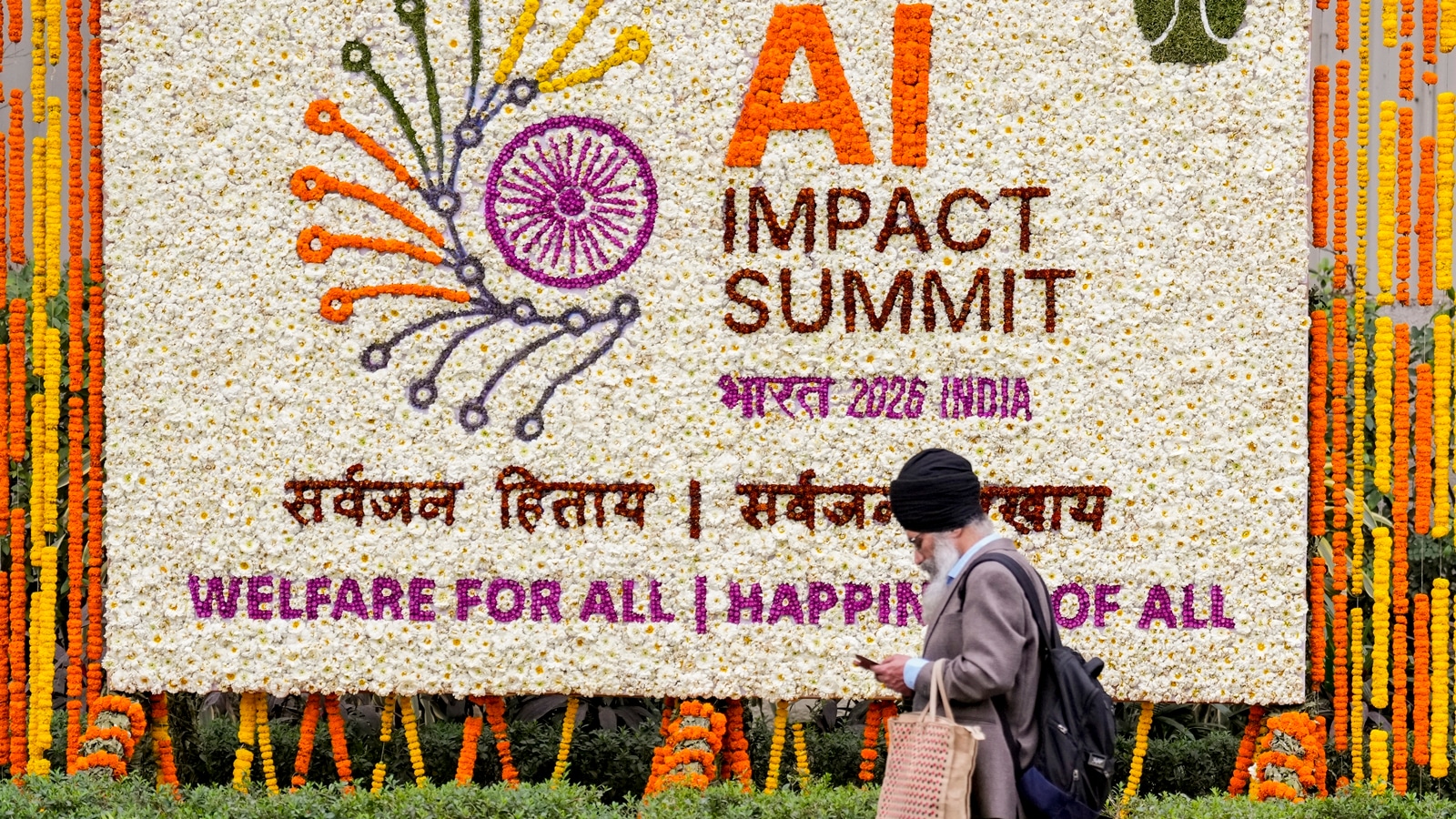
The Artificial Intelligence Summit in Delhi has once again exposed a persistent weakness that continues to shape India’s economic trajectory: The gap between ambition and execution. Coming barely two weeks after the Union Budget, the summit provides an immediate and uncomfortable lens through which to assess the credibility of policy promises. Together, the two events tell a familiar story. India does not lack vision, announcements, or fiscal intent. What it lacks is consistent administrative capability and reliable last-mile implementation.
Finance Minister Nirmala Sitharaman’s ninth consecutive budget, presented on February 1, avoided the usual extravagance of rhetoric. It also, however, avoided a careful accounting of past announcements and their status. This was a missed opportunity. After nearly a decade of continuity, the moment could have been used for reflection on delivery, not merely a presentation of new schemes. Several fresh initiatives filled the 90-minute speech. Their eventual fate remains uncertain. Some may proceed slowly, others may be consigned to history much like earlier flagship programmes such as Make in India or Smart Cities. Our Achilles’ heel has been finding a route from announcement to outcome. This is where, as the Americans evocatively say, the rubber meets the road.

It is reasonable to argue that judgement should wait, since implementation formally begins only in April 2026. But many promised outcomes lie far in the future — 2030, 2035, even 2047. By then, technological change or geopolitical shifts may have altered the relevance of today’s ambitions, including the aspiration to become a global data-centre hub. The semiconductor mission has received a 25-year tax holiday. Data centres and cloud infrastructure have been given similar fiscal backing. Skill development programmes stretch across decades. None of this is inherently problematic because long-term transformation requires durable commitment. The concern arises from India’s uneven record of execution.
The AI Summit illustrated this problem with unusual clarity. Designed to showcase India’s technological readiness and global leadership in digital infrastructure, the event simultaneously revealed familiar administrative weaknesses. Participants encountered long queues, overcrowding, and most strikingly, cash-only payment counters inside a summit celebrating digital transformation and UPI. The irony is hard to ignore.
Thus fiscal incentives and tax holidays may not compensate for weak administrative systems. The same lesson appears across sectors. For example, India’s manufacturing share has remained close to 16-17 per cent of GDP for nearly two decades, despite lower labour costs than many competitors, including China. Infrastructure spending has risen sharply, but project delays and regulatory bottlenecks are familiar.
National budgets increasingly signal direction rather than immediate transformation. With GST firmly in place, customs duties shaped by trade agreements, and direct tax reductions largely exhausted, the annual budget has limited room for dramatic fiscal change. Wealth and agricultural taxation remain politically sensitive. At best, policy can aim to deepen compliance within the existing tax base, roughly 90 million individuals in the tax net, of whom about 30 million pay income tax. Achieving meaningful gains here requires administrative reform: Simpler rules, lower compliance costs, and a less adversarial relationship between state and taxpayer. Reducing the cost of compliance could achieve for India’s tax system what Ronald Reagan once sought in the United States through lower rates, namely, improved compliance and ultimately higher collections through the Laffer effect. Trust, not suspicion, must define the system and digital filing by itself may not be sufficient to achieve the desired result.
History offers some lessons. The landmark budget of 1991 emerged in a crisis. Foreign-exchange reserves covered only days of imports and reform was unavoidable. Most budgets are not written under such pressure and cannot replicate that moment. Expecting each budget to deliver structural transformation misunderstands how reform typically occurs in India. Scholars and thinkers associated with India’s reform era have long recognised this. Jagdish Bhagwati warned against bureaucratic over-activity without clear necessity. Arvind Subramanian argued that steady, credible incremental reforms can eventually produce outcomes comparable to dramatic change. Montek Singh Ahluwalia emphasised calibrated gradualism suited to India’s political and institutional realities. These perspectives share a common insight — implementation determines success more than announcement.
The AI Summit reinforces this idea. India’s ambitions in AI are real and justified. We have enormous talent, data, entrepreneurial energy and racing digital infrastructure. At the same time, global leadership in AI will depend not only on fiscal incentives, but crucially also on governance quality, predictable regulation, efficient logistics, and competent public administration. Without these foundations, incentives alone cannot deliver transformation.
Budget 2026, therefore, is best understood as an incremental continuation of an existing policy path. Fiscal consolidation remains intact. Infrastructure spending continues, manufacturing incentives persist despite modest structural change. Services remain central to employment and tax simplification proceeds gradually. While none of this is trivial, it doesn’t address the deeper constraint revealed once again at the AI Summit, namely weak execution capacity.
After three and a half decades of opening the economy, India’s development challenge is no longer primarily about policy design. It is to bridge the distance between intention and outcome. If incremental reform is eventually to produce transformative change, implementation itself must become the central reform agenda. This may require institutional innovation focused not on new schemes but on delivery of existing ones.
One might even suggest, only half in jest, the creation of an Implementation Commission, tasked not with design, but execution. The idea may sound paradoxical — to reduce bureaucracy one is compelled to create more of it. It is time, perhaps, to also rid ourselves of Sir Humphrey Appleby’s self-serving advice that the purpose of policy is to make it look as if something is being done, whether or not it is. India’s next stage of development will begin when implementation, not appearance, becomes the measure of success.
Kathuria is dean, School of Humanities and Social Sciences, Shiv Nadar University, and professor of Economics. Views are personal

