



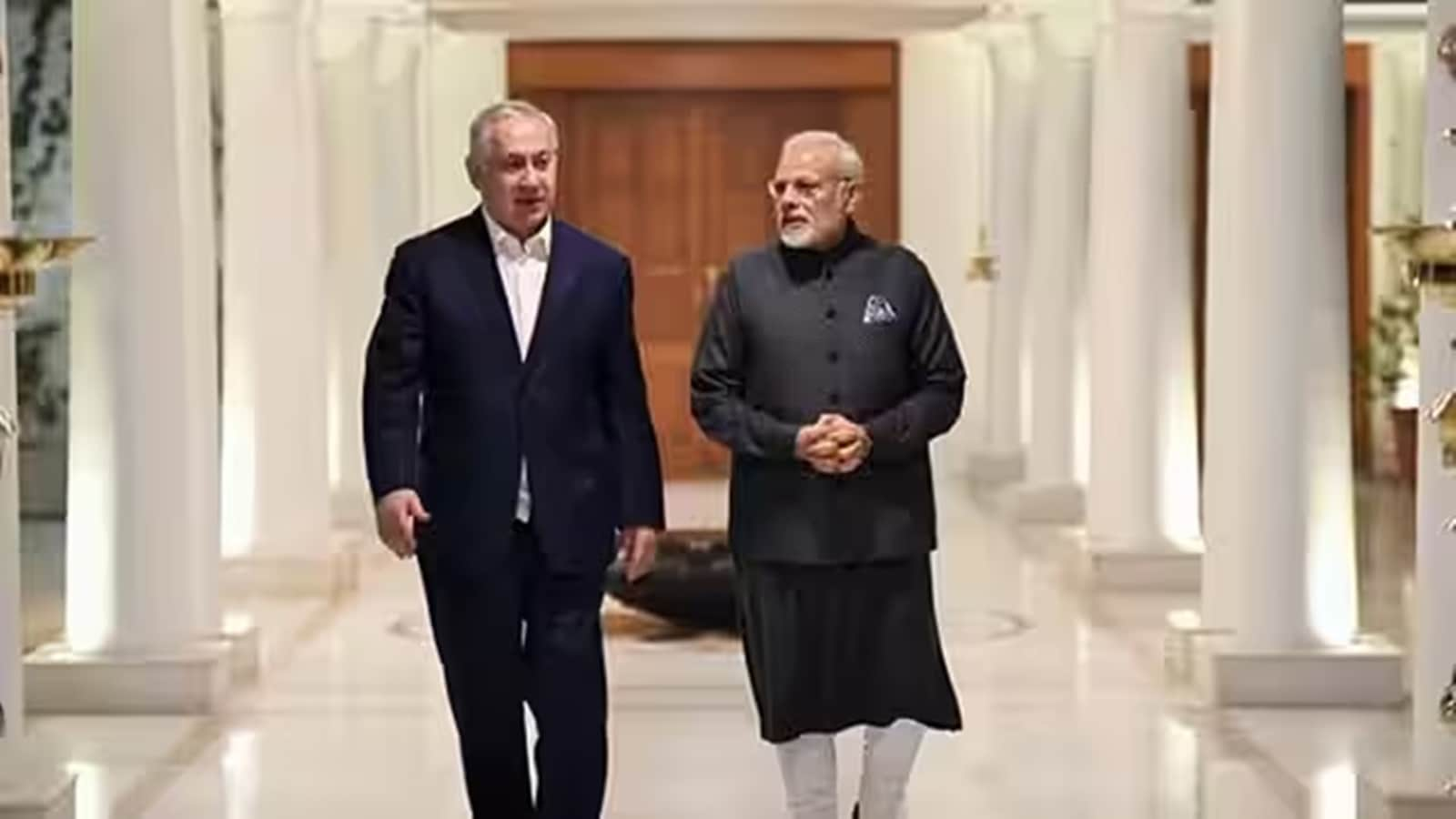
Prime Minister Narendra Modi’s visit to Israel on February 25-26 marks a significant milestone in the evolution of bilateral relations and coincides with a transformation in the geopolitics of the Middle East. On both the bilateral and regional fronts, the PM’s talks with Israeli Prime Minister Benjamin Netanyahu could turn out to be consequential.
India’s engagement with Israel was taboo in the early decades of post-Independence diplomacy. It became a cautious adjunct after the early 1990s, when Delhi established full diplomatic relations. It was only after the Modi government took charge in 2014 that the relationship acquired a strategic dimension. To be sure, Modi’s trip — only the second ever by an Indian prime minister to Israel — will provoke concern in parts of Delhi’s political class. Some will argue that India is abandoning the founding principles of its foreign policy. A closer look at the history of India-Israel relations, however, reveals a far more complex trajectory.

There is no question that stronger ties with Israel are part of the BJP’s ideology, dating back to the Jana Sangh days. In 1977, as foreign minister in the Janata Party government, Atal Bihari Vajpayee opened a political channel to Israel, quietly hosting its foreign minister, Moshe Dayan, in a secret visit to Delhi. It did not remain a secret for long and triggered controversy. As prime minister, Vajpayee hosted Ariel Sharon for the first-ever visit by an Israeli PM to India in 2003. Modi followed with his path-breaking 2017 visit.
But it would be incorrect to say Congress was always hostile to Israel. Jawaharlal Nehru recognised Israel early on, but held back on establishing full relations. He allowed Israel to open a consulate in Mumbai in the 1950s. Ideological antipathy to Israel sharpened only in the Indira Gandhi years, when Indian diplomacy embraced radical rhetoric in the Middle East. Yet, even she did not ask Israel to shut its consulate.
Rajiv Gandhi revived engagement, and Narasimha Rao normalised ties in 1992. Yet, the Congress governments thereafter kept the relationship discreet. The communist parties that rail against engagement today conveniently forget that their tallest leader, Jyoti Basu, travelled to Israel in 2000 to establish cooperation between West Bengal and the Jewish state. Part of the Indian ambivalence toward Israel is due to the huge emotional salience of the Palestinian cause.
An Israeli diplomat in Delhi used to quip that the Congress governments treated Israel like a “mistress” — private engagement and public distance. Modi’s 2017 visit broke that mould. The 2026 trip signals a major expansion of strategic collaboration — especially in security, defence, and advanced technologies.
Modi’s visit comes as Israel faces global criticism for its regional policies. But that is not weighing heavily in Delhi’s calculus. Israel today enjoys greater room for manoeuvre in the region than ever before. Several Arab and Muslim states have normalised ties with Israel. Even those that haven’t — Saudi Arabia, Pakistan, and Indonesia — sit with Israel on Donald Trump’s Board of Peace, which is now empowered to administer Gaza. The gulf between rhetorical solidarity with Palestine and actual statecraft has never been wider in the Middle East and the Muslim world.
Meanwhile, the balance of power on the ground has shifted dramatically since October 7, 2023. The US and Israel’s attacks against Iranian nuclear infrastructure and the systematic degradation of Hamas and Hezbollah — Tehran’s allies — have reshaped the regional balance. Iran — the most consequential revisionist power in the Middle East for four decades — has been severely weakened. Its Axis of Resistance against Israel has been hollowed out. Israel, by contrast, emerges militarily dominant in the region. Tel Aviv’s influence on Washington’s Middle East policy reinforces it politically.
Amid this churn, Netanyahu has floated a new “hexagonal” alliance. Presented as a regional coalition against regional radicalism, it seeks to cover a vast swath stretching from the Mediterranean to the Horn of Africa and Asia. The proposal reflects Netanyahu’s view that India must play a key role in stabilising the Middle East. For India, the idea is attractive not as a formal alliance — which Delhi instinctively avoids — but as an emerging framework for raising its regional profile.
Meanwhile, Iran’s weakening in relation to Israel has also triggered a counter-movement among some regional states — including Saudi Arabia, Turkey, and Qatar — exploring a coalition to constrain Israel. Pakistan has been drawn in. Riyadh and Islamabad signed a Strategic Mutual Defence Agreement last year, treating an attack on one as an attack on both. Turkey has signalled interest in joining. Talk of an “Islamic NATO” worries many, including India. But alliances of this kind have rarely endured in the Middle East; what has persisted is the historic Anglo-American domination. The US remains the chief arbiter of war and peace in the Middle East.
India’s ties with Israel now sit atop a broader transformation. Relations with the UAE are flourishing — from energy and investments to defence manufacturing, fintech, AI, and critical minerals. Economic and military ties with Saudi Arabia have grown. India launched free trade talks with the Gulf countries this month. India’s ties with Israel no longer shape the Middle Eastern engagement with Delhi.
This has enabled India to pursue parallel tracks with confidence: Supporting Palestinian statehood while engaging Israel as a vital partner. Delhi has navigated the competing pulls of Shia and Sunni, Arab and Persian, Ottoman and Arab, as well as internecine quarrels within the Arab world. Except with Turkey, India now maintains productive ties with nearly all major actors in the region.
None of this means India’s Middle East policy has become a walk in the park. The region remains volatile, and conflict remains endemic. Military tensions between the US and Iran, Israel’s domestic political turbulence, and humanitarian crises in Gaza and elsewhere in the region will test India’s ability to balance principle and pragmatism.
But unlike in the past, Delhi is no longer defensive. Today, it engages the Middle East with greater realism. India’s growing interests — ranging from energy to expat labour and connectivity to counter-terrorism — are too important for Delhi to engage the region with old ideological slogans.
The writer is contributing editor on international affairs for The Indian Express. He is associated with the Motwani-Jadeja Institute of American Studies, Jindal Global University, and the Council on Strategic and Defence Studies, Delhi

