



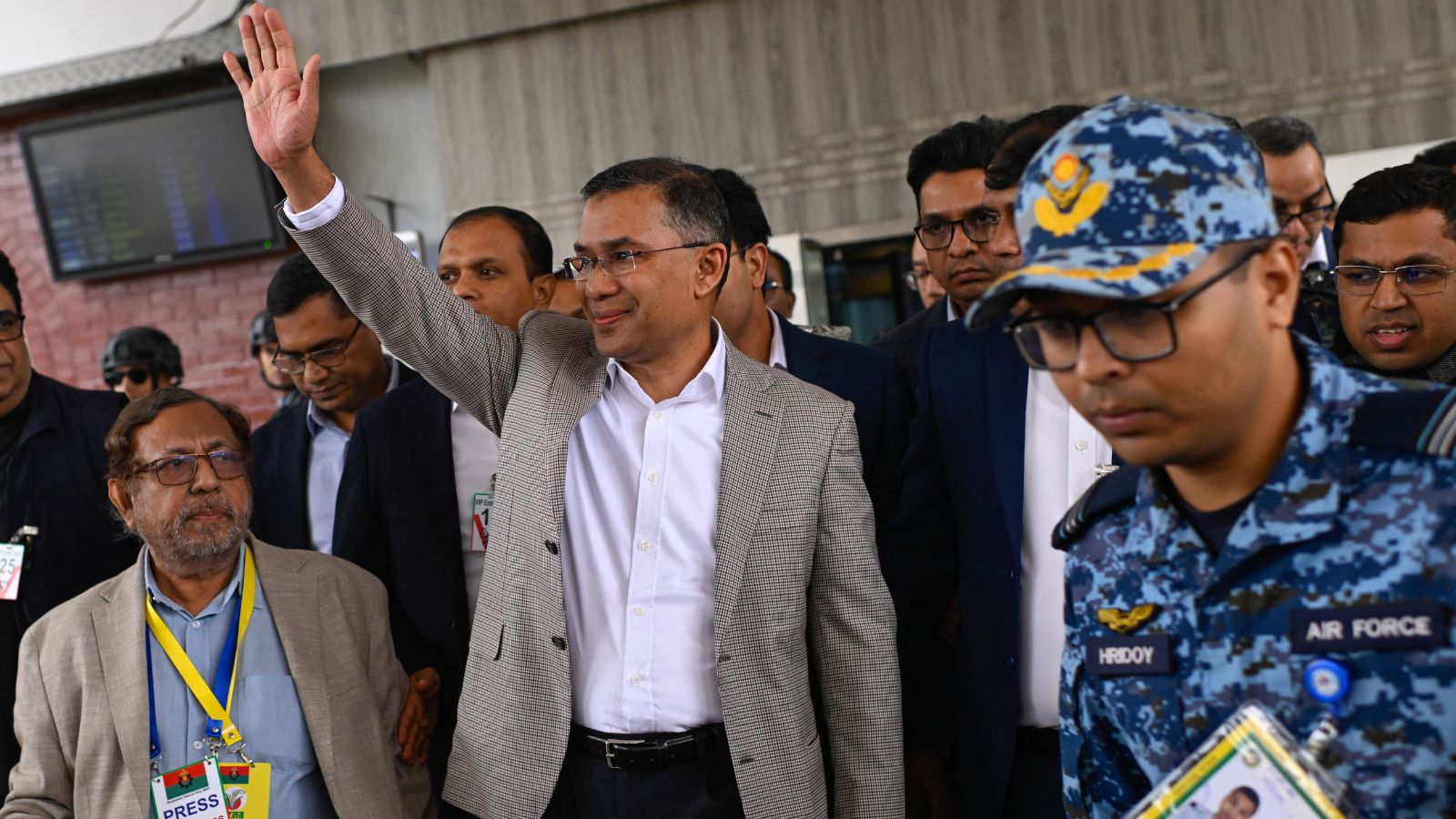
Tarique Rahman, leader of the Bangladesh Nationalist Party (BNP) and son of former prime minister the late Khaleda Zia, is poised to become Bangladesh’s next leader.
In his maiden speech after his return to the country after 17 years of self-imposed exile in England, Rahman recalled the famous “I Have a Dream” speech of American civil rights leader Martin Luther King Jr. However, he remarked that while MLK had a dream, he himself had a plan to build a nation that is safe and inclusive for all citizens, irrespective of faith and region. The moment has now arrived to test whether that plan can translate into reality.

On the domestic front, Bangladesh today faces deep polarisation along political, cultural, and religious lines. The new regime must, therefore, undertake bold and innovative interventions during the initial “honeymoon period” of governance. Despite his electoral success, Rahman is nowhere close to the mass popularity once enjoyed by Bangladesh’s founding prime minister Sheikh Mujibur Rahman, who faced his first public protest in September 1972, merely eight months into office. Public expectations today are no less demanding than those at the birth of the nation.
Beyond the familiar challenges of corruption, unemployment, and law and order, the most pressing issue confronting Tarique Rahman’s government is how to deal with Sheikh Hasina and the Awami League. There is an uncomfortable truth in Hasina’s recent assertion that “a government born of exclusion cannot unite a divided nation.” Although the 2026 elections may be the most credible since 2009, their legitimacy would have been far stronger had the Awami League participated.
Tarique Rahman now faces a critical choice: Pursue a path of political vengeance, as has often been the case in Pakistan, or adopt a reconciliatory approach inspired by South Africa’s Truth and Reconciliation initiatives. The latter could involve granting Sheikh Hasina a pardon, allowing her return to Dhaka, but barring her and her family from future political participation while reintegrating the Awami League into the democratic process.
One of the major structural obstacles to democracy in Bangladesh, as in much of South Asia, is dynastic politics. Denying future political roles to Hasina’s family would mark a significant step toward de-dynastification. However, such reform would require Rahman to initiate similar internal reforms within the BNP. Without dismantling dynastic dominance, Bangladesh’s democracy will remain half-baked.
On the geopolitical front, the harsh reality is that most nation-states today are compelled to navigate great power rivalries, often at a heavy cost. Venezuela, Ukraine, and Iran offer stark examples. Bangladesh is no exception. Rahman’s challenge will be balancing relations with key regional and global actors, particularly India, China, Pakistan, and the United States. During his tenure, Yunus signaled a shift toward closer ties with China and Pakistan, a move that has not gone down well with India. Meanwhile, in her first interview after arriving in Delhi, Sheikh Hasina alleged American involvement in her exit, though her own governance failures were significant.
For Rahman, repairing Indo-Bangladesh relations must be a top priority, perhaps even drawing lessons from aspects of Hasina’s earlier diplomacy. Two issues will be decisive: The treatment of religious minorities, particularly Hindus, and Bangladesh’s posture toward militant groups operating in India’s Northeast. Never has it been clearer that minority rights across South Asia are deeply interconnected. The entire South Asian leadership needs to reflect on how to address the issue in a long-term fashion. Under Yunus, Dhaka not only failed to curb violence against Hindus but at times appeared complicit, despite his conciliatory rhetoric.
The only durable guarantee for minority safety lies in restoring Bangladesh’s secular constitutional ethos — an ambition that appears increasingly difficult given the growing influence of Jamaat-e-Islami. Yet without this foundational shift, any democratic transformation in Bangladesh will remain elusive.
The writer teaches at Jamia Millia Islamia University, New Delhi, and is the author of the forthcoming book Dhaka Is Burning

