



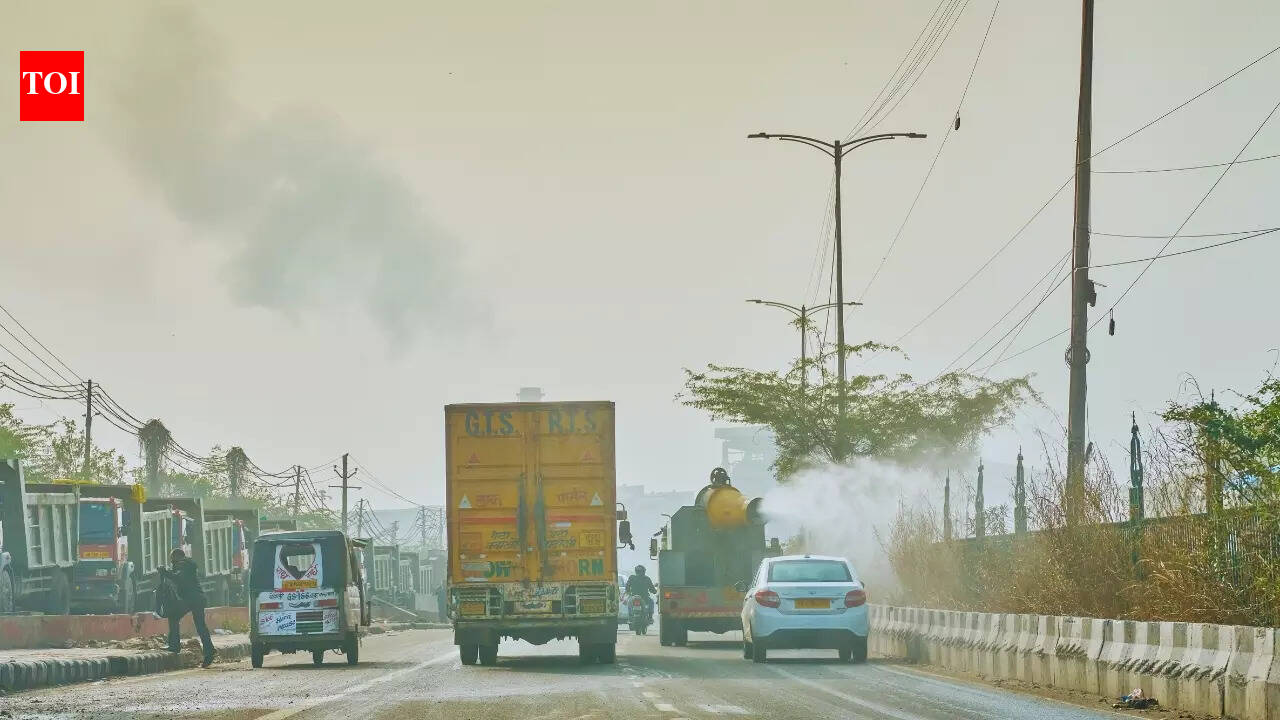
NEW DELHI: New Delhi remained the world’s most polluted capital city for the eighth consecutive year, according to the World Air Quality Report 2025, released on Tuesday by Swiss firm IQAir.The city recorded an annual PM2.5 concentration of 82.2 micrograms per cubic metre, nearly 16.4 times the WHO’s safe limit of five micrograms per cubic metre. India’s national ambient air quality standard for PM2.5 is 40 micrograms per cubic metre.As in previous years, the report differentiated between the city of New Delhi and the wider National Capital Territory. On that basis, the entire Delhi recorded a higher annual PM2.5 level of 99.6 micrograms per cubic metre and was ranked the fourth most polluted city globally, after Loni in Ghaziabad (112.5), Hotan in China (109.6) and Byrnihat on the Meghalaya-Assam border (101.6).Among capital cities, Dhaka ranked second with an average annual PM2.5 concentration of 68 micrograms per cubic metre in 2025.In 2024, Delhi’s annual PM2.5 average stood at 108.3 micrograms per cubic metre, while New Delhi recorded 91.8 micrograms per cubic metre, indicating a marginal improvement in 2025.“While Delhi’s annual average fell 8%, the city still saw sharp monthly spikes from seasonal smog and dust storms. A major April dust storm alone pushed PM2.5 up 15%. Winter pollution-driven by crop burning, temperature inversions, industry and construction-continued to plague the Indo-Gangetic plain,” the report said.The report analysed air quality in 9,446 cities across 143 countries, finding several NCR cities among the world’s most polluted: Ghaziabad ranked 7th (PM2.5 89.2 g/m³), Noida 18th (80.5), Greater Noida 21st (77.2) and Gurgaon 23rd (74.6).Manoj Kumar, an analyst at the Centre for Research on Energy and Clean Air, said: “A significant share of particulate pollution is formed from gaseous pollutants. Unless the CAQM regulates these at the source, only part of the problem is being addressed.” IQAir global CEO Frank Hammes said air quality required active stewardship to safeguard public health. “Without monitoring, we cannot fully understand what we are breathing. Cutting emissions and addressing climate change are essential for lasting improvements in air quality,” he said.

