



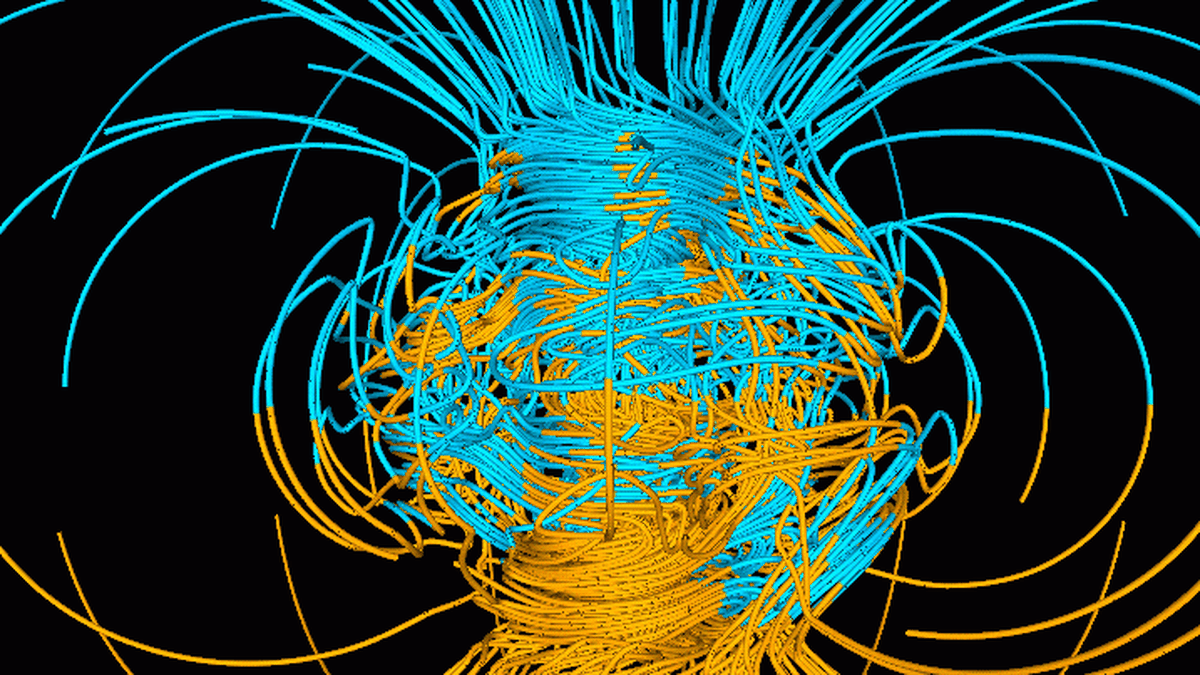

A numerical simulation of the earth’s magnetic field. Blue lines are moving into the core and yellow lines are moving out.
| Photo Credit: NASA
The earth’s magnetic field aids navigation but also protects the planet from high-energy radiation from the sun. For decades, geologists believed that when this field periodically flipped, swapping the north and south poles, the process happened relatively quickly, on the order of 10,000 years. However, a new study in Communications Earth & Environment has reported evidence to reconsider this notion.
By looking back 40 million years into the earth’s history, the team, from France, Japan, and the U.S., found that some transitions last much longer, leaving the planet with a weakened defence for several millennia.
Scientists have identified hundreds of magnetic reversals in the earth’s past. However, most high-resolution data comes from the last 17 million years, a small fraction of the planet’s life. Based on the recent data, many experts believed the 10,000-year duration was an intrinsic property of the earth’s geodynamo, the process by which the churning of the liquid iron outer core generates the magnetic field.
The researchers wanted to know if this was always the case. To test this, they turned to deep-sea sediment cores collected during an international drilling expedition in the North Atlantic Ocean and analysed mud that settled on the ocean floor roughly 40 million years ago, during the Eocene epoch.

As these sediments accumulated, small magnetic minerals within the mud aligned themselves with the earth’s magnetic field. Once buried, these minerals were trapped, creating a permanent record of the field’s direction and strength. The researchers used X-ray scanning and magnetic measurements to ‘read’ these records. They also used astronomical tuning to match sediment layers to known cycles in the earth’s orbital tilt.
Thus the researchers found that one reversal lasted 18,000 years while another stretched across a staggering 70,000 years. These are much longer than the 2,000- to 12,000-year windows observed in more recent geological history. The 70,000-year event in particular was characterised by a complex precursor phase and multiple “rebounds” as the field struggled to stabilise.
The researchers also ran numerical simulations of the earth’s core and found such reversals to be a natural, if rare, part of the geodynamo’s behaviour.
During a reversal, the magnetic field loses much of its strength. A weak field for 70,000 years could have exposed the atmosphere and surface life to significantly more solar radiation for a prolonged period. The researchers suggested these long intervals could have influenced ancient environments and the evolution of life on the earth.
Published – March 12, 2026 08:00 am IST

