



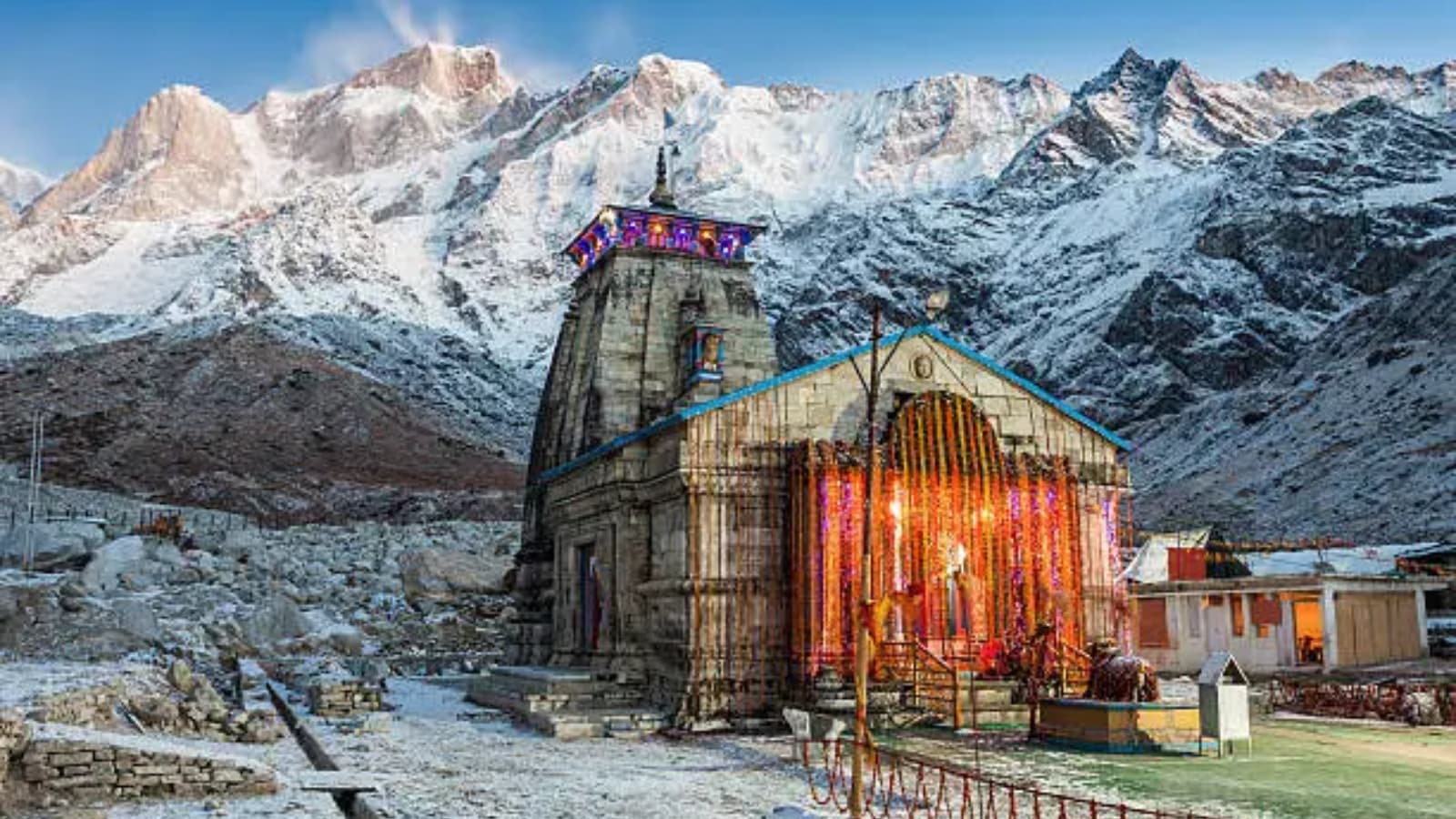
Preparations for the Char Dham Yatra are already underway: The portals of Badrinath are set to open on April 23, and those of Kedarnath on April 22. But making news right now is a controversy regarding the visit of Bollywood actor Sara Ali Khan to Kedarnath. The temple committee has stated that, as a non-Hindu, Khan will be allowed entry into the shrine only after submitting an affidavit declaring her faith in and reverence for Sanatana Dharma. This raises a fundamental question: Can such affidavits legitimately be demanded for entry into any religious site in India?
According to the committee, Khan’s repeated visits to Kedarnath in recent years have not been viewed favourably by sections of local pilgrims and priests. Her religious background — her father being Muslim and her mother Sikh — has been cited as a source of discontent. The chairman of the temple committee has argued that those who are not adherents of Hinduism, or who are “non-Hindus”, must comply with specific rules before entering the inner precincts of the temple. In Khan’s case, the affidavit is presented as a means of verifying the authenticity of her devotion. The chairman of the temple committee has also maintained that the temple is not a tourist spot but a site of faith and spiritual trust. Since it’s a spiritual space, non-Hindu visitors should not consider the temple only as a space to be enjoyed for its natural beauty. They should adhere to prescribed dress codes and behavioural norms, and must refrain from photography or videography that might disrupt the spiritual ambience of the place.

The committee also claims that they have not done anything new. The norms decided upon date back to the time of Adi Shankaracharya, who is credited with establishing these shrines, and that the current measures are merely a reaffirmation of longstanding traditions. Given that the Char Dham sites — Badrinath, Kedarnath, Gangotri, and Yamunotri — are deeply intertwined with the faith of millions, the committee argues that such steps are necessary to preserve their sanctity. At the same time, it maintains that all those who respect the spiritual significance of these sites are welcome, regardless of their formal religious identity. The proposal, however, has been forwarded to the government for approval.
There is no denying that Kedarnath and Badrinath have long been regarded as sacred spaces for Hindu pilgrims. But are these sites religious places only? On the contrary, they have larger cultural and existential significance. These are places where people come not only to perform religious rituals but also to find peace, gain inner calm and, sometimes, even answers to existential questions. Over time, such sites have come to embody something that exceeds the boundaries of formal religion. The committee justifies its position by invoking the need to protect the “spiritual environment”.
This, however, invites a deeper philosophical question: Can spirituality be experienced only through codified religious practices? Is a spiritual life reducible to ritual observance? Can one’s spiritual capacity be determined on the basis of religious identity alone? Swami Vivekananda famously observed, “You have to grow from the inside out. None can teach you, none can make you spiritual. There is no other teacher but your own soul.” Such reflections underscore that spirituality is, fundamentally, an inward and deeply personal experience rather than an externally verifiable condition. Khan herself has stated that she finds a sense of mental peace in Kedarnath. To subject such a personal spiritual quest to suspicion — or to demand that it be validated through an affidavit — is, in effect, an attempt to convert faith into an administrative category. Faith cannot be proven through external documentation. It is by nature personal and inward-looking. To make faith measurable through external means runs counter to the essence of spirituality.
It is therefore not unreasonable to ask whether an avowed atheist, encountering the sublime beauty of Kedarnath temple, might experience a form of spirituality unfettered from organised religion. If so, can access to such a space be denied solely on the grounds that the individual does not profess belief in Sanatana Dharma? If spirituality is an internal experience and connected with the soul, can anyone be denied access to sacred places that help become spiritual on the basis of religious identity which is imposed on an individual from outside? It could also be asked whether merely putting something down on paper can instill genuine faith and reverence for Sanatana Dharma in a person. Every year, millions of people visit Kedarnath. Can an affidavit truly determine whether each of them possesses faith in Sanatana Dharma?
There is another problem regarding the decision of the temple committee. Religion by nature is inclusive. The division that the committee creates between Hindus and non-Hindus, on the other hand, is exclusive. Furthermore, the decision of the temple committee of not allowing a visitor an entry into the shrine without an affidavit is a direct assault on an Indian’s constitutional rights. It may well be inferred that Sara Ali Khan has been singled out precisely to convey the message that these temples operate beyond the purview of the Constitution. If a widely recognised public figure like Sara Ali Khan can be bound by such restrictive regulations, it becomes easier to signal to the general public that the temple stands above the Constitution. Within the temple, it is the temple’s rules that prevail — not the rules of the Constitution.
The temple committee should also consider the historical and civilisational significance of the shrines. For centuries, such pilgrimage sites have functioned as spaces of encounter, where diverse communities converge. Their sanctity has been shaped not by exclusion but by a syncretic ethos that transcends rigid religious boundaries. To affix a narrowly constructed “Sanatani” label onto Kedarnath is, in effect, to participate in a political reconfiguration of sacred space.
In fact, to judge the worthiness of visitors through the lens of “religious purity” risks eroding the universal and humane appeal of places like Kedarnath. What is required instead is a more expansive vision — one that respects individual belief in its own domain and resists the impulse to subject spiritual experience to administrative regulation.
Khan has remarked that whether her visit to Kedarnath pleases others is, ultimately, not their concern. This sentiment captures the crux of the debate. It gestures towards a broader principle: The right to seek meaning, solace, and transcendence cannot be contingent upon external approval. Safeguarding that principle, in contemporary India, may well be the most urgent challenge of all.
The writer is professor, Department of English and Culture Studies, and director, Centre for Australian Studies, University of Burdwan

