



Pujarini Pradhan, a 26-year-old Instagram star with 601,000 followers at @lifeofpujaa, is not your average influencer. A homemaker and mother in a village in West Bengal, she posts takes on life and womanhood without artifice.
In a reel posted on February 24, she says: “I studied in a government school and chose [sic] my own college because in my village we didn’t really have facilities or guidance and exposure was limited… I think where you were born almost decided how far you could go. But today, someone can sit in a small village like mine, pick up a phone, start making reels, and completely change their life… It’s one of the few industries I think where you don’t need a fancy background, big city advantage, or connections. All you need is skill and courage to learn something new…”

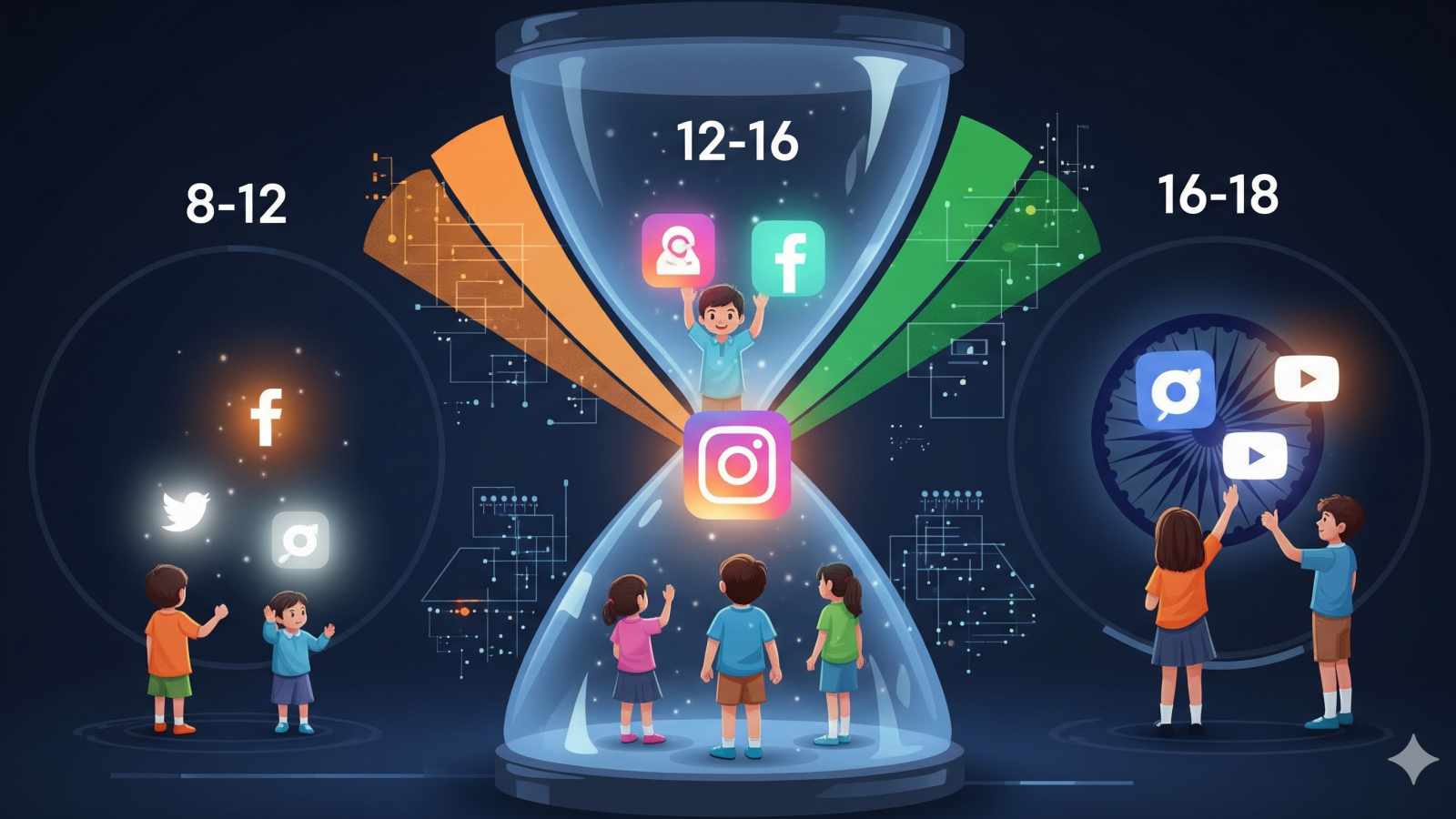
When Karnataka Chief Minister Siddaramaiah, inspired by Australia, announced a probable ban on social media for under-16s in the 2026 state budget, he likely was not the affected party, nor was he thinking of those who were. He consulted educators (mostly vice-chancellors of universities) and health professionals. The central government, by contrast, is considering graded restrictions for the 8-12, 12-16, and 16-18 age brackets, with a separate law planned for the monsoon session of Parliament following public consultation.
To be clear, the research spells out the benefits of restricting social media for children. The US Surgeon General’s 2025 advisory found that adolescents spending more than three hours daily face double the risk of depression and anxiety. A WHO Europe study of 2,80,000 young people found “problematic social media use” rose from 7 per cent to 11 per cent between 2018 and 2022, highest among girls. But a 2025 Nature Human Behaviour study found associations “weak and inconsistent”, suggesting that those with pre-existing conditions use social media more; that is, vulnerability drives social media dependencies.
Despite what the data says, what applies in Sydney or Stockholm does not always translate well to Shivamogga. Regulations are regressive by design, says economist Diana Thomas in her 2019 paper “Regressive Effects of Regulation”. Low-income households pay the costs, while the regulatory agenda is set by the middle and upper classes, who, when negatively impacted, can get around them better than a lower-income household. Take alcohol prohibition, with stylish speakeasies for the upper classes, but dens selling spurious moonshine for lower-income groups. Or Covid lockdowns, in which the upper classes developed remote work, which was not an option for labour classes.
In a stratified social hierarchy like India, education, technology, and information are not equitably accessible. Nearly one in 5 rural schools still has no library at all nationally (17.5 per cent). In nearly half of rural schools, children have no access to supplementary reading material. (Annual Status of Education Report, 2024). Even in Karnataka, which uniquely has 5,766 gram panchayat libraries servicing 70 per cent of the populace, implemented through the library cess (Karnataka Public Libraries Act of 1965), research finds they are underfunded and underused.
It is typical to suppress and control what you do not understand. The government cannot push for AI investments and technological infrastructure of the future while suppressing digital literacy. Age verification systems need to be tamper-proof. Digital literacy campaigns should be widespread and familiarise students with how algorithms work. Cyber safety should be swift to take down and penalise scams and harmful content. The Digital Personal Data Protection Act 2023 remains unnotified two years after enactment.
Over 23 lakh students competed for 1.20 lakh MBBS seats (NEET UG 2025), and 1,87,223 candidates competed for 18,160 IIT seats in 2025. In this highly competitive scenario set up with systemic barriers, every access to information offers an edge to a student. 82.2 per cent of Indian children aged 14-16 can use a smartphone; 57 per cent use it for education, 76 per cent for social media, with access of girls to learning online at equal rates to boys (ASER 2024). A ban would destroy the parity of the disadvantaged.
Also, direct educational uses are considered good, and loitering on social media is “bad”. But social skills make a huge part of employability. Using social media, students share resources, build community, and create a flow of information from mock papers to opportunities to intern with or apply to gigs. Entrepreneurship today is seeded on an Instagram page. A lingua franca of the day is playing out on social media, without which our students would no longer be in the know.
“Is it time for India to set a social media age limit for adolescents?”, a 2025 paper by Om Prakash (Indian Journal of Psychiatry, Feb 2025), identifies three types of social media use among Indian adolescents: Educational access; peer support networks; and information access for marginalised groups (such as LGBTQ+ youth in conservative settings, first-generation learners, young women in families resistant to their education). It warns of the impact of anxiety and depression, cyberbullying, harassment, sleep and attention disruptions, but also clarifies that a ban risks cutting off marginalised students from critical resources. Today, a student in an environment that stigmatises seeking mental health support, learning, and physical disabilities can bypass social censure and access aid, helplines, and online forums, even anonymously, for help. Belonging is more than a resource.
Charul Honariya grew up in Kartarpur village, Bijnor, UP, in a family of seven surviving on Rs 8,000 a month. She cracked NEET 2020 with an AIR of 631 and reached AIIMS New Delhi without a coaching centre or a tutor, studying using free YouTube content. Physics Wallah, founded as a YouTube channel in 2016, became a $3.7 billion company precisely because rural students had no other access to JEE and NEET preparation. It reaches 98 per cent of India’s pin codes. The village-to-topper pipeline is what Karnataka now proposes to shut.
Australia can afford to ban social media for children. When governments have failed to ensure equitable, sustainable, and affordable delivery mechanisms, when last-mile connectivity and safety are not guaranteed, the government and educators have no business kicking out the legs of the table that children are only just gaining a place at.
Protection is another instrument that directs control away from the personhood of the user to the hands of an overseer, and it will compound the need for regulatory intervention. What Karnataka’s children need is not less access, but a government that empowers them to navigate the world.
The writer is a therapist, AI researcher, and co-founder of Project Shunyata

