



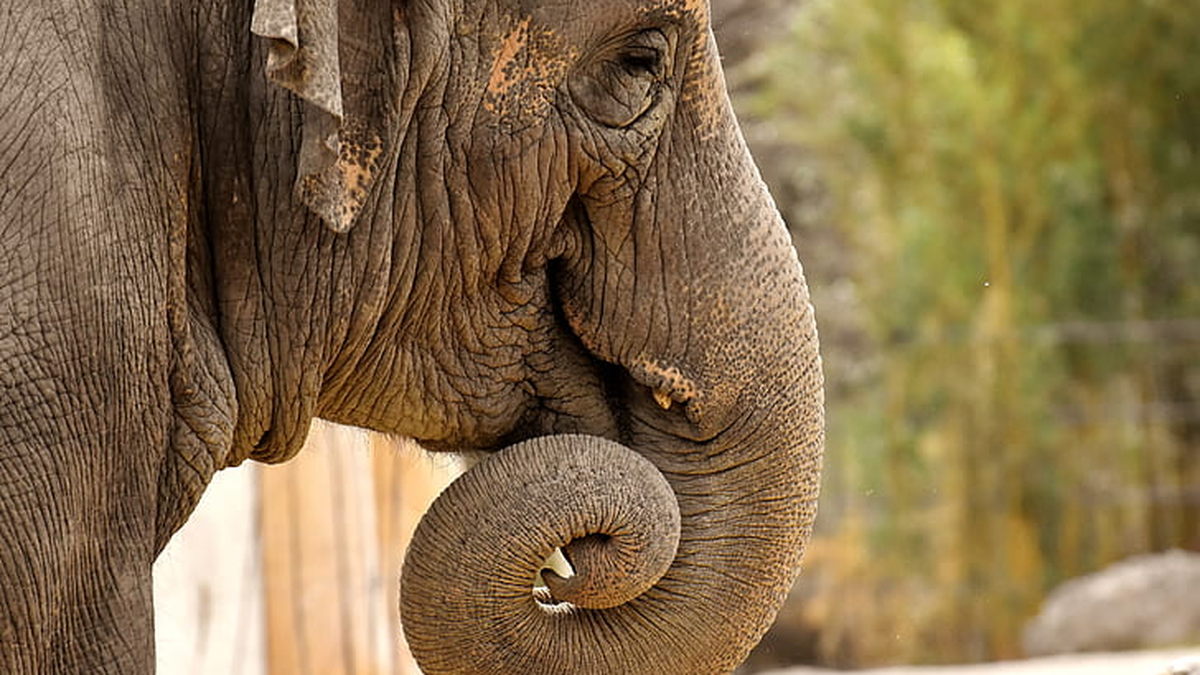
A long-standing intervention by the Assam government to reduce crop depredation by elephants in its forest regions, piloted and designed by environmental non-government organisation World Wildlife Fund (WWF), is actually associated with more accidental elephant deaths, a study in Conservation Biology has reported.
Launched in 2003 in Sonitpur district, the anti-depredation squads (ADS) of Assam coordinated local villagers and the Forest Department to guard their fields and collectively chase elephants away. The squads’ aim was to find safety in numbers for humans while averting direct conflict that could result in elephants being killed by traps or poaching. Versions of this kind of guarding exist across the world.
Assam scaled up the ADS’ presence in 2008 and continues to launch new squads even today. They are a part of official national guidelines to deal with human-elephant conflicts and are also present in West Bengal, Odisha, and Chhattisgarh. A 2019 review by the Union Environment Ministry, of the various ways in which people can respond to human-elephant conflicts, noted ADS operations were “not systematic” and that “local mobs” firing shots towards elephants reduced their effectiveness.
Using data of 20 years of elephant deaths in Sonitpur, mapped alongside the presence of ADSs in villages in the area in this period, the study found a nearly 2-3x increase in accidental elephant deaths associated with villages that had ADSs than the ones that didn’t. The elephants didn’t die due to direct conflict with villagers but were found in ditches or trenches, electrocuted, or had veered into the paths of oncoming trains. The study revealed no discernible impact on human mortality.
Nitin Sekar, lead author of the study, said the results went against their original hypothesis: “All of us were prepared for the evidence to show no effect on mortality. We were hoping it would reduce human and elephant mortality. But this was a surprise.”
Mr. Sekar began the analysis when he was National Lead for elephant conservation at WWF-India, with the idea of statistically pinpointing the impact of ADSs. He is now a director at Conservation X Labs.
E. Somanathan, professor at the Economics and Planning Unit of the Indian Statistical Institute, Delhi, and head of the Centre for Research on Economics of Climate, Food, Energy and Environment, designed the statistical analysis in the study. He said the increase in deaths, while statistically conclusive, may not have been directly evident to people in the field, who believed the intervention reduced elephant as well as human mortality.
“The whole purpose of WWF-India’s interventions is conservation so they were not expecting this,” Mr. Somanathan said.
While the team was prepared for the data to not be good enough to draw one conclusion or the other, they didn’t expect the actual finding.
“It is a 200% increase in the death rate from conflicts of elephants,” Mr. Somanathan said. “A doubling or tripling is a big effect. This is a big enough number that it warrants careful examination of the programme. People chasing away elephants has to be given a second look. The programme should think carefully about how it is being done.”
Though the study began in 2019, the authors added multiple controls to their data to account for other mitigating factors, leading to a longer time before it was published.
‘Raises more questions’
The paper said, “Although at odds with one of the hypotheses underpinning the ADS program, this finding is consistent with the concerns of several experts on human-elephant conflicts.”
Pranav Chanchani, head of species conservation, and Aritra Kshettry, national lead for elephant conservation at WWF-India, however cautioned that the link between elephant deaths and ADS actions were tenuous.
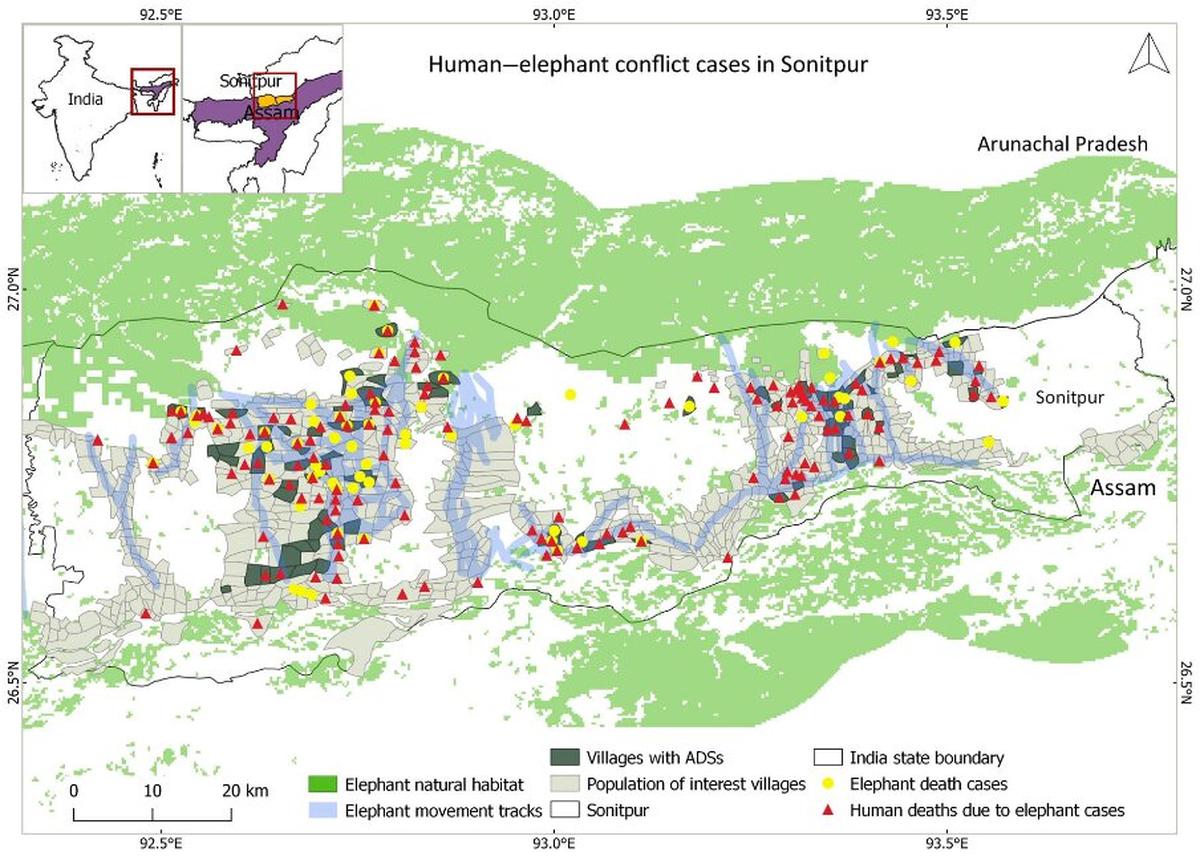
Villages in Sonitpur district selected as the study’s population of interest.
| Photo Credit:
DOI: 10.1111/cobi.70204
“The ADS study found a strong association between ADS ‘presence’ and elephant mortality data, and thus raises important questions about prevalent human-elephant conflict management strategies,” Mr. Chanchani and Ms. Kshettry wrote in an email.
“But there are also several key gaps in the ADS study that limit direct attribution or causal inference, and so the study likely raises more questions than it answers.”
Organised guarding
Assam is home to more than 5,000 wild elephants, the second largest population of the large mammals in India. Sonitpur, in north-central Assam, is a part of one of five priority landscapes for elephant conservation as identified by the Elephant Task Force in 2010 — and home to around 1.9 million people.
When the WWF conceptualised the ADS in 2003, there had already been a decade-long history of lost forest cover, Mr. Chanchani and Ms. Kshettry said. Elephants displaced from their habitats began to range over crop lands, tea plantations, and the banks of the Brahmaputra river, among other landscapes. The locals harassed and chased them, leading to higher mortality for both. The WWF believed that if ADSs organised guarding activities, it could reduce overall elephant mortality instead of leaving communities to their own devices.
ADSs were formed in villages where there had been recent incidents of crop raiding, incentivising the community to join hands with the widely mistrusted Forest Department to respond to elephants together. Each ADS had 10-15 male volunteers, who were given searchlights and firecrackers to keep elephants at bay. Department officials cooperated with ADSs and used information from them to drive elephants away from fields.
Per the new study, however, the sound and light possibly created what it called a “landscape of fear”, forcing elephants to lose caution and stray into more dangerous situations.
“Although caution is prudent given the modest sample sizes and uncertain quality of postmortem data in the region, these findings suggest that, in communities with ADSs, elephants may have been less likely to notice hazards, such as a ditch, lethal wire or an oncoming train because they were too frightened or distracted by those pursuing them (or perhaps even by the perceived greater likelihood of pursuit),” the paper read.
Mr. Chanchani and Ms. Kshettry however also cautioned that while data for elephant mortality was taken from across many years, ADSs are active only in the cropping season, which means some deaths may have been incorrectly attributed to ADS activity. They also said the study had no ground-truthing.
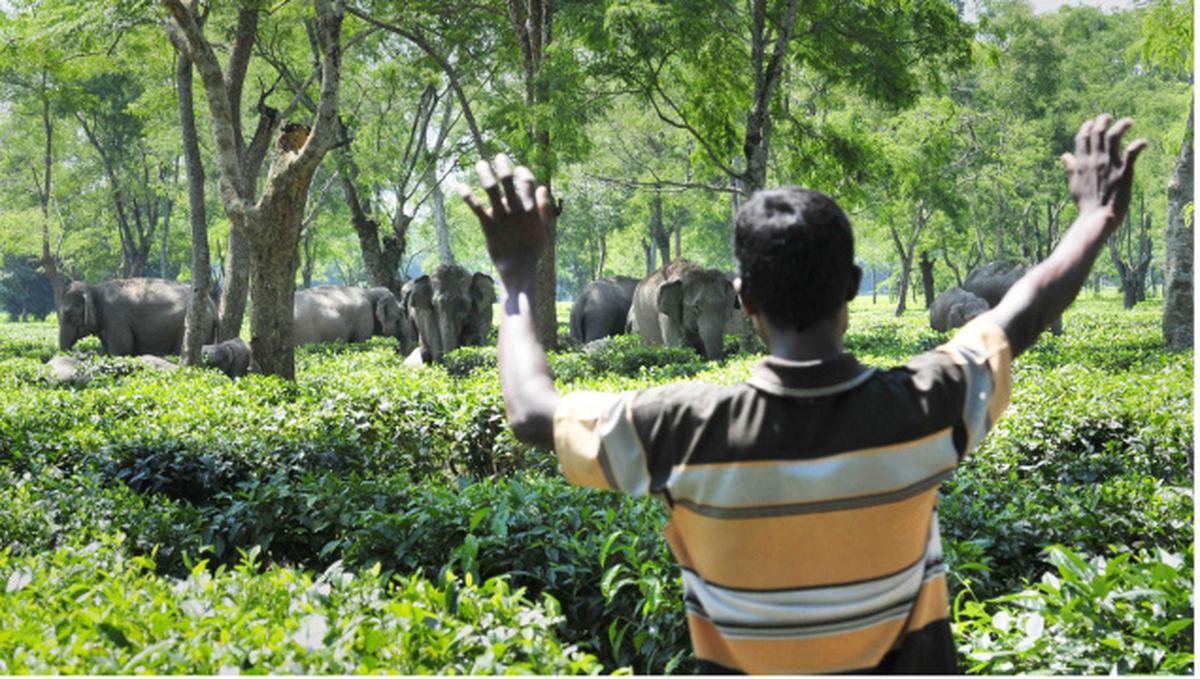
A villager trying to chase away a herd of wild elephants resting in Bholaguri tea garden in Sonitpur district, September 2014.
| Photo Credit:
RITU RAJ KONWAR
Developing controls
The study used 20 years of data gathered by WWF-India’s ground team in Assam and human and elephant mortality data by the Forest Department. Given that the hypothesis was that ADSs would reduce elephant mortality, the researchers tried to reject many alternative explanations.
The agricultural area within a village draws elephants more because it could seem to offer more nutrition than foraging in forest areas. By adjusting for this, the study could account for whether there had been a higher than usual presence of elephants in the area. The second and third variables were the fraction of area around a village composed of elephant natural habitat and changes in the distance from the village to areas accessible to elephants on elephant movement paths. The study also accounted for an increase in the population of humans and for the intensity of lights at night, a common proxy for the extent of development.
The researchers also factored in other variables. For instance, ADSs were likely to start in villages where there had recently been incidents of conflict. Since human or elephant deaths are not that common in these events, a further incident immediately after the launch of an ADS would be unlikely, since one would have just occurred. This might have been interpreted as being a result of the ADS itself.
So in the analysis, the team excluded the year an ADS was formed as well as the two preceding years from the comparison with death rates in years with an active ADS. When they found that the result was an increase rather than a decrease in elephant deaths, they also excluded only the year in which an ADS was formed from the comparison with death rates in years with an active ADS. The result was similar, Mr. Somanathan explained.
Another bias they addressed was that of underreporting — because of bad relations villagers typically had with the Department. With the ADSs mending these ties, it could be that there were the same number of deaths and that more were now being officially counted. When the study included a control for the potential undercounting bias, there was still an overall increase in elephant mortality associated with ADSs.
Due to lack of data, the study was unable to account for whether ADSs have been able to protect more crops than before.
Pause and check
Given the proliferation of anti-depredation squads across India, the study raises serious concerns about the effectiveness of such interventions — and raises questions about why this outcome hadn’t been detected earlier.
“We are talking about 14 additional deaths in as many years,” Mr. Sekar said. “ADSs are active for months on end over many years. The only way you can find this connection is through statistics. It seems highly unlikely to me that someone in the field could have detected this effect.”
Both Mr. Sekar and Mr. Somanathan called for a re-evaluation of this and other interventions to reduce human-elephant conflict, including electrified fences and using sound and light in innovative ways.
“This is a good example of why we need more evaluations,” Mr. Sekar said. “We shouldn’t be rapidly expanding an intervention without evaluating its effect. It is also generally ideal not to make any big policy decisions based on one study. The best next step would be prompt, rigorous evaluation of ADSs by other groups.”
Mr. Chanchani and Ms. Kshettry agreed that there was a need for further study — while noting that ADSs have also consistently been evolving to match ground needs.
“We believe that it will be prudent to pursue a strategy wherein ADSs adaptively hone their actions, especially in relation to chasing,” they wrote. “Unless data to the contrary becomes available, we think it unlikely that the alternative (disorganised chasing) will have better outcomes for people and elephants.”
Mridula Chari is an independent journalist based in Mumbai.

