



Prime Minister Narendra Modi inaugurated the India AI Impact Summit 2026 at Bharat Mandapam, New Delhi, on Monday, February 16, 2026. He said India stands at the forefront of the artificial intelligence transformation, and its strides in AI reflect both ambition and responsibility, underscoring India’s commitment to responsible and inclusive artificial intelligence. UK Deputy PM David Lammy called the Delhi summit an “important moment” to unlock the full benefits of AI. It marks the 4th Artificial Intelligence (AI) Summit after summits in the UK, South Korea, and France.
Global tech leaders Sundar Pichai, Bill Gates, and Sam Altman, and leaders of about 20 countries, including Brazil and France, are among those from about 100 countries attending the summit this week. The summit features over 3,250 speakers and more than 500 sessions. The session “Leveraging AI for Defence: Driving Innovation & Efficiency” was held on February 17. The discussion highlighted AI as a key enabler of future military capabilities, focusing on secure and trusted defence AI ecosystems.
AI Transforming Defence
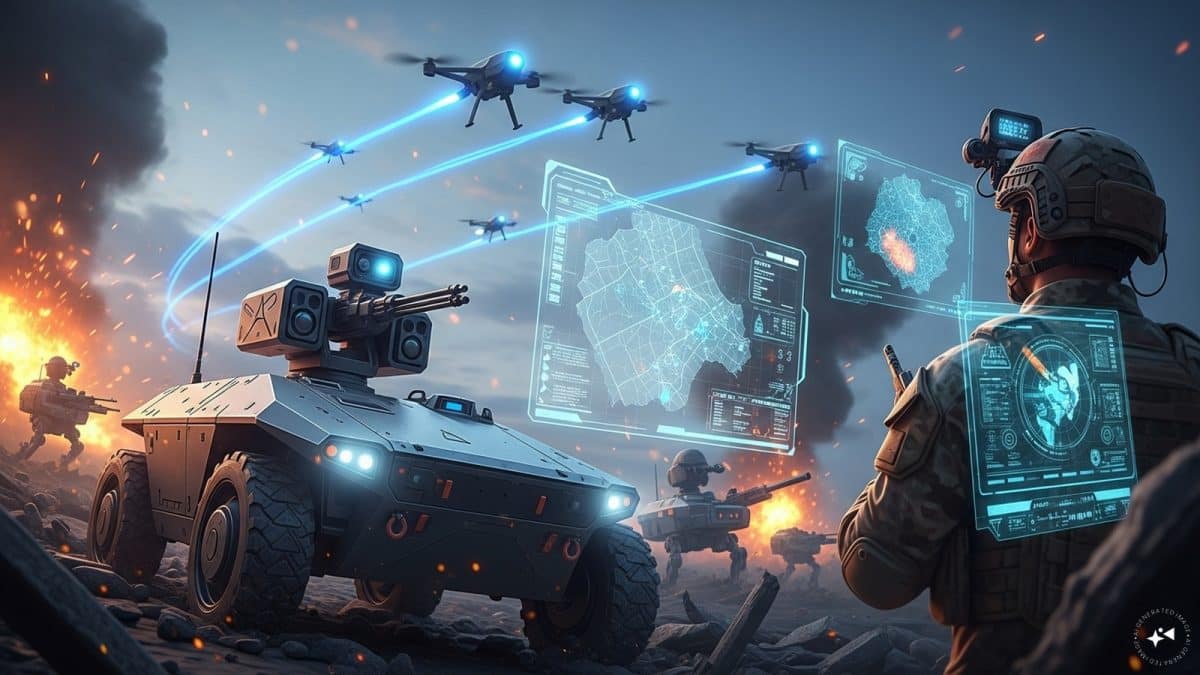
AI is transforming defence through autonomous systems, enhanced surveillance, and accelerated decision-making, acting as a critical force multiplier in modern warfare. Key applications include AI-guided drones/swarms, robotic vehicles, predictive maintenance, cyber-security, and data analysis for target identification. These technologies enhance speed, accuracy, and efficiency across all operational domains.
AI powers Unmanned Aerial Vehicles (UAVs), ground vehicles, and submarines for surveillance and reconnaissance. AI-driven loitering munitions (kamikaze drones) can identify and engage targets independently. AI analyses satellite, drone, and sensor data for Intelligence, Surveillance & Reconnaissance (ISR). It also helps detect border intrusions. It aids in identifying patterns and forecasting potential conflicts.
AI processes vast data for rapid target identification and battle damage assessment. It helps quicker and more accurate combat decision-making from a multitude of choices that are thrown up after analysing multi-sensor inputs. AI also helps create realistic simulations for training and war-gaming. AI systems detect anomalies in military networks, predict breaches, and deploy automated countermeasures and help in cyber security.
AI helps predict maintenance needs for military equipment and optimises supply chains for more efficient logistics and maintenance, thus improving availability and reducing costs.
Major Powers Investing in Military AI
Major powers are heavily investing in AI, with estimates indicating significant expenditures by both the US and China on military AI research. European Union (EU) countries are also stepping up investments in AI for military use. Effective defence requires AI to work across different systems and allied forces, a key priority for organisations like Nato.
Global investments in military AI are rapidly expanding, driven by geopolitical tensions, with the market projected to grow from over $22 billion in 2026 to over $100 billion by 2034. Key investments focus on autonomous systems, surveillance, logistics, and intelligence analysis, led primarily by the US and its allies. Another forecast projects a CAGR of 20.7 per cent from 2026 to 2034. The key driver is the need for enhanced operational efficiency and the development of autonomous uncrewed platforms. The major investment areas include C4ISR (command, control, communications, computers, intelligence, surveillance, and reconnaissance), predictive maintenance, cyber security, and target identification.
The US leads in AI defence investment, with a 2023 private investment of $67 billion, 8.7 times that of China. The Pentagon’s Defence Innovation Unit is heavily engaged in contracting with tech startups. Major industry players include Palantir, Shield AI, Elbit Systems, Textron Inc, and Rebellion Defence.
In 2026, AI is expected to be deeply integrated into the “digital backbone” of military operations, with a focus on reducing data redundancy by 45–55 per cent and improving coordination by 35–40 per cent.
India’s AI Mission and Vision
Launched in March 2024 with a Rs10,372 crore outlay, the IndiaAI Mission aims to build a robust, inclusive AI ecosystem, positioning India as a global AI leader by 2035. The mission focuses on creating indigenous foundational models, deploying over 38,000 GPUs, and fostering startups to drive AI-driven socioeconomic transformation in healthcare, agriculture, and education.
The key pillars and initiatives of India’s AI Mission include increased compute capacity by establishing a GPU-based, high-performance computing infrastructure, with 38,000-plus GPUs already deployed to offer affordable, scalable, and accessible AI resources, reducing reliance on foreign hardware. Innovate and focus on developing indigenous Large Multimodal Models (LMMs) and domain-specific foundational models. Promote AI applications with high social impact in sectors like agriculture, healthcare, and governance, with 30+ applications already approved. Support deep-tech AI startups with funding and mentorship to foster innovation. Implement safe and trusted AI with ethical AI frameworks, including bias mitigation, algorithm auditing tools, and deepfake detection. Establish 27-plus Data and AI labs to improve data quality and support AI research, with hundreds more identified. And talent development by supporting over 13,500 undergraduate, postgraduate, and PhD students through skill development initiatives.
“AI for All” will ensure AI benefits every citizen, targeting economic empowerment and bridging social divides. As part of Viksit Bharat 2047, it will drive economic growth, with projections suggesting AI could add $1.7 trillion to India’s economy by 2035. Positioning India as a global leading voice in responsible AI is highlighted by the India-AI Impact Summit 2026. Focusing on accountability, safety, and transparency is outlined in India’s AI Governance Guidelines. Key projects within this framework include Bhashini for language translation, BharatGen for multimodal LLMs, and various startups developing Indian-language models like Hanooman.
Indian Military’s Operations and AI Plans
India’s armed forces are rapidly adopting indigenous AI for surveillance, logistics, and combat and are fast becoming a data-centric force. A joint services approach is being coordinated by Headquarters Integrated Defence Staff (HQ IDS). These steps include the formulation of an AI strategy, creating organisational structures, and bringing in new processes. Data handling and AI technology acquisition are being coordinated.
Key initiatives, highlighted at the 2026 AI Impact Summit, include the EKAM (AI-as-a-Service), a secure, air-gapped indigenous cloud platform developed for data sovereignty. AI-enabled (SAM-UN) geospatial platform for situational awareness, mission planning, and disaster management. It supports autonomous drone/vehicle systems to enhance operational edge. Deployment of XFace for facial recognition and Nabh Drishti for real-time mobile telemetry for surveillance and identification. For logistics and safety, use AI for vehicle tracking and driver fatigue detection. For combat support, implementing AI-driven tools for deepfake detection, cyber security, and predictive maintenance. Development of AI-powered unmanned aerial systems (UAS) for counter-drone operations.
Specialised AI cells are established in each service branch – Army (Mhow), Navy (INS Valsura), and Air Force (Rajokri). The focus is on integrating AI to enhance speed in decision-making and developing autonomous, self-reliant systems. A central data repository is being developed to make data from drones, satellites, and sensors accessible and machine-readable. The Indian Army’s AI Roadmap for 2026-27 emphasises deploying AI for border surveillance, drone swarming, and faster decision-making to secure high-conflict zones. The Indian Air Force’s (IAF) Integrated Aerospace Command and Control System (IACCS) is constantly being updated with AI tools. Advanced data analytics help AI-enabled combat decisions and greatly shorten the OODA (Observe, Orient, Decide, Act) loop. AI in the cockpit will help the pilot take quicker combat decisions. AI optimises flight paths for fuel efficiency and manages air traffic in crowded, contested, or complex environments.
Locating the unique signature of a radio or radar signal that’s emitted by a particular aircraft within the entire electromagnetic spectrum is like trying to find a needle in a haystack. In the past, sensors were recording broad frequency ranges, and specialists in labs were analysing them for hours or days before designing jamming systems to address each signal. Today, AI systems are being employed to help detect and identify signals of interest and to implement the appropriate technology to jam the signal or to help intercept the threat as needed.
AI can also be used to help intercept incoming threats. When a ballistic missile launch is detected, it’s possible to determine the missile’s expected trajectory and intervene before the missile hits its intended target. Predictive AI can be used to identify the missile’s electromagnetic signature and to either jam the signal or redirect the missile or direct interceptors to destroy the missile before it reaches its target. An AI-based system may also be able to decipher any encrypted communications, providing valuable information about the opposition’s capabilities or intent. AI will play a great role in embedded systems in electronic warfare. AI will also support directed energy weapon targeting and employment.
The Indian Navy’s marine domain awareness and submarine systems are seeing AI-based enhancements. Key military maritime AI applications include autonomous AI-driven unmanned surface vessels (USV/UUVs) and submarines for dangerous, long-duration missions like mine countermeasures, surveillance, and anti-submarine warfare without risking human life.
Logistics and maintenance management in all three services have a huge infusion of AI-based systems. The adoption of AI and new skills and a workforce requires an interface with private industry. Services are creating and curating training programmes to ensure that the workforce keeps pace with AI developments in the private sector.
It must be understood that data and network security requirements are paramount and non-negotiable.
Institutional Setup at MoD
The Defence Artificial Intelligence Council (DAIC) is a high-level body established by India’s Ministry of Defence (MoD) in 2019 to provide strategic guidance and policy framework and foster AI adoption for national security. Chaired by the Raksha Mantri (Defence Minister), it works with the Defence AI Project Agency (DAIPA) to drive AI projects across the armed forces. The three service chiefs, the defence secretary, the national cyber security coordinator, and members from the DRDO, industry, and academia.
The Department of Defence Production of the MoD constituted a task force to study the future use of AI in defence applications. The MoD allocated significant funds annually to the Defence AI Council (DAIPA) for AI projects and infrastructure, alongside similar allocations for each service. The DAIPA (set up in 2019) continues to drive AI adoption across services, with 61 AI-specific projects identified, 26 of which have been completed by DPSUs.
AI will also cut down the military platform and weapon development cycle for DRDO, DPSUs and private industry. It will support India’s AMCA fifth-generation fighter aircraft development and testing.
Partnership with the Industry and Academia
In recent years, the civilian industry has led the way in AI development and implementation across various sectors. Tech companies are spending billions of dollars on AI, and many of the applications developed can be utilised in the military. These include image recognition, language processing, predictive analysis, autonomous systems, and robotics. The armed forces are engaging closely with the industry to pick up dual-use technologies that can be adapted for military use.
Leading AI institutions in India include premier IITs (Madras, Bombay, Delhi, Hyderabad, and Kharagpur), IIIT Hyderabad, IISc Bangalore, and top private universities like VIT Vellore, offering specialised B.Tech, M.Tech, and research programmes in AI, machine learning, and data science. These institutes are recognised for cutting-edge research, industry collaborations, and strong academic foundations. Indian Armed Forces are engaging with these.
Issues Remain for Concern and Consideration
While AI speeds up processes, military doctrine emphasises human oversight for ethical decisions and to prevent biases. Should it be Human-in-the-Loop with constant monitoring, or should it be Human-on-the-Loop for veto? What should be the level of autonomy, especially when it comes to Lethal Autonomous Weapons Systems (LAWS) and “killer robots”? Could swarms of such weapons start killing like a pandemic? Can AI-based weapons go out of control and start attacking the originator?
A shortage of specialised AI expertise and ethical considerations surrounding autonomous weapon systems are significant challenges. Some investors are reducing exposure to AI-enabled targeting systems due to ESG (Environmental, Social, and Governance) concerns and ethical scrutiny.
Conclusion
AI is revolutionising warfare as the military uses cutting-edge technologies to become more effective and efficient in both offensive and defensive operations. Data is the new gunpowder. The quantum and speed of data generation have been exponential. AI with quantum computing supports handling such huge data for actionable intelligence and decision-making in split seconds. Warfighting is all about speed, range, and precision. “Detect first, decide first, shoot first, neutralise first” is the mantra. AI is already having a dramatic effect on the tools of warfare. It is now at a stage where militaries that do not adopt AI will be rendered technologically inferior.
AI has been used for a variety of military and defence purposes for decades and will continue to play a major role in the way wars are waged in the future. As a result, the centralised data centres and embedded computing systems that enable AI will be required to provide unprecedented levels of computing power and bandwidth as new military applications of AI are developed and deployed.
Future generations of fighter jets, submarines, and other military vehicles are being tested to operate with a swarm of unmanned vehicles. AI will be used to control the swarm of unmanned aerial vehicles (UAVs) while the pilot focuses on executing his mission.
As the race to find new military applications of AI goes on, nations and government organisations are working to establish the guidelines and standards to help ensure that AI is applied ethically. Autonomous and semi-autonomous weapon systems will be designed to allow commanders and operators to exercise appropriate levels of human judgement over the use of force. AI may be used to help leaders and commanders make more informed decisions, but it’s ultimately a person, not a machine, that determines the final action.
Most industries that use AI rely on ground-based, climate-controlled data centres where space for processing equipment is virtually unlimited. Defence and military applications of AI will also require ruggedised embedded systems that must function reliably and consistently in confined and potentially hostile environments on the ground, in the water, in the air, or in space. The accelerated progress in software and AI technology virtually guarantees that the defence industry will see tremendous advances and continue to find new applications for AI in the military.
The Indian military’s AI-related funding has just begun to increase. Yet compared to our primary strategic challenger, China, which is spending more than 30 times this amount, it needs to go up much more. To not fall behind the technology cycle, greater investments will have to be made.
The main advantages of using AI in defence are real-time situational awareness, faster threat detection, better coordination of autonomous systems, higher precision in target identification, reduced human deployment and exposure, improved battle damage assessment, and better logistics and maintenance management.
Defence systems operate in adversarial high-risk scenarios, demanding extreme reliability, resilience and security. With human lives at stake, the costs of mistakes are high. AI global powers channel unprecedented resources into research and development because of the profound transformation it brings in modern warfare.
(The writer is former Director General, Centre for Air Power Studies. Views expressed in the above piece are personal and solely those of the author. They do not necessarily reflect Firstpost’s views.)
End of Article

