



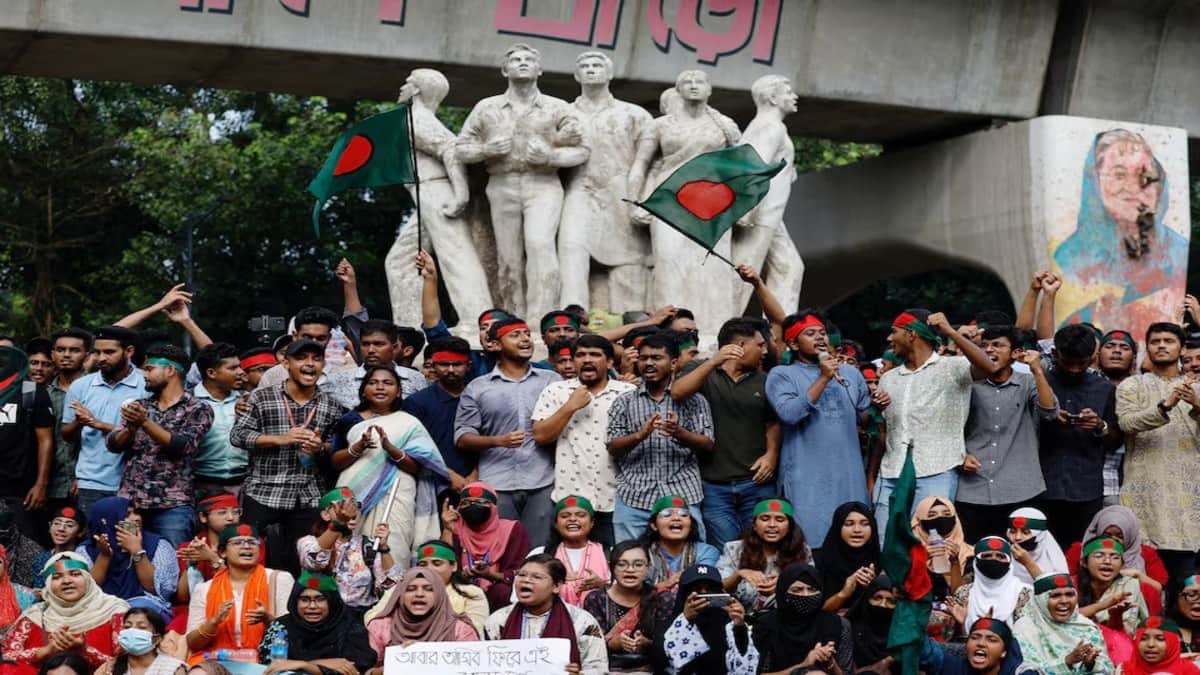
‘Gen Z’ has become one of the most abused terms in the last few months in the subcontinent, with opposition leaders in India to student leaders in Bangladesh and even Nepal using it as some sort of panacea for all problems that exist in their respective countries. The allure of young people who have completely lost faith in the leadership turning out in the streets for protests is so strong that such images often hit the headlines whenever it happens anywhere in the world. In the case of Iran, we have almost become accustomed to such visuals without anything actually changing on the ground so far, to be honest.
Thus, in 2024, when Bangladesh witnessed a ‘revolution’ by students which was triggered by a court ruling and one that soon transformed into an anti-Hasina protest, it became an event that attracted a lot of attention not just in India but also in the West. Although the students’ protest, which the highly compromised Wikipedia calls the world’s first ‘Gen-Z revolution’, began on a very promising note, two years and various compromises later, here we are with just 6 seats in the kitty for the National Citizen Party, the political culmination of the ‘revolution’ in a 350-seat parliament. What started out with a lot of optimism for a new kind of politics has fizzled out with the student leadership becoming a fringe story in a power transition that they themselves initiated.
The Bangladeshi Nationalist Party (BNP) is back in power with its past record of unstable governance, deep corruption, unemployment and campus violence, while Jamaat-E-Islami has emerged as the principal opposition party whose views on imposing shariah law and outlawing women from politics are already in the public domain. The way elections have turned out for the ‘students’ revolution’ has left many perplexed. If the protests as shown on our social media timelines and our TV sets were very real, then how come the students are not a part of the new leadership in Bangladesh? Forget the outsiders; even student leaders themselves are confused with the trajectory of their political fate.
As someone who has done her doctoral studies at a university that draws upon students from across the subcontinent, the ‘revolution’ seemed quite personal to me. The peers from Bangladesh were enthusiastic after having removed Hasina from power and were looking forward to a new future for Bangladesh. However, one reality that they tend to miss is that the removal of Hasina from power and who succeeds her to rule the country next is a script that they neither wrote nor executed.
While the Western media celebrated them as ‘heroes’ of democracy, and the domestic media, including the one in India, also used the same frame to glorify them, the strings were clearly being pulled from outside. There is recorded evidence of Jamaat leaders being courted and cultivated by the US Department of State. Long before the Washington Post leaks of 2026 that revealed the American preference for Jamaat, there was a human rights report by the State Department that called for ‘political freedom’ for the extremist group as early as 2023. The groundwork that was laid with utmost dedication by the Americans bore handsome fruits when, in 2025, the country’s top court lifted the ban on Jamaat and allowed it to participate in the general elections. Each of the 68 seats that Jamaat has scored today is a testament to the relentless support from what some people also term as the US ‘Deep State’.
The thing with ‘Gen-Z revolutions’ is that they have had a really high visual appeal with a bunch of passionate youth pitted against a leader who has already been demonised by the global information machinery as a ‘fascist’ and a ‘dictator’. However, beyond the carefully crafted narrative lies the ugly truth of who is being nurtured to ultimately fill the vacuum once the incumbent is forced to leave? In the case of Bangladesh, the events as they unfolded in the aftermath of the ‘revolution’ left no scope for ambiguity at all. They had a Nobel Laureate, Muhammad Yunus, serving as the head of the interim government with just a minimal representation from the student uprising so as to maintain the facade of regime change being a student-led movement. This was a message which was clearly received by the student leaders as well, as a result of which Nahid Islam, an advisor in Yunus’s cabinet, resigned to focus on active politics and thus formed a full-fledged political organisation, the National Citizen Party, in 2025.
As per insiders, the NCP did have considerable external backing in the form of facilitated interactions with the Jamaat and prioritised access to media to push their narrative. This is the reason why Jamaat made a considerable concession of 30 seats to them in the recently concluded polls. But at what cost? The students, as I know them from my experience of studying at a common institution for years, were very progressive, liberal and pluralistic, but here they were aligning with Jamaat, a party whose stated goal is to impose shariah, outlaw women completely from public life, including from elections, and take Bangladesh back to the dark ages once in power. So the ‘revolution’ was limited to fighting only one kind of ‘tyrant’ while kissing the other?
Not to mention how the “students” who wanted to restore true democracy in the country never protested against the ban on the Awami League from contesting elections. Democracy is built from the ground up with a large number of genuine representatives of people who actually enjoy popular support being a part of almost each political party. Here Awami League was no different. Hasina can be the dictator that they claim, but what was the fault of ordinary political workers of the League who had put their sweat and blood all these decades to make a common Bangladeshi feel heard in the corridors of power? The ‘student revolution’ had lost legitimacy the moment they allowed Jamaat to take over after the removal of Hasina and the second time when they watched a political party that secured more than 60 per cent of the popular vote in 2024 elections be banned from contesting recent polls.
One may even say that the way the NCP has poorly performed in the recent elections proves how the ‘Gen Z revolution’ was not as deeply rooted as we were made to believe by the media and proponents of a similar movement in India. If regime change was a goal for an external power, then the student leaders were their best bet for achieving legitimacy.
The preference for Jamaat at the helm was real, a fate that the Bangladeshis managed to avoid at the last moment. What Bangladesh’s electorate has now done by electing BNP is nothing but a compromise in the face of the imminent challenge of the country’s ‘Talibanisation’ by the Jamaat. It is amusing how a highly corrupt man, Tariqur Rahman, who ran a parallel government from ‘Hawa Bhaban’ the last time BNP was in power, is the country’s best hope for survival and reasonable governance. Someone who sought bribes, did money laundering and was even convicted for a terror attack is soon going to be at the helm in Bangladesh.
What did the ‘student revolution’ really achieve then? Jamaat, whose antics have been a perennial threat to Bangladesh’s progress, is now a mainstream political force, and BNP, which also has a past track record of co-opting Islamic extremists, will now form the government. The economy of the country also lies in shambles with record highs of unemployment but the lowest ever FDI inflow. More than two million jobs have already disappeared from the country, and another million are all set to vanish thanks to the automation challenge.
The graduate unemployment rate that stood at just five per cent in 2010 has exceeded 14 per cent after the ‘revolution’. Political dreams of the youth are obviously fading away as reality is striking them now. Many with higher degrees are already planning to leave the country, and the rest of the others are struggling for jobs. The ‘Gen Z revolution’ that started in the summer of 2024 will only make for a nice story for their grandkids: the time they gathered on the streets in pursuit of true democracy but ended up as puppets for the designs of the deep state.
(The author is a New Delhi-based commentator on geopolitics and foreign policy. She holds a PhD from the Department of International Relations, South Asian University. She tweets @TrulyMonica. The views expressed in the above piece are personal and solely those of the author. They do not necessarily reflect Firstpost’s views.)
End of Article

