



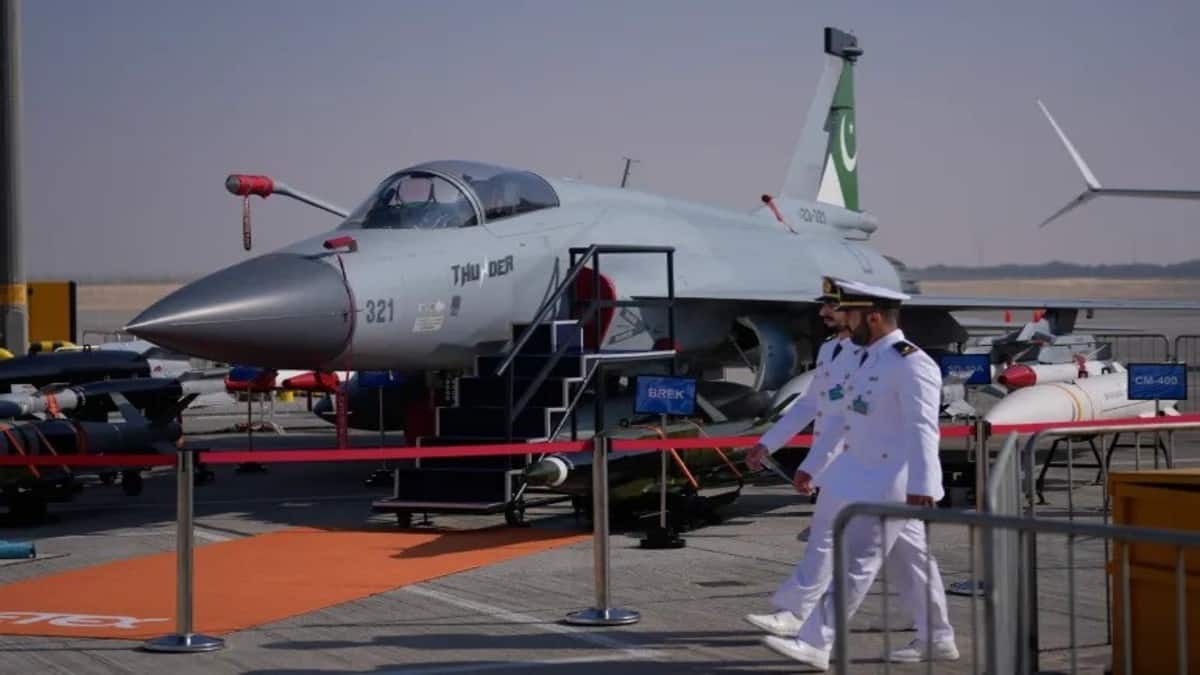
In moments of national stress, states often turn to symbolism. In moments of institutional crisis, they turn to narratives. Pakistan, for decades confronting both simultaneously, has increasingly relied on manufactured breakthroughs to compensate for the absence of its measurable progress. Over the last few weeks, this tendency has taken a particularly visible form as the repeated announcement of defence-export “successes”, centred around the JF-17 Thunder fighter aircraft, is presented as proof that Pakistan remains strategically relevant, technologically capable, and globally sought after. Yet beneath the headlines lies a widening gap between rhetoric and reality, the one that has completely eroded Pakistan’s credibility abroad while aiming to momentarily soothe perpetual anxieties at home.
The story of Pakistan’s supposed defence-export boom cannot be understood in isolation. It must be seen as part of a longer pattern of domestic diplomacy, where announcements are calibrated for internal political consumption rather than external verification. The pattern is familiar, repetitive and cyclic. Every time the economy in Pakistan falters, a discovery is announced. When foreign reserves dip, a deal is declared. When its isolation deepens, a partnership is unveiled. The content of these claims matters less than their emotional effect on a domestic audience conditioned to equate headlines with progress.
In 2023 and 2024, Pakistan’s leadership repeatedly claimed that massive oil and gas reserves had been discovered off the Karachi coast. These announcements were made with extraordinary confidence, yet without any seismic data, independent validation, investment commitments, or production timelines. Energy experts quietly dismissed them, international oil companies as usual stayed away, and no drilling programme ever followed. The oil never appeared, but the purpose of the announcement had already been served, as it had generated hope, dominated the domestic news cycles, and briefly shifted attention away from the chronic economic pain that its people suffer due to its crumbling economy. The JF-17 narrative functions in precisely the same way, only with jets replacing the oil rigs this time around.
The JF-17 Narrative and the Manufacturing of Momentum
The JF-17 Thunder is a joint Pakistan-China project originally conceived to provide Pakistan with a cost-effective, lightweight, multirole fighter that could be produced locally and operated affordably. It was never designed to compete with advanced Western platforms, nor to dominate global export markets. Its value lay in giving Pakistan a degree of autonomy and replacing ageing fleets at a manageable cost. For years, that is exactly how it was treated.
What has changed is not the aircraft but the narrative. Faced with a shrinking diplomatic footprint, limited export success in other sectors, and growing reliance on external bailouts, Pakistan’s establishment has recast the JF-17 as the centrepiece of a supposed defence-export revolution. Official statements, leaks to international media, and domestic amplification have repeatedly suggested that multiple countries are either close to signing contracts or already negotiating large orders. The tone of these announcements is deliberate. They are framed as inevitabilities rather than mere possibilities, implying that Pakistan’s rise as an arms exporter is only a matter of time.
Yet when these claims are examined through the lens of evidence, the picture collapses. No signed contracts have been publicly released. No buyer governments have issued confirmations. No delivery schedules have been announced. No financing arrangements have been disclosed. The entire story rests on anonymous briefings and optimistic language, the weakest foundation on which to build credibility in a market that functions on documentation, signed contracts and MOUs above just news headlines.
Domestic Diplomacy and the Politics of Reassurance
To understand why Pakistan persists with this strategy, one must understand the domestic political environment in which these announcements are made. Pakistan’s economy remains structurally fragile. Its growth is inconsistent, its exports stagnant, and its fiscal stability dependent on external lenders. The IMF is not merely a lender of last resort but a recurring presence in national life, an admission of systemic failure that no government ever wants to acknowledge.
In this environment, defence exports offer a uniquely powerful narrative. They allow the state to claim that Pakistan is not merely surviving but competing and that it’s not merely dependent on international loans and grants but a productive nation. They also reinforce the military’s image as the country’s most functional institution, an image that needs constant makeovers to stay credible domestically.
This is why defence-deal announcements are often timed during moments of internal stress. They serve as psychological counterweights to bad news, replacing discussions of inflation, unemployment, and debt with visions of strategic relevance. Whether the deals materialise is almost irrelevant in the short term; the announcement itself performs the political function.
The Uncomfortable Numbers: Only Four Operators Worldwide
The global footprint of the JF-17 tells a far more sobering story. Despite more than a decade of marketing and repeated claims of interest, only four countries currently operate the aircraft. Pakistan, as the primary developer and sponsor, accounts for the majority of the fleet. The remaining three – Myanmar, Nigeria, and Azerbaijan – represent limited and highly specific use cases, not a wave of global adoption.
This is a crucial point, because arms exports follow a predictable pattern. Successful platforms attract a growing user base, creating ecosystems of maintenance, training, upgrades, and interoperability. The JF-17 has failed to cross that threshold. Its user base has stagnated, not expanded, even as Pakistan’s announcements suggest the opposite. The discrepancy between claims and reality is not a matter of interpretation but a matter of pure arithmetic.
Myanmar: When a Buyer Becomes a Warning
The experience of Myanmar illustrates why the aircraft has struggled to attract repeat customers. After inducting JF-17s, the Myanmar Air Force reportedly encountered persistent technical problems that went far beyond routine teething issues. Reports pointed to avionics failures, radar performance issues, and reliability problems severe enough to ground large parts of the fleet. In operational terms, this rendered the aircraft unreliable for sustained combat use, delivering a devastating verdict for any fighter platform.
What makes Myanmar’s case particularly damaging is not just the technical failure but the silence that followed. Pakistan never publicly addressed the reported issues. There was no transparent explanation, no visible remediation programme, and no effort to reassure other buyers. The absence of response reinforced the perception that problems were being concealed rather than resolved. For potential customers watching from the sidelines, the message was crystal clear that the operational risk would be solely borne by the buyer, and not the seller, effectively killing the J-17 as a reliable export-oriented fighter jet.
Nigeria: Quiet Dissatisfaction and Eroding Confidence
Nigeria’s experience, though less dramatic, has followed a similarly troubling trajectory. Initial celebrations accompanied the induction of JF-17s into the Nigerian Air Force, with Pakistan presenting the deal as a breakthrough into African markets. Over time, however, reports emerged of frustration within the Nigerian defence establishment. Maintenance proved more complex than expected, spare parts supply remained inconsistent, and readiness rates were far lower than projected.
These are not trivial complaints, as the fighter aircraft are not purchased for display but for sustained operational use. When availability falls short of expectations, confidence erodes and credibility crumbles. Nigeria’s experience has done little to enhance the aircraft’s reputation among other potential African buyers.
The Production Problem: When Claims Defy Capacity
Perhaps the most glaring contradiction in Pakistan’s narrative lies in its production capacity. Pakistan Aeronautical Complex at Kamra remains the sole manufacturing hub for the JF-17. Even under optimal conditions, its output is limited to roughly 16 to 25 aircraft per year. This figure includes aircraft destined for the Pakistan Air Force, which continues to induct new units and remains the priority customer.
Yet Pakistan’s claims imply the simultaneous fulfilment of multiple large export orders. Such a scenario would require a dramatic expansion of production facilities, workforce training, supplier networks, and financing mechanisms. None of these expansions have occurred. No new assembly lines have been announced. No supply chain investments have been disclosed. No long-term financing structures have been established.
This mismatch between claimed demand and the actual capacity exposes the narrative’s fragility. It suggests that the announcements are not based on industrial planning but on political necessity. Real exporters announce capacity expansions before announcing deals. Pakistan announces deals before expanding capacity, a reversal that reveals the true objective of the messaging.
China’s Quiet Role and Strategic Limits
The JF-17’s dependence on Chinese subsystems adds another layer of complexity that Pakistan’s narrative glosses over. While Pakistan presents the aircraft as a symbol of self-reliance, its supply chain remains deeply intertwined with Chinese components, from avionics to weapon platforms. Any large-scale export programme would therefore require not only Pakistan’s consent but also China’s active participation, export approvals, and production support.
China, however, has shown little interest in aggressively marketing the JF-17 as a global platform. Instead, it has focused on its own aircraft exports, including more advanced platforms like the J-35s. This limits Pakistan’s ability to scale exports independently and further undermines the plausibility of the claims being made.
Reuters, Amplification, and the Credibility Cost
The international amplification of Pakistan’s claims through high-profile media coverage, especially by Reuters, has created a secondary problem. When so-called international media outlets report on negotiations or “advanced talks” based on anonymous sources, the domestic narrative is validated. Yet when those deals fail to materialise, the same coverage becomes a record of unfulfilled promises.
Over time, this manufactured narrative has made international observers to discount Pakistan’s announcements. What begins as optimism in media headlines is viewed as real scepticism because Pakistan’s capability-to-noise ratio has destroyed its international reputation by repeated exaggeration.
This is the real cost of Pakistan’s domestic diplomacy. It does not merely mislead the domestic audience; it repeatedly erodes trust in the international arena. In defence markets, where credibility is cumulative and reputations are built over decades, this erosion is difficult to reverse.
From Exports to Illusions: The Danger of Believing One’s Own Narrative
The JF-17 is not an abject failure. It is a limited aircraft built for limited needs, and it has served those needs within Pakistan. The failure lies in transforming it into a symbol of global demand and strategic resurgence. By doing so, Pakistan has turned an average fighter into an exaggerated myth and, in the process, weakened the very credibility it seeks to project.
Just as oil discoveries were once used to manufacture the illusion of imminent prosperity, fighter jet announcements are now being used to manufacture the illusion of international relevance. Both serve the same political purpose. Both collapse under scrutiny, and both leave behind a residue of disbelief that makes future claims harder to sustain.
Pakistan’s problem is not that it announces too much. It is that it announces what it cannot deliver. And in a world where credibility is a currency, repeated overstatement is a form of slow self-impoverishment.
When Pakistan cannot deliver economic stability, it starts delivering narratives. When it cannot close manufacturing contracts, it manufactures news cycles. And when reality intrudes, it simply shifts to the next announcement. But unlike headlines, credibility does not reset. It is accumulated, and once depleted, it is far harder to rebuild than to replace by merely announcing its arrival.
(Raja Muneeb is an independent journalist and columnist. He tweets @rajamuneeb. The views expressed in this article are personal and solely those of the author. They do not necessarily reflect the views of Firstpost.)
End of Article

