



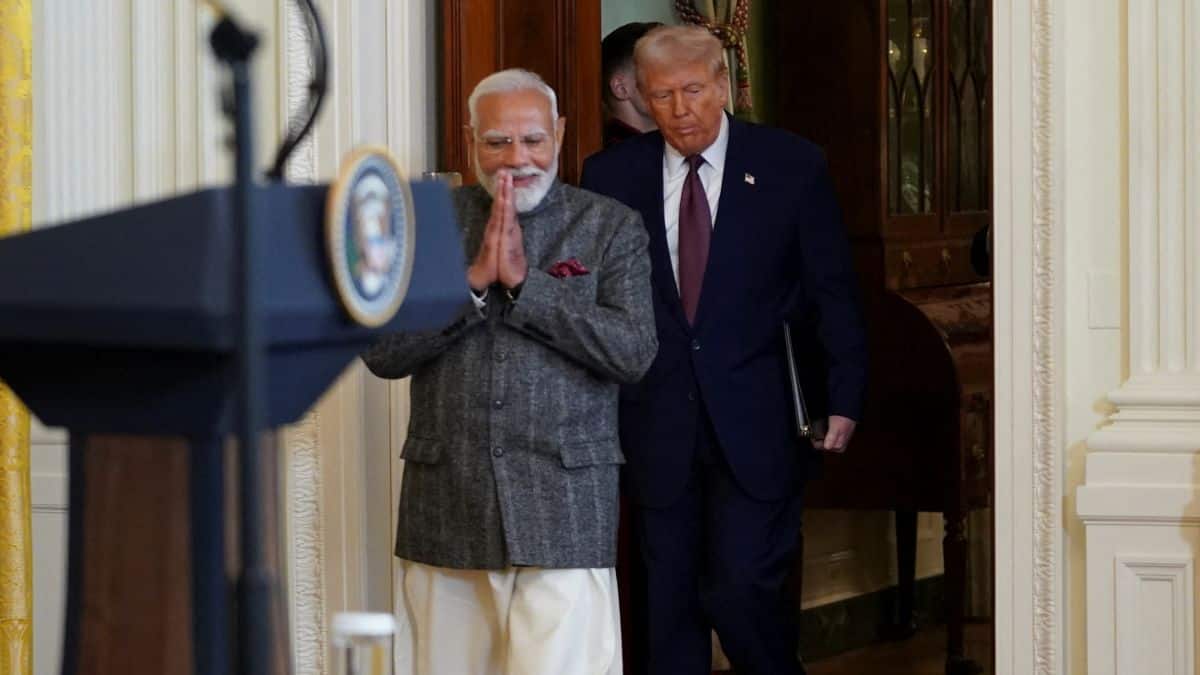
Two giants stand on either side,
With oceans vast and hearts allied.
From India’s factories to America’s malls
A new accord now breaks the walls.
Not just in goods or market rate,
But anchoring a common fate.
The India-US trade deal announced by President Donald Trump on his social media platform ‘Truth Social’ after a telephone call with Prime Minister Narendra Modi marks a historic de-escalation of trade tensions and a strategic realignment between the world’s two largest democracies. Prime Minister Modi confirmed the deal in his own post on ‘X’, saying, “Big thanks to President Trump on behalf of the 1.4 billion people of India for this wonderful announcement. When two large economies and the world’s largest democracies work together, it benefits our people and unlocks immense opportunities for mutually beneficial cooperation.”
The deal follows a “Famous Five” trend in 2025-26, where India also secured landmark trade pacts with the European Union, UK, Oman and New Zealand, reducing its vulnerability to any single nation’s trade volatility. A major catalyst for the US shift was India’s successful negotiation of a landmark free trade agreement with the European Union just days before the US-India deal was announced. This deal signalled that India had viable alternatives to the American market, pressuring Washington to reach an agreement or risk losing its competitive edge in one of the world’s fastest-growing economies.
Negotiations had previously stalled due to what US Commerce Secretary Howard Lutnick described as a “personal” breakdown in communication. The deal was finalised only after a direct telephone call between President Trump and PM Modi, which Lutnick had previously cited as the missing component for a breakthrough.
The United States has slashed tariffs on Indian goods from 50 per cent down to 18 per cent. At 18 per cent, India now faces lower tariffs than regional rivals like Vietnam (20 per cent), Bangladesh (20 per cent), Pakistan (19 per cent), and China (37 per cent), giving “Made in India” products a decisive pricing advantage in the US market. This reduction is a major boost for labour-intensive sectors such as textiles, apparel, leather, gems and jewellery, and engineering goods. For India, the 50 per cent tariffs were devastating labour-intensive sectors like textiles, gems, and jewellery. Trump said that India is expected to reduce tariffs on US industrial goods to zero (down from 13.5 per cent). While India has not confirmed this, it has stressed that it will maintain safeguards for its sensitive agriculture and dairy sectors.
In a major diplomatic pivot, Trump said that India has agreed to stop the purchase of Russian crude oil, and that India will shift its energy procurement to the United States and potentially Venezuela. Trump also said that this move aims to limit Moscow’s energy revenues and is framed as a step towards ending the conflict in Ukraine. While US President Donald Trump has publicly stated that Prime Minister Modi agreed to the halt, the Indian government has not yet made a formal public declaration confirming a complete ban, focusing instead on the tariff benefits. Moving away from discounted Russian oil may increase India’s import bill and impact its current account deficit.
The Kremlin has stated it has received no official communication regarding a cessation of oil trade and continues to emphasise the strategic partnership between the two nations. However, India had already begun scaling down its imports of Russian oil as part of a major strategic shift linked to a new trade agreement with the United States. Russian oil imports fell to a two-year low in December 2025. Recent data indicates daily imports dropped from 1.8 million barrels per day (bpd) in November 2025 to approximately 1.2 million bpd in December and January 2026. Imports are expected to continue declining, with projections suggesting a drop to 1 million bpd in February and 800,000 bpd in March 2026.
Trump said that India has pledged to purchase over $500 billion worth of US energy, technology, coal, and agricultural products over time. The $500 billion figure—representing more than ten times India’s current annual imports from the US—may be a long-term aspiration framed to appeal to his domestic audience rather than a near-term contractual obligation. It serves as a “political signal” of a renewed partnership rather than a finalised contract, and can be contextualised as a broader ambition for total bilateral trade to reach $500 billion by 2030, rather than solely US exports to India.
While the deal resolves immediate trade friction and provides a “booster shot” to Indian manufacturing, its long-term success depends on the final legal texts and India’s ability to manage its relationships with other global powers. There are challenges which may still remain. The government maintains that sensitive sectors like dairy and poultry are protected, though there are concerns that the deal may eventually grant greater access to highly subsidised US agri-products, potentially triggering rural distress for millions of Indian farmers. High-profile sectors like steel and aluminium may remain outside the scope of tariff relief due to U.S. national security laws.
President Trump’s social media announcement of the India-US trade deal is strategically framed for his support base. The post highlights several key elements tailored to his “America First” platform. His claim that India has agreed to “BUY AMERICAN” at unprecedented levels, including a commitment to purchase over $500 billion in U.S. energy, technology, and agricultural products, will certainly go down well with his supporters.
By asserting that India will stop buying Russian oil and pivot to US and Venezuelan sources, Trump framed the deal as a victory for both American energy exporters and his administration’s geopolitical stance against Russia. By announcing the deal himself, Trump showcased that he is a man of action, and that his preferred style of direct, leader-to-leader deal-making bypasses traditional bureaucratic channels. Of course, by saying in his post that the deal was at the request of PM Modi, Trump signalled to his support base his own implicit strength and standing in global affairs.
The India-US trade deal should also help narrow the current account deficit, stabilise the rupee, and reduce India’s vulnerability to global shocks over time. After Trump’s announcement on February 2, 2026, the rupee surged 1.2 per cent to 1.4 per cent, jumping from nearly 91.50 to as high as 90.36 against the US dollar. The deal has also sparked renewed interest in Indian equities, further supporting the currency.
The India-US trade agreement is expected to pave the way for deeper collaboration in critical technologies, including nuclear power, defence manufacturing (like jet engines), and data centre infrastructure. It is expected to significantly advance the India-US strategic partnership, evolving from the Initiative on Critical and Emerging Technology (iCET) into a broader framework called TRUST (Transforming the Relationship Utilising Strategic Technology), which was announced during PM Modi’s US visit in February 2025.
Summing up, the 2026 India-US trade deal restores India’s export competitiveness by slashing punitive American tariffs. It is a strategic reset that significantly lowers trade barriers for Indian exporters and strengthens the bilateral economic partnership. While a formal legal agreement for the “first tranche” of this pact is expected to be signed by mid-March 2026, the significance of this deal lies in the “de-escalation” of a months-long trade war and its potential to reshape global supply chains.
Sectors with thin margins, such as textiles and apparel, gems and jewellery, leather, and footwear, are witnessing an immediate revival in export orders from the US. Exporters of machinery, auto components, and generic drugs will benefit from improved pricing and reduced trade hurdles. Industry groups expect a recovery in volume for shrimp and frozen food exports, which had plummeted under higher tariffs. This verse perhaps describes the prevailing sentiment:
A “win-win” pact, a strategic reset.
Challenges will now be successfully met.
Anchored in value, safe from the storm,
The India-US partnership begins to form.
A future woven, strong and true,
As old friends pledge to cooperate anew.
(The writer is a retired Indian diplomat and had previously served as Ambassador in Kuwait and Morocco and as Consul General in New York. Views expressed in the above piece are personal and solely those of the author. They do not necessarily reflect Firstpost’s views.)
End of Article

