



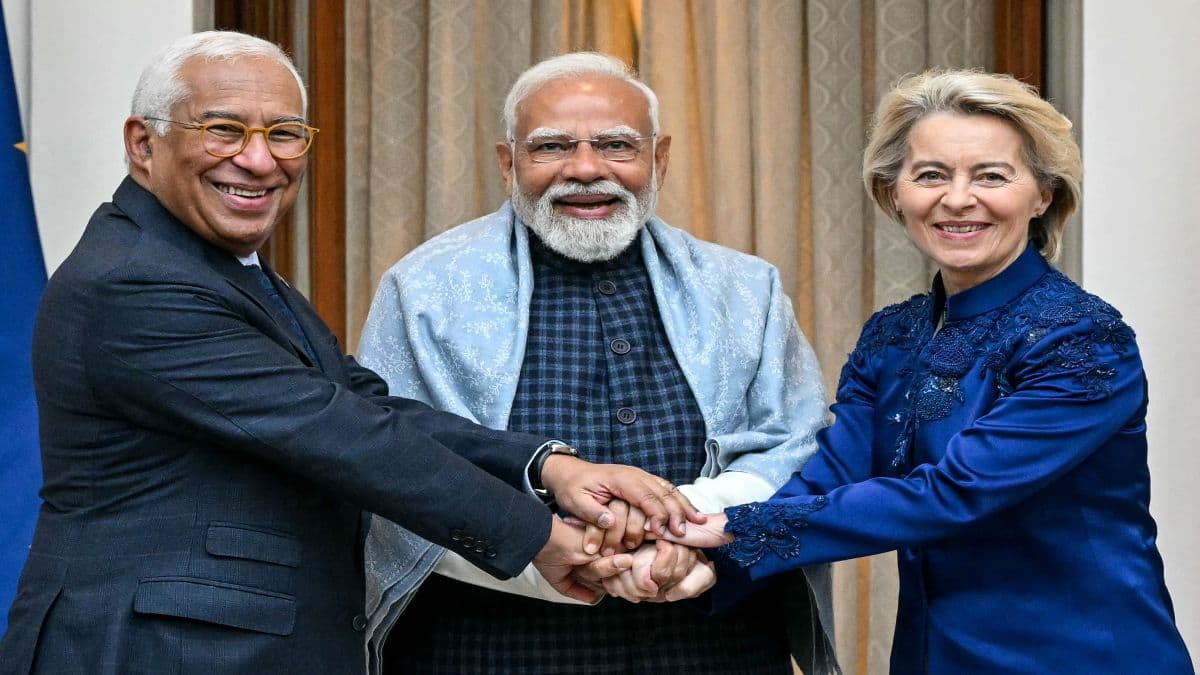
On January 27, India (the most populous nation and soon to be the third-largest economy in the world), and the European Union (a group of 27 countries and the second-largest economic bloc in the world) announced the conclusion of a mega Free Trade Agreement (FTA). The deal will be signed in the coming months after legal scrubbing and legal vetting, and will become operational by the end of the year, after it is approved by the European Parliament and Bharat’s Union Cabinet.
Mother of All Deals
European Commission President Ursula von der Leyen and India’s Minister for Commerce and Industry, Piyush Goyal, have both dubbed the just-concluded FTA as “the mother of all deals”, and for once, the hyperbole fits. The India–EU free trade agreement will connect over two billion people across a market representing nearly a quarter of global GDP.
Also, from Bharat’s perspective, it is the largest-ever trade deal.
Economic Insurance
Size and the deal’s impact aside, its significance lies in the timing, which represents not only the return of the free world order but also, in a world fragmented between Washington’s capricious tariffs and Beijing’s economic coercion, this deal is economic insurance.
In the Making for Two Decades
The FTA was signed at the 16th Summit meeting between India and the EU but had been in the making for two decades and had undergone many twists and turns, false starts, and steep gradients. For the uninitiated, the India-EU trade deal was first negotiated between 2007 and 2013 but was abandoned due to irreconcilable differences between the two sides.
In a fresh beginning, on 8 May 2021, EU and Indian leaders agreed to resume negotiations for a “balanced, ambitious, comprehensive and mutually beneficial” trade agreement and to launch separate negotiations on an investment protection agreement and an agreement on geographical indications (GIs). Leaders also agreed to link trade negotiations to finding “solutions to long-standing market access issues”.
Bilateral negotiations, restarted in 2022 after a nine-year lull, gained momentum after Trump imposed import tariffs on several trading partners, including a 50 per cent duty on goods from India.
Flurry of Deals
The agreement comes days after the EU signed a crucial deal with the South American bloc Mercosur, following last year’s deals with Indonesia, Mexico and Switzerland. The agreement also marks the culmination of the ninth trade deal by India in the past four years and comes closely on the heels of New Delhi’s finalised agreements with Britain, New Zealand and Oman.
The flurry of deals underscores global efforts to counter the United States, as President Donald Trump’s attempt to seize Greenland and tariff threats against European countries test long-standing Western alliances.
The Backdrop
How important the FTA is can be gauged from the following data available on the official website of the European Commission.
The EU is India’s largest trading partner, accounting for trade in goods worth €120 billion in 2024, or 11.5 per cent of India’s total trade. India is the EU’s ninth-largest trading partner, accounting for 2.4 per cent of the EU’s total trade in goods in 2024, well behind the US (17.3 per cent), China (14.6 per cent), and the UK (10.1 per cent).
Trade in goods between the EU and India has increased by almost 90 per cent in the last decade.
The EU’s imports from India comprise mainly machinery and appliances, chemicals, base metals, mineral products, and textiles. The EU’s main exports to India consist of machinery and appliances, transport equipment, and chemicals.
Trade in services amounted to €59.7 billion in 2023 (with EU exports of €26 billion).
The EU’s share of foreign direct investment (FDI) stock in India reached €140.1 billion in 2023, up from €82.3 billion in 2019, making the EU a leading foreign investor in India. India’s FDI stock in the EU was €10.3 billion.
Some 6,000 European companies are present in India.
Leaders Speak
Prime Minister Narendra Modi said on the conclusion of the deal, “Friends, today, India has concluded the largest ever free trade agreement in its history.” He also declared that the partnership would “strengthen stability” amid global turmoil.
PM Modi added further, “There comes a time when history tells us this was a turning point. This is when the moment took a new direction, when a new era began.”
European Commission President Ursula von der Leyen reciprocated: “This is a tale of two giants,” she said. “Two giants who choose partnership, in a true win-win fashion. A strong message that cooperation is the best answer to global challenges.”
Also, von der Leyen wrote in a post on X, “Europe and India are making history today… We have created a free-trade zone of two billion people, with both sides set to benefit. We will grow our strategic relationship to be even stronger.”
What Is in the Deal
The deal is India’s largest and most comprehensive trade agreement, covering goods, services, and investments across the EU’s customs union. The new deal would give India an edge in several sectors, including textiles, pharmaceuticals, machinery, steel, petroleum products and electrical equipment.
In quantitative terms, the deal will see the EU drop tariffs on 99.5 per cent of Indian exports to the 27-nation bloc, while India has given concessions on 97.5 per cent of imports from the EU.
Under the deal, New Delhi will lower tariffs on European cars and wine, while the EU signalled it would assist Indian companies with decarbonisation and negotiate duty-free quotas for Indian steel. As reported by Politico, economists at the Kiel Institute estimate that the accord could lift EU exports to India by up to 65 per cent and add more than a tenth of a percentage point to GDP on both sides.
India will gradually slash tariffs on European cars, reducing them from 110 to 10 per cent on 250,000 cars every year.
India will lower wine tariffs to between 20 and 30 per cent from 150 per cent now, depending on value. European olive oil will also enter India duty-free, rather than face a 45 per cent tariff.
Overall, the EU is giving India access to 144 service subsectors, while India is opening 102 subsectors to the EU, including in the financial, maritime, and telecommunications industries.
Win-Win
Crucially, this deal represents an opportunity for both sides to “diversify and look beyond the US and grow beyond their dependence on the American market”.
The economic benefits of the FTA flow in both directions, creating genuine complementarity rather than zero-sum competition. For India, the elimination of European tariffs opens markets for textiles, pharmaceuticals, gems and jewellery, and engineering goods, where Indian producers already compete globally but face barriers to entering Europe.
How Will the Deal Benefit India?
The EU will scrap all tariffs on 90 per cent of Indian goods, and within seven years, this will be extended to 93 per cent.
Among those benefitting from zero tariffs immediately are marine/seafood products, such as shrimp and frozen fish (currently levied at up to 26 per cent); chemicals (12.8 per cent); plastics and rubber (6.5 per cent); leather and footwear (17 per cent); textiles (12 per cent); apparel (4 per cent); base metals (10 per cent); and gems and jewellery (4 per cent).
There will be partial tariff cuts and quotas for about 6 per cent of Indian goods, bringing the EU’s average tariff rate down from 3.8 per cent to 0.1 per cent.
Overall, 99.5 per cent of bilateral trade will benefit from some form of tariff concession.
India is still seeking improvements in tariff-free steel export quotas, and the outcome of these talks is due by June 30, before EU rules take effect on July 1. Under the deal as it stands, India would be allowed to export 1.6 million tonnes of steel to the EU duty-free, but this is only about half of what it exports annually.
What Benefit Does the EU Get?
Indian tariffs on 30 per cent of goods imported from the EU will fall to zero immediately.
Overall, tariffs on 96.6 per cent of EU goods exports to India will be eliminated or reduced, EU officials said. As per the European Commission, the EU will save up to 4 billion euros ($4.74bn) in duties on European products each year.
Besides the relaxation of tariffs on car imports from the EU, existing Indian tariffs of up to 44 per cent on machinery, 22 per cent on chemicals, and 11 per cent on pharmaceuticals will, for the most part, be eliminated.
Tariffs on EU aircraft and spacecraft will also be eliminated for almost all products, while those on optical, medical and surgical equipment will be eliminated for 90 per cent of products.
Meanwhile, spirits and wines imported to India from the EU, currently tariffed at 150 per cent, will be cut to 20-30 per cent for wines, 40 per cent for spirits, and 50 per cent for beer.
India will also provide improved access for EU firms in financial and maritime services, and both sides will simplify customs rules and provide stronger intellectual property protections.
Beyond the numbers game, the deal provides Europe with supply chain diversification beyond China. India’s manufacturing share of GDP is 13 per cent, compared to China’s 26 per cent, suggesting substantial growth potential in sectors where European firms need alternatives.
Strategic Rationale
The strategic rationale for the FTA is that India needs stable conditions for export-oriented manufacturing to compete with Vietnam, Thailand, and Malaysia in attracting firms diversifying away from China. Europe needs economic partnerships that provide leverage against American protectionism and Chinese pressure without requiring political alignment on every foreign policy question.
Future Perfect
After the implementation of the FTA, bilateral trade between India and the EU is projected to grow to between $200 billion and $250 billion by 2030, from $136.5 billion in 2024–25.
Key projections and drivers for India-EU trade by 2030 include:
Trade Volume Growth: The total bilateral trade, in billions, is expected to grow substantially, with some projections aiming for $250 billion by 2030–31.
Sectoral Increases: Specific sectors are expected to see massive growth, including a potential doubling of apparel exports from $5.5 billion to over $11 billion.
Key Drivers: The deal includes reducing or eliminating tariffs on 96.6 per cent of EU exports to India, alongside increased access to the EU market for Indian goods.
Key Sectors: Significant growth is expected in textiles, machinery, automobiles, chemicals, and pharmaceuticals, with India’s textile sector aiming for $100 billion in exports by 2030, strongly supported by the EU market.
Investments & Green Energy: The partnership is targeting $10 billion in foreign direct investment for green technologies, such as electrolyser manufacturing, by 2030.
This enhanced cooperation is expected to help European firms diversify supply chains away from China while boosting India’s manufacturing capacity.
Taking the Plunge
After on-and-off talks since 2007, India and the EU have finally taken the plunge, responding to steep US tariffs and cheap goods from China, creating the mother of all deals, bringing unparalleled opportunities for the two billion people of India and the EU, with a combined market estimated at Rs 2,091.6 lakh crore ($24 trillion).
As the FTA takes shape and is implemented, it is a big leg-up for the strategic relationship between India and the EU, for goods and services, and for taking innovation to a much higher level.
The FTA delivers an unprecedented opportunity to re-establish the rule-based trade order of free trade and is a timely reminder to the fractured world that “globalisation, instead of dying, will be thriving soon”.
Make no mistake, as the Government of India’s PIB note dated January 27, 2026 rightly says, “The FTA of strategic significance evolves India–EU relations from a traditional into a modern, multifaceted partnership, providing a stable and predictable environment for exporters, enabling Indian businesses, including MSMEs, to plan long-term investments, integrate into European value chains, and ensure consistent favourable market access amid global economic uncertainties.”
More importantly, apart from merchandise trade, this FTA assumes salience for transformation in the services sector.
Services Sector: Tango of the Future
Under the FTA, the EU has secured broader and deeper commitments across 144 service subsectors, including IT/ITeS, professional services, education, and other business services. This covers a vast range of service sectors, in which Indian service providers will have a stable, conducive regime in the EU market to supply their services. India’s competitive, high-tech services are expected to drive India’s exports while benefitting EU businesses and consumers.
And This Services Sector’s Future Is Complementary
Under the FTA, India has also offered 102 subsectors that cover EU priorities, including professional, business, telecommunications, maritime, financial, and environmental services. This will offer EU businesses a predictable regime to bring investment and innovative services to India, thereby enhancing their exports and providing best-in-class services to Indian businesses.
This mutually beneficial framework is set to accelerate trade in services, unlock new opportunities for Indian and EU professionals and businesses, and strengthen India’s presence in high-value global markets, fostering innovation, skills mobility, and knowledge-based economic growth.
Winner No. 1: The Indian Talent
The FTA establishes an assured regime for the entry and stay of professionals, including Business Visitors, Intra-Corporate Transferees, Contractual Service Suppliers, and Independent Professionals.
The EU is ageing, while India is poised to enjoy an unprecedented demographic dividend over the next few decades. Through a comprehensive mobility framework in the FTA, India strengthens its position as a global talent hub.
The agreed framework eases the movement of employees (and their spouses and dependants) of Indian corporations established in the EU in all service sectors. For business entities aiming to provide services under a contract to EU clients, India can access 37 subsectors, including IT, business, and professional services.
Independent professionals intending to provide services to EU clients gain certainty in 17 subsectors, covering IT, R&D, and higher education, creating expanded opportunities for Indian professionals and knowledge-driven trade.
India and the EU have agreed on a constructive framework to enable Social Security Agreements within five years with all EU member states and a continuing, conducive framework for the entry of Indian students to study and avail of a post-study work visa.
The benefits are humongous. It has taken two decades, but it has arrived as a global game changer — the mother of all trade deals. The deal is done, but not yet done. In the months to come, both the EU and India will need to move fast in a calibrated and symbiotic manner to turn the audacious dream into reality.
(The author is a multi-disciplinary thought leader with Action Bias and an India-based impact consultant. He is President of Advisory Services at BARSYL. Views expressed are personal and do not necessarily reflect Firstpost’s position.)
End of Article

