



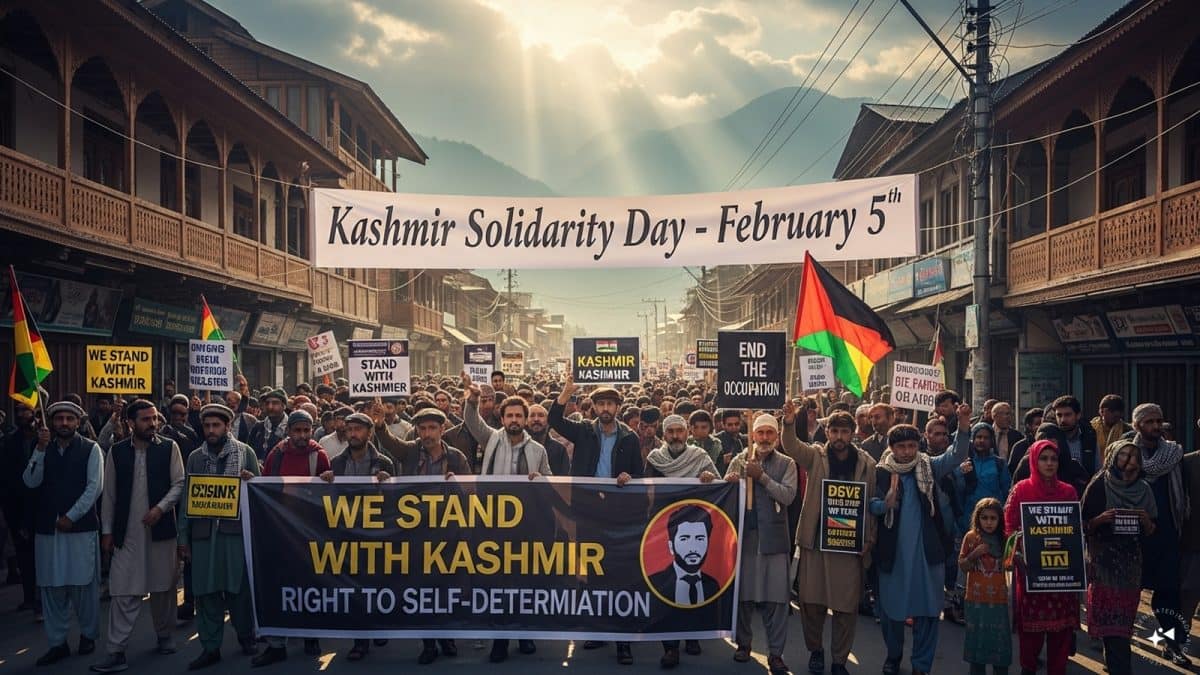
Despite repeated humiliations, Pakistan is not done embarrassing itself on the world stage when it comes to Kashmir. Since 1990, on February 5 each year, Pakistan observes Kashmir Solidarity Day to show support and unity with the people of Jammu and Kashmir, attempting to present itself as the injured party in a dispute it has long reduced to propaganda.
The smokescreen is one of showing solidarity with Kashmiri people, but what rarely enters these theatrics is the uncomfortable fact that the Kashmiris who actually live in Pakistan-occupied Kashmir (POK) enjoy neither meaningful political power nor control over their own land and resources. As the slogans grow louder, the distance between what Pakistan claims to represent and what it actually administers continues to widen, exposing a narrative that survives more on repetition than on truth.
Decision-making processes in POK do not flow from local assemblies or elected representatives, but from distant bureaucracies and military offices that answer to no Kashmiri constituency. Laws are framed elsewhere, revenues are allocated elsewhere, and dissent is treated less as a democratic right than as a security problem. In this arrangement, the language of self-determination becomes little more than a diplomatic slogan, deployed when useful, discarded when inconvenient, and never allowed to translate into genuine political agency for the people on whose behalf it is supposedly invoked.
The consequences of this arrangement are felt most sharply in the everyday lives of those who inhabit these territories. Despite sitting atop vast hydropower potential, forests, and mineral wealth, local communities see little of the revenue generated from their own land. Employment remains scarce, infrastructure fragile, and public services chronically underfunded, even as resources are siphoned off to serve priorities set far away from Muzaffarabad or Gilgit. What Pakistan calls guardianship increasingly resembles extraction, where the region’s strategic and economic value is retained while the people themselves are left to absorb the costs of neglect and misrule.
It is in this climate that calls to boycott Kashmir Solidarity Day have started to gain traction within these regions themselves. Leaders of grassroots movements and local action committees have argued that the annual spectacle does nothing to address the shortage of jobs, the erosion of land rights, or the absence of accountable government. To many residents, the day has come to symbolise not international concern but domestic neglect, a reminder that while their plight is invoked on television screens and diplomatic podiums, it remains unresolved in their towns and villages. The louder the slogans become, the more they seem to underline the silence surrounding the basic demands of those living under Pakistan’s rule.
This year’s officially sanctioned theatre is set to reach its predictable crescendo in Muzaffarabad, where the All Parties Hurriyat Conference (APHC) has announced a major demonstration beginning at 9:00 am from Shaheed Burhan Wani Chowk and ending at Sathra Mor. Its leaders, including Secretary General Advocate Parvez Ahmed Shah, have called on the public to turn out in large numbers to display support for what is described as the “Kashmir cause”. The rally is being backed by a familiar constellation of political and religious actors, from Pakistan Tehreek-e-Insaf to Jamaat-e-Islami and the Muslim Conference, underscoring how these events have become less an expression of Kashmiri will and more a coordinated exercise by Pakistan’s own political machinery.
What makes the entire exercise even more hollow is the solemnity with which it is wrapped. The official programme for the day states that a one-minute silence will be observed at 10:00 AM in memory of “Kashmiri martyrs”. Yet unless that phrase includes the Kashmiri Pandits driven out by terror and the countless Kashmiri Muslim civilians killed by Pakistan-backed terror groups and state operatives, the gesture is little more than a ritual stripped of meaning. These are the real victims of the machinery that Pakistan has sustained for decades in the name of Kashmir, and any remembrance that excludes them is not an act of mourning but an exercise in selective amnesia.
What makes this contradiction even more grotesque is the money trail behind these theatrics. On one hand, Pakistan is willing to spend lavishly on choreographed rallies, transport, banners, media coverage, and political pageantry for Kashmir Solidarity Day, turning grievance into a funded spectacle. On the other hand, there is now a widely circulated video in which Prime Minister Shehbaz Sharif and Army Chief Asim Munir openly admit the humiliation of going around the world with a begging bowl, pleading for bailouts and emergency funds to keep the country afloat. A state that claims it cannot survive without external handouts somehow always finds the resources to stage performative outrage on Kashmir. That is not solidarity; it is misallocation, and it exposes where Islamabad’s priorities truly lie.
What sets this year apart is not the message but the scale and choreography behind it. The Shehbaz Sharif government has turned Kashmir Solidarity Day into a centrally managed national campaign, declaring a public holiday and issuing directives for rallies, marches, seminars, prayer gatherings, and even symbolic human chains across cities. State broadcasters have been instructed to run wall-to-wall Kashmir programming, while public transport, government buildings, and institutions have been visually rebranded with Kashmir-related slogans.
Intelligence assessments indicate that participation has been mandated down to the level of schools, colleges, arts councils, and district administrations, with essay competitions, debates, puppet shows, documentaries, photo exhibitions, and even metro bus branding pressed into service. Social media monitoring further shows that roughly 85 per cent of Kashmir Solidarity Day content carried overtly negative messaging about India, underscoring that what is being marketed as solidarity is, in reality, a synchronised propaganda exercise aimed less at Kashmiri welfare than at sustaining Pakistan’s external narrative.
The question, then, is why this sudden surge in enthusiasm and orchestration has emerged around a ritual Pakistan has been performing for decades. The answer lies less in Kashmir and more in damage control. This year’s meticulously synchronised campaign is widely seen as an effort to repair Pakistan’s narrative credibility after Operation Sindoor once again brought international attention to Islamabad’s enduring links with cross-border terror networks. In the weeks that followed, Pakistan’s carefully curated image was further punctured when senior military personnel were seen offering funeral prayers for slain terrorists, including commanders of Jaish-e-Mohammed and Lashkar-e-Taiba killed in counter-terror operations. Photographs showing Pakistan Army officers attending the funerals of terrorists killed in Operation Sindoor, led by figures such as Lashkar-e-Taiba commander Abdul Rauf, left little room for plausible deniability.
Against this backdrop, the 5 February spectacle appears less like an expression of solidarity and more like a hurried and desperate attempt to recast a state widely known as the “mothership of terrorism” into a self-styled champion of Kashmiri rights.
(The writer takes special interest in history, culture and geopolitics. The views expressed in the above piece are personal and solely those of the author. They do not necessarily reflect Firstpost’s views.)
End of Article

