



Recently, a friend of mine sent me his view, which he called an uncomfortable truth: in tomorrow’s world, AI (artificial intelligence) will be supreme. He first noted: “AI will affect most the ‘thinking-heavy’ professions, not the mechanical ones.”
For decades, the worth of military analysts, strategic thinkers or geopolitical commentators came from three advantages: access to information, ability to process large quantities of documents and recognition of past patterns across history, doctrine and behaviour.
Today AI does all three faster, deeper, broader and with no effort.
AI can read every paper published in the world in the last 20 years in seconds; it can compare doctrine shifts across the world or detect patterns of human behaviour that humans would miss, while instantly generating alternative doctrines.
In these circumstances, what remains to be done for humans?
“Not analysis. Not synthesis. Not even forecasting,” says my friend. The human is slowly shifting “from judgement under ambiguity to choosing which question to ask”.
In the AI yuga (era), the loser will be the one who still believes that expertise comes from downloading and reading more PDFs.
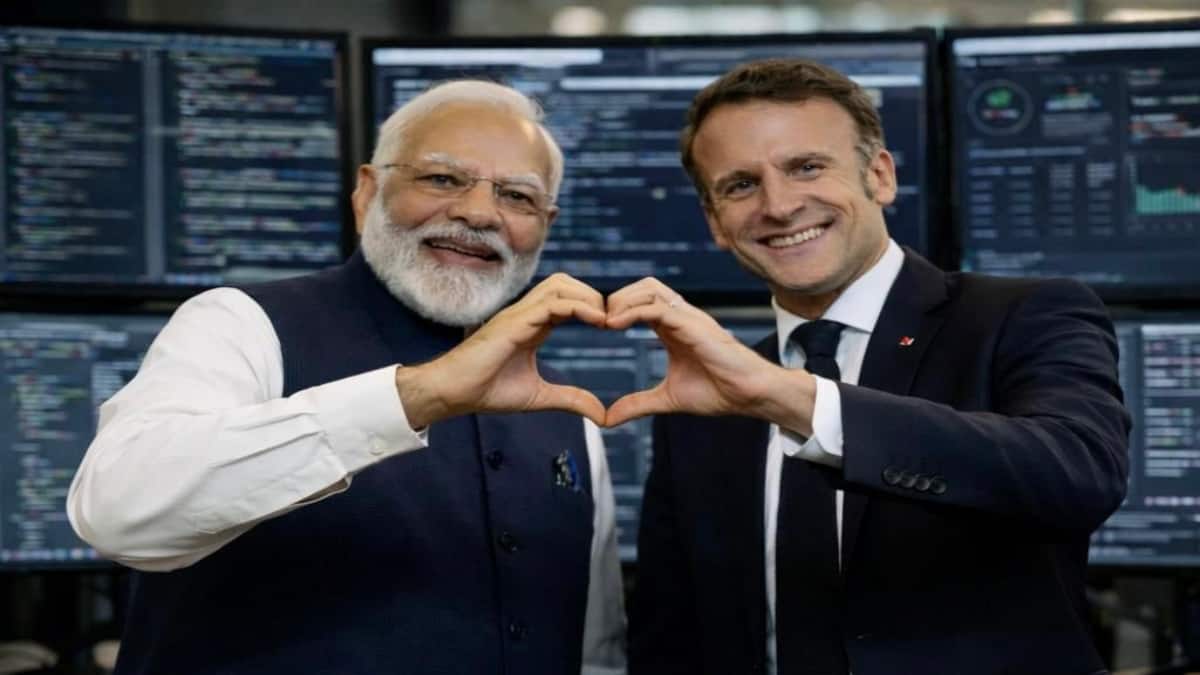
All this came to mind while watching French President Emmanuel Macron’s fourth visit to India. Having watched most of the visits of the heads of the French State for the past 25 years, the present one seems very special in many ways.
A long way has been covered since the 90s, when the initial boost was provided by the visit to Delhi of President Jacques Chirac in January 1998 and Prime Minister Atal Vajpayee’s trip to Paris later in the year. Although these visits saw the setting up of a framework for a strategic partnership, the first of its sort in the world.
From Friendship to Partnership
Before reaching Delhi in 1998, President Chirac had declared that he was keen on an ‘ambitious partnership’. Using a de Gaulle-like language, Jacques Chirac saluted India, “a nation which has affirmed its personality on the world stage”. He said that he had come to show that “France wanted to accompany India in its potent march [towards the future].”
Inaugurating a seminar in Vigyan Bhavan, the French President suggested to “reflect, together with those of our partners involved, on the ways to reconcile our common will to cooperate and the necessary respect for the rules the international community has set itself.”
Chirac’s words were not mere political niceties. When India conducted its nuclear tests in Pokhran in May 1998, France was one of the few countries which did not condemn Delhi (or impose sanctions). This was greatly appreciated, and when Prime Minister Vajpayee returned Chirac’s visit in October, the new strategic dialogue could take its first concrete steps.
Over the years, this partnership has continued, while taking new shapes, new levels and new forms.
From the friendship once mentioned by General de Gaulle, the relation had become a deep partnership. By putting proper structures in place, the dialogue was institutionalised.
The Fourth Visit
Twenty-eight years later, Emmanuel Macron, President of the French Republic, paid his fourth visit to India from February 17 to 19.
The highlight of his trip was his participation in the Artificial Intelligence Impact Summit 2026.
While in Mumbai, the French President and the Indian Prime Minister had the opportunity to have bilateral talks and jointly inaugurate the 2026 India-France Year of Innovation.
Both leaders agreed to elevate relations to a ‘Special Global Strategic Partnership’ to guide bilateral cooperation in the coming decades and “act as a force for global good that can help build not only prosperity and resilience in their economies and advance their countries’ security but also work collectively towards addressing challenges in an increasingly uncertain global environment and, thus, help build a stable rules-based international order.”
The planet is indeed facing serious challenges; the world seems to have entered a period of great uncertainty, not to say chaos. To solve our problems in the forthcoming AI-yuga, can machines replace men?
In this perspective, it is interesting that France and India agreed “to intensify joint research, co-design, co-development and co-production of advanced defence platforms, including in the field of air, naval and land systems, and emerging dual-use technologies, in line with the ambitious Defence Industrial Roadmap agreed in 2024”.
But it is not in the defence domain alone.
Indeed, ‘innovation’ will play a crucial role in the new world set-up.
Sales of Armament
During the visit, the media mainly focussed on sales of 114 Rafale planes (and perhaps 31 more fighters for deployment on India’s aircraft carriers), but it is not the only takeaway from the visit, though it is indeed a mega order; a quick calculation shows that once the contract is finalised, France will deliver 145 Rafale jets (some of them assembled in India), to which should be added 26 Rafale-M already ordered by the Indian Navy.
The Joint Statement further noted, “They welcomed ongoing discussions on furthering defence cooperation in the helicopter [sector].” Modi and Macron also virtually inaugurated an assembly line in Karnataka’s Vemagal to manufacture H125 helicopters by Airbus, a move which is expected to greatly strengthen India’s aerospace manufacturing ecosystem.
Another interesting development was the online inauguration of the Maintenance, Repair and Overhaul (MRO) facility for Leap engines [Leading Edge Aviation Propulsion], the establishment of the MRO facility for M-88 engines mounted on Rafale aircraft and the joint venture with Bharat Electronics Limited to produce the Hammer missiles in India.
The leaders also jointly inaugurated the Airbus Helicopters H125 (Écureuil or Squirrel) Final Assembly Line, a first of its kind in the private sector helicopter manufacturing facility in India.”
Combining the strength of Tata Advanced Systems and Airbus, it could serve India’s growing market and export to third countries.
A joint venture is certainly the right way ahead.
What will make history?
The decision to walk together in the domain of ‘innovation’, which will be crucial in the new era, may be remembered as a historical move.
As the Joint Statement pointed out: “Building on the existing trust in high technology collaboration between India and France, both leaders agreed to constitute a Joint Advanced Technology Development Group to explore opportunities to co-develop emerging and critical technologies in identified niche areas to retain a competitive military edge and mitigate supply chain vulnerabilities.”
Indeed, innovation will decide the leadership of the future.
Only nations with a strong will (and capacity) to innovate (particularly in the AI field), while keeping moral and ethical values in mind, will be able to play a meaningful role in tomorrow’s world. In this perspective, collaboration will be another important factor.
The statement observed that both nations “welcomed the progress in existing bilateral cooperation on critical and emerging technologies, including on space, civil nuclear energy, cyber and AI, and encouraged to go further in technology cooperation. They welcomed the launch of the India-France Innovation Network to bring together the innovation ecosystems of France and India through a digital network by connecting key stakeholders, including innovators, start-ups, businesses and incubators of both countries.”
Undoubtedly, in the new era, humanity will move from ‘who knows more’ to ‘who understands consequences better’.
In the future, to not be left behind, innovation (in all domains) and collaboration will have a crucial role to play, and one can say that France has been (and is) a truly reliable friend and has the capacity to remain a dependable partner for India in the years to come.
Incidentally, President Macron arrived in India at the start of what the Chinese call the ‘Red Horse, Red Goat Year’; this event takes place once in the 60-year Chinese zodiac cycle. The Fire Horse and Fire Goat years are traditionally associated with intense, chaotic energy, upheaval, and significant societal, political, or environmental changes. In Chinese astrology the Red Fire Horse brings extreme energy, passion, and, historically, volatility.
Here too innovation and collaboration will be useful.
(The writer is Distinguished Fellow, Centre of Excellence for Himalayan Studies, Shiv Nadar Institution of Eminence (Delhi). Views expressed in the above piece are personal and solely those of the writer. They do not necessarily reflect Firstpost’s views.)
End of Article

