



In a 1995 New York Times opinion piece which he authored, Donald Trump said that his ego plays a major role in his life. The title of the article was ‘What My Ego Wants, My Ego Gets’. Trump discussed the role of his ego in his business transactions.
There can be no doubt that Trump’s ego also plays a big role in shaping his approach and policies as the President of the United States of America. His behaviour is characterised by inflated self-esteem, often projecting himself as superior or better than others.
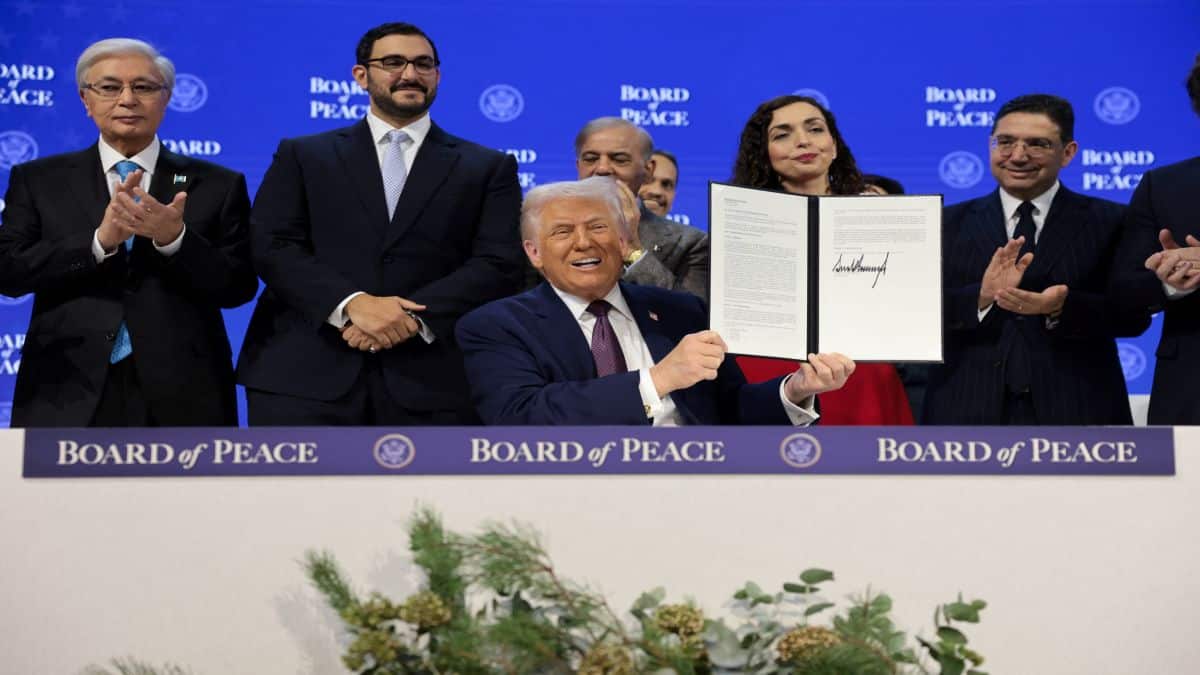
The Board of Peace (BoP), formally launched by President Trump at the World Economic Forum in Davos on January 22, 2026, has been widely characterised by critics as a “vanity project” and a manifestation of Trump’s personal power and ego. While originally endorsed by UN Security Council Resolution 2803 to oversee Gaza’s post-war reconstruction, the board’s new charter has mutated into a broader global governance mechanism that many observers argue is designed to centre around Trump himself.
The charter explicitly names Donald Trump as the inaugural chairman, a position he will hold for life or until voluntary resignation, even after he leaves the White House. Trump holds sole power to invite or dismiss member countries, set agendas, issue resolutions, and exercise a tie-breaking “veto power” over all decisions.
Permanent membership on the board requires a $1 billion contribution within the first year. Countries that do not pay are limited to three-year terms subject to the chairman’s renewal. The board’s executive is dominated by Trump’s family members and political allies, including Jared Kushner, Marco Rubio, and Steve Witkoff. Former British Prime Minister Tony Blair will also be on the board.
Trump invited approximately 60 world leaders to join the founding body. The launch has been met with a mix of enthusiastic support from allies and scepticism from others. Leaders from Argentina (Javier Milei), Hungary (Viktor Orbán) and Pakistan (Shehbaz Sharif) signed the charter. While Israel, Egypt, Morocco and several Gulf states like Saudi Arabia, the UAE and Bahrain have also joined, the inclusion of autocratic leaders has led some to describe it as a “club of autocrats”.
Major G7 allies, including the UK, France, and Germany, have largely stayed on the sidelines or declined invitations. Russian President Vladimir Putin was invited and is reportedly “studying the details”. Ukrainian President Volodymyr Zelenskyy confirmed receipt of an invitation but expressed difficulty in joining a board alongside Russia. Some leaders, such as Italian Prime Minister Giorgia Meloni, stated that joining such a board would be incompatible with their national constitutions.
Trump himself stated that the board “might” replace the UN because it “never helped” him. Major Western allies like the UK, France, Norway, and Sweden have declined or raised serious concerns about its compatibility with international law. The Guardian newspaper described it as a “privatised UN with one shareholder: the US president”.
France stated the board’s charter “contradicts” the UN Charter and raises “major questions” about respect for international governance structures. As a permanent member of the UN Security Council, France emphasised that the UN remains the “keystone of effective multilateralism” and cannot be bypassed or supplanted. Paris criticised the board’s charter for extending “beyond the sole framework of Gaza”, noting it lacked a specific “Gaza mandate” and appeared to establish a global authority with broad, powers. French officials expressed concern over the board’s funding model, which requires member nations to contribute $1 billion in cash to secure permanent membership.
The UK has also officially declined to sign the charter for President Donald Trump’s ‘Board of Peace’. UK officials are wary that the board’s charter does not explicitly mention Palestinian territories and appears to grant Trump sweeping decision-making powers. Foreign Secretary Yvette Cooper stated that the UK will not join due to the invitation extended to Russian President Vladimir Putin. She argued that it is inappropriate to involve Putin in a peace initiative while there is no evidence of his commitment to ending the war in Ukraine.
Cooper described the proposal as a “legal treaty that raises much broader issues” beyond its original focus on Gaza. Prime Minister Keir Starmer has emphasised a “common sense pragmatism”. While the UK supports the 20-point peace plan for Gaza endorsed by the UN, it remains sceptical of the board’s structure and its potential to undermine or replace the United Nations.
Germany has officially declined to join Trump’s proposed Board of Peace in its current form. Berlin views the board as a “counter-draft” to the United Nations. German officials were also reportedly surprised by the document’s content. Although originally envisioned to manage a Gaza ceasefire, the final charter proposes a permanent international organisation with a mandate to resolve global conflicts.
Germany remains committed to a multilateral international order with the UN Charter at its core and believes that the new body undermines existing institutions. The invitation extended to Russian President Vladimir Putin has also unnerved Germany, as it complicates efforts to address the ongoing conflict in Ukraine and broader European security.
Trump’s egoistic behaviour is also characterised by an extreme intolerance for criticism or dissent, and an example of this is how Trump has reacted to Canada’s comments on their bilateral relationship.
On January 22, 2026, President Donald Trump officially uninvited Canada from his proposed Board of Peace. Trump rescinded the invitation via a post on Truth Social, formally notifying Carney that the board was withdrawing its offer. The withdrawal of the invitation followed a series of public disputes between Trump and Canadian Prime Minister Mark Carney.
The uninviting occurred just hours after Prime Minister Carney hit back at Trump’s claim made at the World Economic Forum in Davos that “Canada lives because of the United States”. Carney responded by stating, “Canada doesn’t live because of the United States. Canada thrives because we are Canadian.”
During his address in Davos, Trump had complained that Canada should be “grateful” to the US and specifically warned Carney to remember that the next time he made public statements. Relations between the two leaders have been strained by Trump’s recent suggestion that Canada be annexed as the “51st state” and ongoing trade disputes involving tariffs.
India has not yet joined Trump’s Board of Peace, choosing instead a “wait and watch” approach. While India received an official invitation and has not formally declined, it was notably absent from the signing ceremony held on January 22, 2026, at the World Economic Forum in Davos. India’s decision to remain non-committal is driven by several strategic, legal, and geopolitical concerns.
First, New Delhi is wary of the BoP’s potential to bypass or weaken the existing United Nations framework. India has historically insisted that international peacekeeping and reconstruction efforts must occur under a UN mandate. The fact that several key partners of the US, including France, Germany, and the UK, have decided not to join has led India to question the board’s global legitimacy and whether it will survive beyond the current Trump administration.
Second, India seeks to maintain its independent foreign policy, avoiding becoming an instrument of unilateral US initiatives that may have unclear legal standing or decision-making processes. Thus, India would not like to take any action which could erode its strategic autonomy.
Third, the board includes Israeli leadership but excludes Palestinian leadership, which conflicts with India’s long-standing support for a negotiated two-state solution and Palestinian self-determination. Moreover, the “permanent” membership on the board reportedly requires a $1 billion contribution to a reconstruction fund, creating concerns that the initiative is more transactional than humanitarian.
Fourth, Pakistan formally joined the BoP at the Davos ceremony. India is cautious about sharing a diplomatic platform with Pakistan, especially given concerns that the board’s broad mandate could eventually be expanded by Trump to include the Kashmir dispute.
During his debut appearance at the World Economic Forum (WEF) in Davos on January 22, 2026, Elon Musk mocked President Donald Trump’s ‘Board of Peace’ by using a pun to suggest it was more about territorial acquisition than global harmony. Musk questioned the spelling of the initiative, asking the audience, “I heard about the formation of the peace summit and I was like, is that, is that p-i-e-c-e?” He followed the pun by joking that the board was actually interested in “a little piece of Greenland, a little piece of Venezuela”. Musk concluded by laughing and stating, “All we want is a piece,” directly lampooning Trump’s previous high-profile interest in “controlling” Greenland.
While Musk appeared to be cracking a joke, he was exactly right in his comments and his assessment of Trumpism, especially due to developments relating to Venezuela and Greenland. Donald Trump’s foreign policy involves both direct military intervention and aggressive economic coercion to secure strategic territory and resources. The US military operation in Venezuela that resulted in the capture of President Nicolás Maduro and his wife has been labelled as an action not of peace but a violation of international law and an act of “imperial aggression”. Trump explicitly cited the need to control Venezuela’s oil infrastructure, to recoup “stolen oil money” and to benefit US firms.
In his speech at the World Economic Forum in Davos on January 21, 2026, Trump stated he “won’t use force” to acquire Greenland, reversing previous threats that had included military action. Thus, the immediate military threat to Greenland appears to have been temporarily averted.
However, Trump continues to demand eventual ownership and has issued veiled warnings to those who refuse him (stating that the US will “remember” their refusal). It cannot be ruled out that he may re-escalate his demands if negotiations do not yield the “ownership” he seeks. Thus, Trump’s persistent demands for Greenland are a long-term risk to regional stability.
Summing up, Trump’s Board of Peace will function more like an “imperial court” than a multilateral diplomatic body. Trump will serve as the inaugural chairman with no specified term limits, granting him potentially lifetime control. The chairman will hold “final authority” regarding the interpretation of the charter and has veto power over all decisions.
While Trump said that the board would work “in conjunction” with the United Nations, critics view it as a US-led rival to the UN Security Council. Trump maintains the board is a “nimble and effective” body that can achieve peace where traditional diplomacy has failed, but many analysts are questioning its long-term viability and describing it as a “non-starter”.
(The writer is a retired Indian diplomat and had previously served as Ambassador in Kuwait and Morocco and as Consul General in New York. Views expressed in the above piece are personal and solely those of the author. They do not necessarily reflect Firstpost’s views.)

