



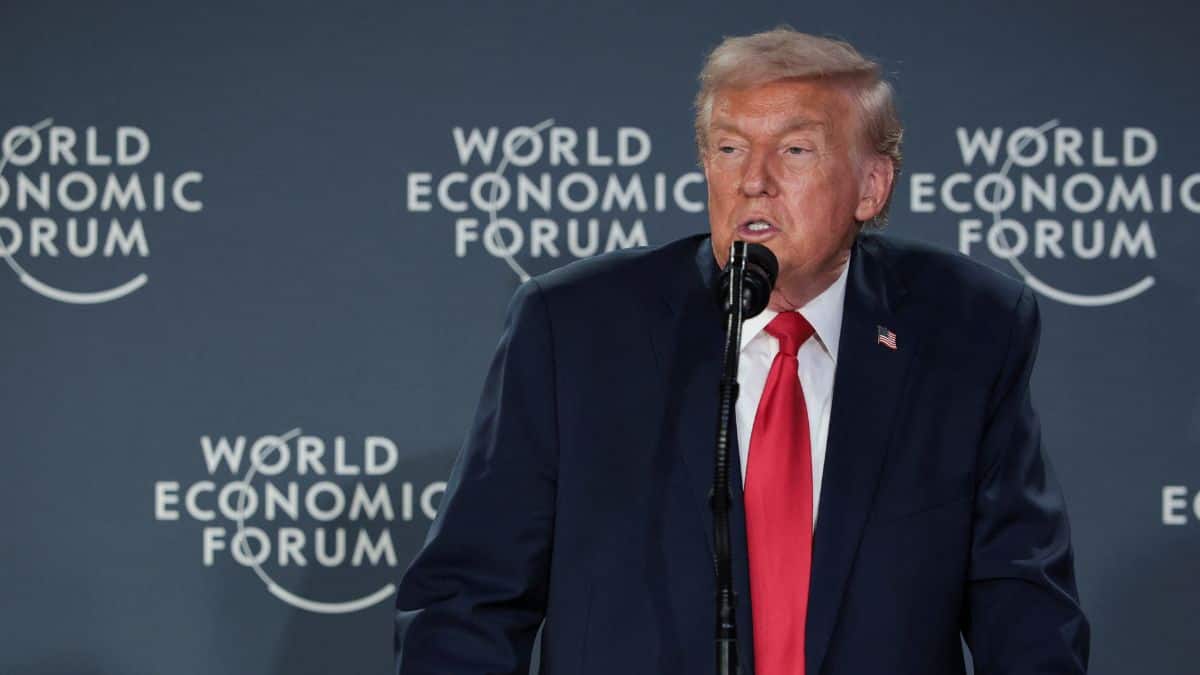
Soon after the sensational kidnapping of Venezuelan President Nicolas Maduro, US President Donald Trump wasted no time in reminding the world that American power under his leadership is no longer constrained by diplomatic niceties or international conventions.
Emboldened by what he views as a successful covert operation in Venezuela, Trump renewed his threat to annex Greenland, the semi-autonomous territory of Denmark. With characteristic bravado, he declared, “If we don’t do it the easy way, we’re going to do it the hard way.” Thus was born the “Donroe Doctrine”, Trump’s 21st-century reinterpretation of the 19th-century Monroe Doctrine, which asserted America’s dominance over the Western Hemisphere.
This time, however, Trump’s ambitions stretch beyond Latin America and into the icy frontiers of the Arctic. Alarmed by his open threats, Danish and Greenlandic foreign ministers are preparing to meet US Vice President JD Vance and Secretary of State Marco Rubio in Washington.
Greenland has repeatedly insisted it is not for sale, while Denmark has warned that any American military action would effectively kill Nato, of which Denmark is a founding member.
On the eve of these talks, Greenland’s Prime Minister Jens-Frederik Nielsen stated unequivocally that his people would choose Denmark over the US if forced to decide. That alone signals how bleak the prospects are for a diplomatic resolution.
Trump’s Desperation
Trump first floated the idea of purchasing Greenland in 2019 during his first term, when many dismissed it as a joke. But the former real estate mogul never jokes about land. Greenland is the world’s largest island, nearly two-thirds the size of India and six times larger than Germany. Beneath its frozen surface lie massive untapped reserves of oil, gas, and critical minerals.
In his second term, Trump is no longer coy about his intentions. He has openly stated that America needs Greenland’s rare-earth minerals – cobalt, lithium, graphite, and other strategic elements – to reduce its dependence on China. Beijing currently dominates global supply chains for these minerals, which are essential for electric vehicles, renewable energy, and defence technologies. For Trump, acquiring Greenland is not merely about territory; it is about breaking China’s strategic stranglehold.
Strategic Interests in the Arctic
Lately, Trump has emphasised security concerns even more than economic ones. He argues that American ownership of Greenland would dramatically expand US military reach in the Arctic and curb Chinese and Russian influence in a region increasingly vital to global power equations.
Geographically, Greenland is a strategic gem. Positioned between North America and the Arctic, it offers ideal locations for early-warning missile systems and maritime surveillance. However, Denmark and Greenland rightly point out that the US does not need to own the territory to benefit from it militarily.
America already operates Pituffik Space Base (formerly Thule Air Base) in Greenland, in place since World War II. The base plays a crucial role in missile detection and space surveillance. Under existing treaties, the US faces no restrictions on expanding its military presence there. Washington also plans to modernise the base as part of the proposed “Golden Dome” missile defence system, which includes space-based components.
In fact, Denmark and Greenland have expressed willingness to allow greater American investment and participation in resource exploration. Ownership, therefore, is not a strategic necessity; it is a political obsession.
Greenlanders Refuse
Trump has tried to woo Greenlanders with money. Addressing Congress last year, he promised safety, prosperity, and unprecedented development. US officials even floated the idea of paying $100,000 to every inhabitant of Greenland. But the response from Nuuk, the capital, has been overwhelmingly hostile. “Greenland is not for sale” t-shirts are flying off shelves.
The indigenous Inuit population distrusts Washington. Having endured three centuries of Danish colonial rule, including forced “re-education” and mass sterilisation programmes in the 1960s and 1970s, they are wary of trading one master for another. Many also fear losing free healthcare and education under America’s profit-driven system. The proposed cash handouts would vanish quickly, while structural insecurity would remain.
Trump Wants to Make History
The US has a long tradition of territorial expansion: Alaska from Russia, Louisiana from France, and Florida from Spain. Even Greenland was targeted before: in 1946, President Harry Truman offered $100 million in gold, which Denmark rejected.
If Trump succeeds, it would be the largest territorial acquisition in US history. Political historians Peter Baker and Susan Glasser argue that it could place Trump alongside William Seward, who bought Alaska. For a man obsessed with legacy, Greenland represents his ticket into the history books.
A Direct Threat to Nato
Trump’s belligerence has rattled European capitals. Under Article 5 of the Nato treaty, an attack on one member is considered an attack on all. If the US uses force against Denmark to seize Greenland, Nato would effectively collapse.
The hypocrisy is staggering. The same European powers loudly condemn Russia for Ukraine while staying silent about Trump’s threats. Had a non-Western nation threatened to invade another sovereign country, sanctions would have followed immediately. But Europe’s dependence on American security has rendered it toothless. Eighty years after World War II, it still cannot defend itself.
This cowardice exposes Nato’s moral bankruptcy. Supporting Ukraine against Russian “aggression” while ignoring American imperialism makes a mockery of international law.
Trump’s Contempt for Legal Order
Trump has made it clear he considers international law irrelevant. Last week, he told the New York Times that his only restraint is his own morality. That should terrify the world.
After Maduro’s abduction, his aide Stephen Miller bluntly told CNN: “The real world is governed by strength, force, and power.” This brutal realism defines the Trump doctrine. Rules are for the weak; power belongs to those who dare to use it.
In this context, military action against Greenland would not be shocking – just another chapter in Trump’s imperial project.
Implications for India
India may be geographically distant from Greenland, but it cannot ignore developments in the Arctic. In 2008, India established its first Arctic research station in Svalbard, Norway, and later became an observer in the Arctic Council. However, the region remains dominated by Russia, China, the US, and Nato countries.
During President Putin’s recent visit to India, New Delhi and Moscow signed a security agreement granting access to each other’s naval facilities, including Russian Arctic bases. Trump’s potential takeover of Greenland would dramatically expand America’s Arctic footprint, complicating this arrangement and India’s ambitions.
Yet every crisis also presents opportunity. Improved ties with the Trump administration could open doors for India in Greenland. The recent announcement by US Ambassador Sergio Gor that India will be invited to join “Pax Silica”, America’s initiative to secure AI and semiconductor supply chains, is encouraging. It signals Washington’s recognition of India as a strategic partner.
This cooperation could extend to critical minerals and Arctic exploration. If India plays its cards right, it could leverage Trump’s Greenland obsession to secure resource access and technological partnerships.
Conclusion
Trump’s Donroe Doctrine marks a dangerous return to raw power politics. From Caracas to Nuuk, he is redrawing red lines with military bravado. Greenland is not just about minerals or missiles; it is about Trump’s desire to dominate history itself.
For Denmark and Greenland, the road ahead is grim. For Nato, this could be an existential crisis. And for the world, it is a reminder that the empire never truly died; it merely changed its language.
India must remain vigilant. As global power equations shift, New Delhi should pursue strategic autonomy while exploiting emerging opportunities. The Arctic may be frozen, but geopolitics there is heating up fast.
(The writer is a techie, political analyst, and author. He pens national, geopolitical, and social issues. His social media handle is @prosenjitnth. Views expressed in the above piece are personal and solely those of the author. They do not necessarily reflect Firstpost’s views.)
End of Article

