



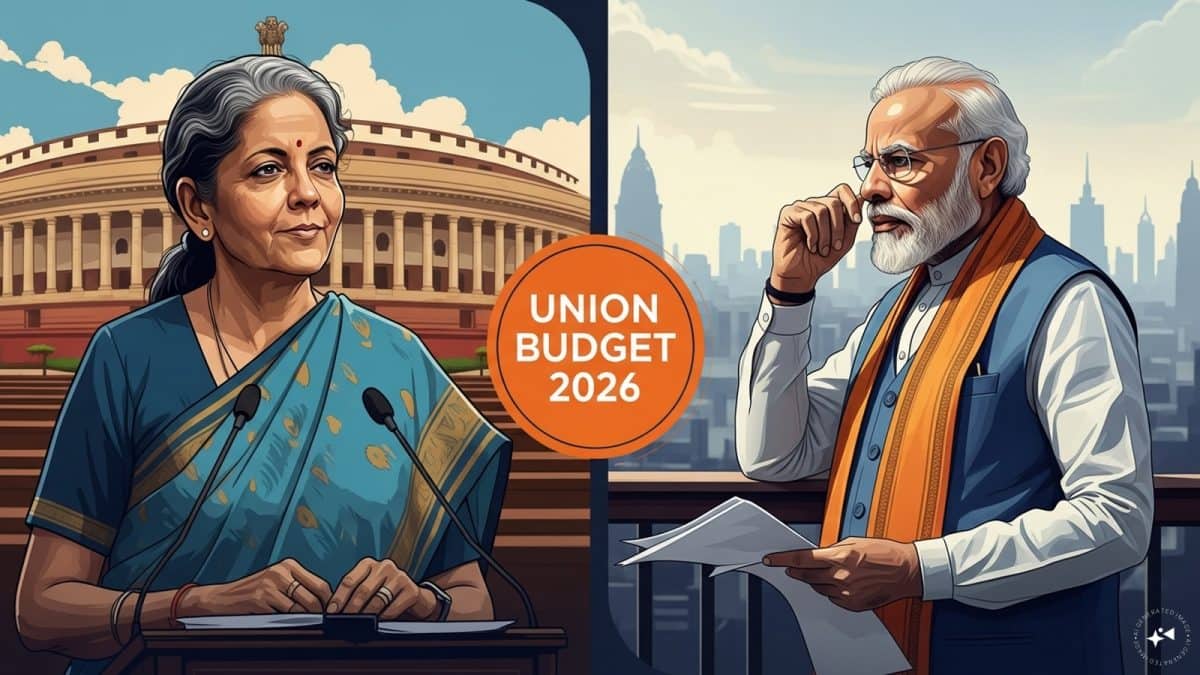
In a world where trade is fragmenting, supply chains are being rewritten, and new technologies are compressing business cycles, the easiest response for any government is to slow down, hedge, and postpone hard decisions. This budget does the opposite. It argues—implicitly and repeatedly—that India’s best hedge against global volatility is domestic capability, competitive openness, and fiscal credibility. This pragmatic triad sits at the heart of the Viksit Bharat journey.
The Finance Minister frames the last decade as one of stability, discipline, growth, and moderate inflation, built through “action over ambivalence” and reforms that strengthen jobs, productivity, and household purchasing power. The point is not nostalgia; it’s a signal to markets and citizens alike: we know what worked—now we scale it.
What makes Budget 2026–27 particularly interesting is the way it is structured: not as a scattered list of sops, but around a clear governing logic—the three “Kartavya” (duties): (1) accelerate and sustain growth, (2) fulfil aspirations and build capacity, and (3) ensure broad access and participation. It’s a budget that answers three big questions at once: How do we grow faster? How do we prepare our people for that growth? And how do we make sure the gains are widely shared?
Growth: Manufacturing Depth, Infrastructure Momentum, and City-Scale Competitiveness
The Budget’s growth engine is built on scale, clusters, and capability. The government highlights “over 350 reforms” rolled out after the 2025 Independence Day announcement—a deliberate reminder that reform is now treated as continuous delivery, not a one-off event. If Viksit Bharat is the destination, reforms are not milestones; they are the highway.
On manufacturing, the speech focuses on strategic sectors where supply chains will define geopolitical power: biopharma, semiconductors, electronic components, rare earths, chemicals, capital goods, and textiles. The approach integrates fibre, cluster modernisation, sustainability, and skilling.
Two announcements stand out for their long-term intent:
Biopharma Shakti: ₹10,000 crore over five years to build India as a biologics and biosimilars hub, supported by upgraded National Institute of Pharmaceutical Education and Research capacity, a network of 1,000+ clinical trial sites, and a strengthened Central Drugs Standard Control Organization.
ISM 2.0: Building on the India Semiconductor Mission to push equipment, materials, and Indian IP, reinforcing that “Make in India” increasingly means “Design and build core tech in India.”
Additionally, electronics components outlay rises to ₹40,000 crore, rare earth corridors are being developed in mineral-rich states, and new schemes for construction equipment and container manufacturing are announced. India is moving from assembly to ecosystems.
Infrastructure remains a second growth flywheel, with public capex proposed at ₹12.2 lakh crore—a continuation of the “capex-led crowding in” strategy. Importantly, an Infrastructure Risk Guarantee Fund will provide partial credit guarantees during the riskiest phases of projects, reducing the cost of private capital by de-risking execution.
Logistics improvements target multi-modal competitiveness: new dedicated freight corridors, expanded waterways, and a push for coastal cargo to increase modal share over time. City Economic Regions (CERs) are being introduced with meaningful allocations to shape regional “growth engines”. As the Budget notes, growth is not being chased—it is being engineered as the default outcome.
Capacity: A Services-Led Jobs Strategy for the AI Era
The second Kartavya is explicitly people-first. Nearly 25 crore individuals have moved out of multidimensional poverty through sustained reforms. The forward plan emphasises services-sector growth, proposing a high-powered “Education to Employment and Enterprise” committee that aims for a 10% global share by 2047 and explicitly examines the impact of AI on jobs and skilling. AI disruption is treated as a policy variable to manage, not a storm to endure.
Sector-specific initiatives include:
-
100,000 additional allied health professionals over five years, plus 1.5 lakh caregivers trained in the coming year.
-
Five regional medical hubs for medical value tourism.
-
Expanded Ayush institutions and labs to meet global demand.
-
Scaling the “Orange economy” via AVGC labs in schools and colleges and a new design institute.
-
University townships near industrial/logistics corridors and girls’ hostels in every district.
As the Budget emphasises, “Viksit Bharat will not be built by capital alone; it will be built by capability—at scale.”
Inclusion: Farmers, Women Entrepreneurs, Divyangjan, Mental Health, and Regional Balance
The third Kartavya embeds inclusion into programme design: farmer income diversification, women-led enterprise retail (“She-Marts”), Divyangjan skilling and assistive device access, and mental health and trauma care, including a proposed NIMHANS2 and upgrades to regional institutes.
In agriculture, Bharat-Vistaar, a multilingual AI tool integrating AgriStack and ICAR practices, will deliver customised advisories, raising productivity and resilience among small farmers. Inclusion is not a footnote—it is a growth strategy. “A nation cannot compound prosperity with half its potential left idle.”
Fiscal Credibility and Tax Architecture: Reforming the State for Speed
A visionary budget requires fiscal discipline. Debt-to-GDP is declining to 55.6 per cent in Budget Estimate 2026–27, with a fiscal deficit of 4.3 per cent of GDP, maintaining macro stability while preserving room for priority spending.
Tax reforms simplify rules and forms under the Income Tax Act, 2025, effective 1 April 2026. Measures like lower TCS for education/medical remittances, tax holidays for qualifying foreign cloud providers, customs simplification, energy-transition exemptions, and reduced duties on personal-use imports all aim to modernise enforcement and enhance competitiveness.
Conclusion: Institutionalising Growth and Opportunity
Budget 2026–27 does not merely announce growth; it institutionalises it through industrial ecosystems, de-risked private investment, city-scale economic regions, and a national skilling agenda. Its central philosophy: pragmatism enables ambition. India stays on track to create a Viksit Bharat not by waiting for the world to stabilise, but by making India resilient, competitive, and opportunity-rich—one reform, one corridor, one cluster, and one capable citizen at a time.
(Aditya Pittie is an angel investor, author, policy thought leader, and entrepreneur. Views expressed in the above piece are personal and solely those of the author. They do not necessarily reflect Firstpost’s views.)
End of Article

