



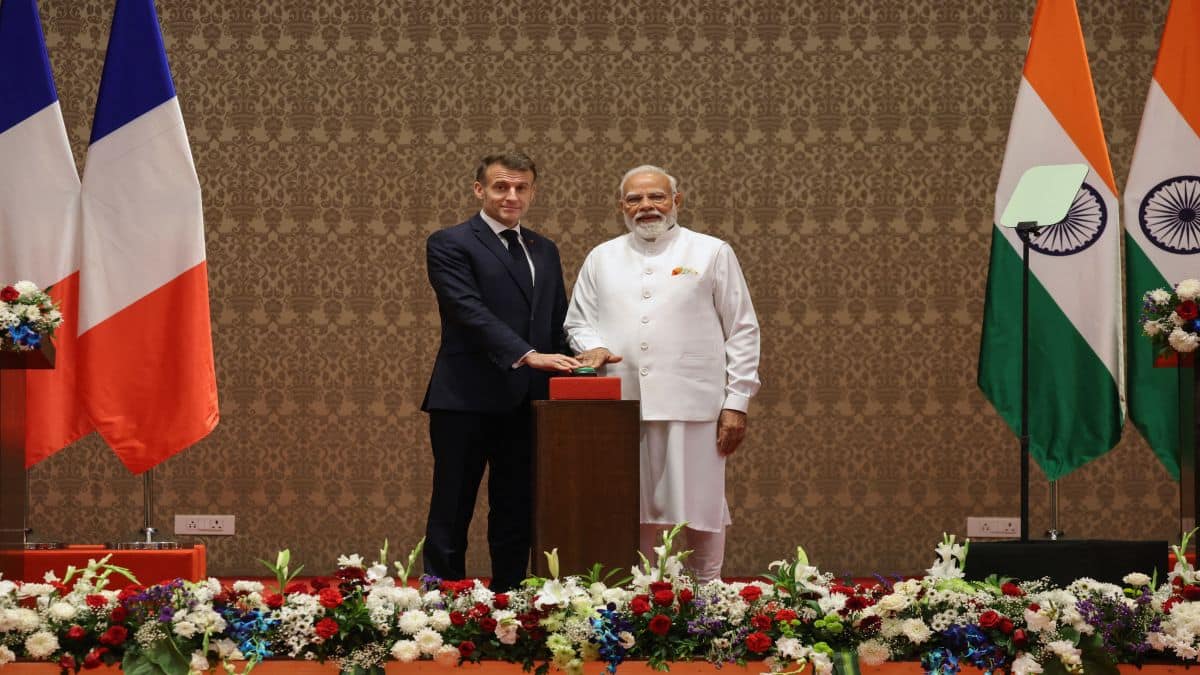
When French President Emmanuel Macron stepped out for an early jog along Marine Drive, it was more than a personal fitness ritual. It was a subtle but powerful symbol. Marine Drive is not merely a promenade; it is a metaphor for Mumbai’s resilience, India’s economic dynamism, and the country’s quiet confidence in its own security architecture.
To see the French President running freely along the Queen’s Necklace in 2026 evokes an unspoken comparison with the dark days of 26/11. The contrast is stark. What was once a city under siege is now a global hub that hosts leaders without anxiety, conducting diplomacy amid an atmosphere of normalcy and assurance. In international politics, optics matter. This was optics done right.
It set the tone for a visit that is not transactional but anchored in continuity. Among Western partners, India’s relationship with France has arguably been the least encumbered by volatility. There have been no sudden strategic reversals, no public recriminations, no abrupt policy pivots. Instead, the partnership has evolved steadily across governments in both capitals.
That consistency is a strategic asset. Enduring relationships in international affairs are rare. When they exist, they enable long-term investments — political, military, technological and psychological. France has repeatedly demonstrated that it views India not as a tactical lever but as a structural partner in shaping a multipolar world.
The warmth between Prime Minister Narendra Modi and President Macron is not merely personal chemistry. It reflects a deeper convergence. France has supported India’s quest for strategic autonomy, whether in the Indo-Pacific, counter-terrorism forums or advanced technology domains. Paris has not sought to subsume India into alliance politics; instead, it has treated New Delhi as a peer with independent agency. That mutual respect has removed many of the irritants that often plague major-power relationships.
Defence cooperation remains the spine of this engagement, and here the potential acquisition of 114 additional Rafales looms large. The earlier induction of the Dassault Rafale into the Indian Air Force was not merely a procurement decision; it was a statement of trust. The aircraft has since integrated seamlessly into operational structures, enhancing air dominance, deterrence and precision-strike capabilities.
A follow-on order of 114 aircraft, if finalised, would be transformative. It would represent one of the largest defence acquisitions in India’s history and would significantly shape the combat profile of the Indian Air Force for decades. More importantly, it signals French confidence — not only in the platform, but in the professionalism and doctrinal maturity of the Indian Air Force. Paris understands that the Rafale in Indian hands is not simply an export success; it is an operational multiplier deployed by one of the world’s most experienced air forces.
The deal, beyond its headline value, carries industrial implications. Expanded production, deeper technology transfer and potential co-manufacturing align with India’s long-term ambition to strengthen its domestic aerospace ecosystem. France has historically shown greater flexibility in sharing high-end capabilities compared to many Western counterparts. That willingness to move beyond off-the-shelf sales into collaborative frameworks reinforces the perception of France as a dependable partner.
Yet this visit is not confined to hardware. President Macron’s participation in the AI summit underlines the widening arc of cooperation. Artificial intelligence, digital governance and emerging technologies represent the next frontier of strategic partnership. Both India and France seek influence in shaping global norms for AI — balancing innovation with ethical guardrails. Their cooperation in this space positions them not merely as consumers of technology, but as norm-shapers.
Trade and economic engagement have also grown — a less glamorous but equally consequential foundation of the relationship. Bilateral merchandise trade between India and France has steadily expanded over the past decade, crossing $12 billion in recent years and trending upwards even when defence spending is excluded.
India’s exports to France — pharmaceuticals, engineering goods, automotive parts — have diversified, while French investments in India span automobiles, energy, luxury goods and services. The Economic Partnership Agreement between India and the European Union further amplifies France’s role as a gateway to deeper ties with the EU market. Robust trade flows, sustained private-sector engagement and growing French FDI reflect not a fleeting spike but a durable economic relationship.
On the larger geopolitical canvas, the timing of the visit is instructive. India is recalibrating aspects of its relationship with the United States. While ties remain robust, the evolving political landscape in Washington introduces elements of unpredictability. France, by contrast, offers continuity. Paris has long advocated strategic autonomy for Europe and, in doing so, has found natural resonance with India’s own approach to global engagement.
Differences exist, of course — including nuanced divergences on Middle East policy. But these have not translated into friction. The maturity of the India–France relationship allows both sides to hold independent views without jeopardising broader cooperation. That resilience is what distinguishes enduring partnerships from episodic alignments.
The Indo-Pacific dimension further cements the strategic logic. France, with territories and a military presence in the region, is not an external commentator but a resident power. Its naval deployments and security cooperation initiatives dovetail with India’s maritime priorities. Shared exercises, information exchange and maritime domain awareness initiatives have grown steadily, contributing to regional stability.
Macron’s jog, the tribute to the 26/11 victims, the defence discussions and the AI summit appearance together form a narrative arc. It is a story of transformation — from vulnerability to confidence, from episodic engagement to structured partnership, from defence procurement to strategic co-creation.
For India, the visit reinforces a central diplomatic theme: diversification without dilution. New Delhi is not pivoting away from any partner; it is widening its circle. France stands out in that circle as a country whose approach has been free of abrupt shifts. That steadiness enables India to pursue long-term interests without hedging against sudden policy swings.
For France, the engagement affirms its relevance in Asia’s strategic theatre. By deepening defence, technology and political ties with India, Paris anchors itself in one of the fastest-growing major economies and a pivotal Indo-Pacific actor.
In international relations, relationships that endure without turbulence accumulate strategic capital. They allow for risk-sharing, capability-building and joint vision-setting over decades rather than news cycles. The India–France partnership exemplifies that principle.
I wish President Macron had also taken time out from the AI Impact Summit to jog in New Delhi’s Lodhi Garden, Sundar Nursery or Kartavya Path. He would have found many admirers who appreciate what he has contributed to Indo-French relations, which are only set to become stronger.
(The writer is the former Commander of India’s Srinagar-based Chinar Corps. Currently he is the Chancellor of the Central University of Kashmir and a member of the National Disaster Management Authority. Views expressed in the above piece are personal and solely those of the author. They do not necessarily reflect Firstpost’s views.)
End of Article

