



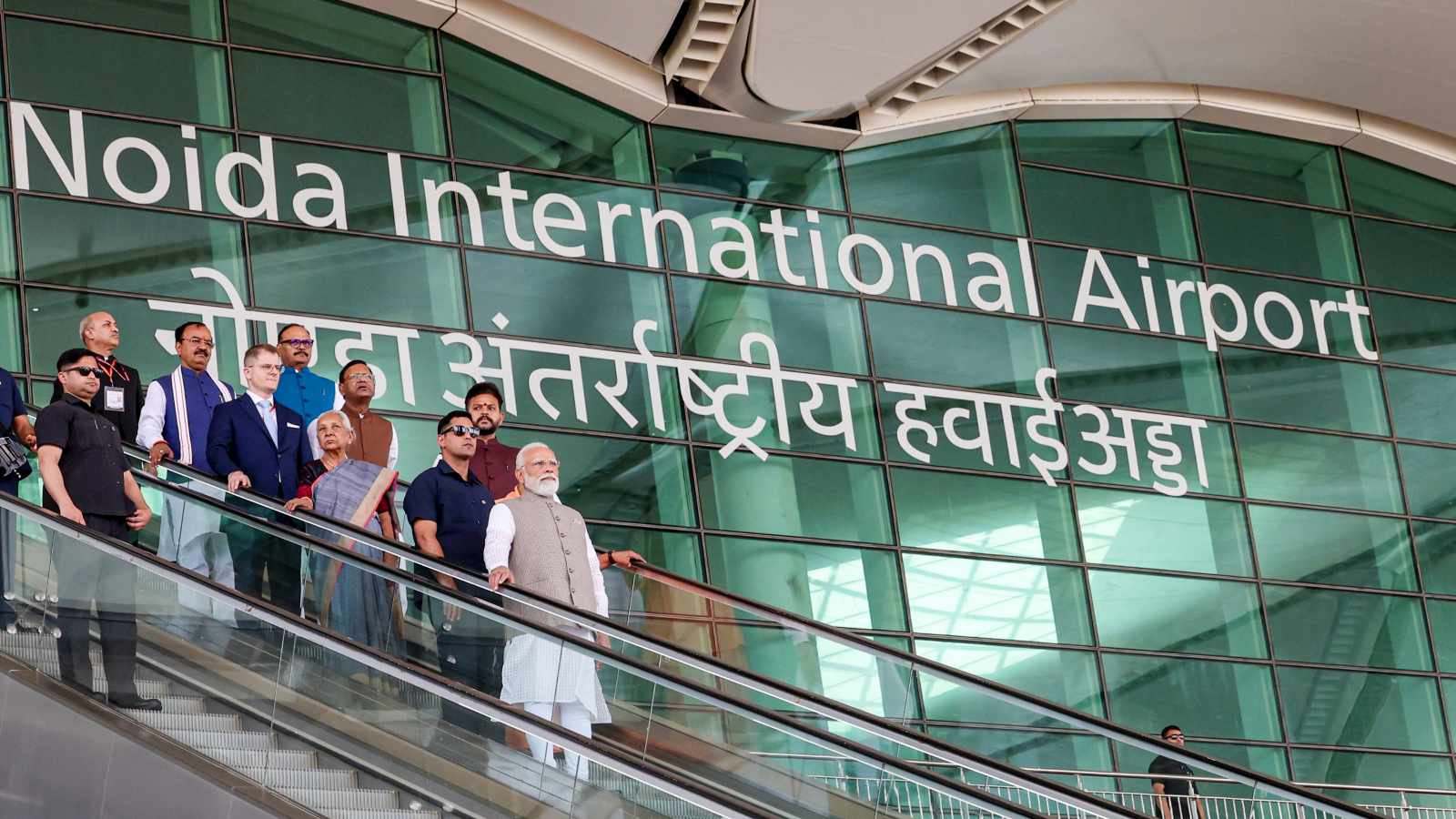
The recent inauguration of the Noida International Airport at Jewar by Prime Minister Narendra Modi was framed not merely as an infrastructure milestone, but as a symbol of a larger developmental vision. In his address, Modi emphasised that such projects would “give wings to progress”, positioning the airport as part of the broader Viksit Bharat trajectory. Yet, beyond the spectacle of inauguration and the rhetoric of potential growth, the airport crystallises a deeper political question that will shape Western Uttar Pradesh in the run-up to the 2027 elections. It’s not simply about who builds development, but who owns, negotiates, and ultimately benefits from it.

For decades, Western Uttar Pradesh has been read through familiar analytical frames ranging from agrarian structures and caste alignments to the afterlives of communal conflict. However, to rely solely on these categories today is to misrecognise the transformation underway. The region is not just electorally significant; it is structurally unsettled. The central political question is no longer reducible to which party will win, but rather who commands the process of change itself.
What we are witnessing today resonates deeply with Karl Polanyi’s notion of the “double movement”. As market forces expand through land commodification, infrastructure corridors, and logistics-led growth, society also produces counter-pressures demanding protection and redistribution. Western UP is precisely such a terrain where the expansion of capital-intensive development coexists with anxieties over displacement, inequality, and loss of social security.
The region is undergoing multiple shifts simultaneously. Agriculture is no longer the sole means of livelihood. Land, once embedded in identity and subsistence, is increasingly treated as a speculative asset. Younger generations are orienting themselves toward non-agrarian futures, while villages are drawn into expanding metropolitan geographies. Yet these transformations are deeply uneven, with some benefiting disproportionately and others adapting with difficulty, and many left navigating precarity. Politics, in this context, becomes less about ideological commitment and more about mediating differentiated experiences of “change”.
One of the most significant consequences of this transition is the erosion of singular political identities. This can be seen in the case of the category of “farmer”. Long treated as a cohesive political subject, it has fragmented internally. Individuals within the same village and often within the same caste now occupy divergent economic positions. A landowner who has profited from highway expansion operates within a different horizon of expectations than a small cultivator facing declining returns, or a landless worker dependent on migration. These differences translate into distinct political rationalities.
Economic development, rather than producing stable political moderation, is generating new cleavages and contingent alignments. Modernisation here is not linear; it is disruptive, uneven, and politically generative. At the centre of this transformation lies land, which is not merely a resource but a site where state policy, private capital, and local aspirations converge. Projects like the Noida airport intensify this convergence. They continuously revalue land, turning it into a volatile economic asset. This produces both opportunity and insecurity. Those who gain from rising land values often align with narratives of rapid development, while those who feel excluded or displaced demand compensation or resistance. Politics thus shifts from a binary of pro- or anti-development to a negotiation over its terms and distribution.
Political parties are responding to this altered terrain in distinct ways. The Bharatiya Janata Party positions itself as the principal architect and manager of change, emphasising infrastructure, connectivity, and investment. The BJP’s narrative is centred on the assumption that transformation is both necessary and ultimately beneficial, even if it produces short-term inequalities. These inequalities need to be mitigated through welfare schemes. Opposition formations such as the Rashtriya Lok Dal and the Samajwadi Party, meanwhile, seek to politicise the unevenness of this change. Leaders like Jayant Chaudhary and Akhilesh Yadav foreground agrarian distress, inclusion, and distributive justice, arguing that change must be negotiated rather than imposed.
Caste, while still salient, is being reconfigured within this evolving political economy. It no longer functions as a stable predictor of political behaviour. Instead, caste identities are increasingly mediated by access to economic opportunity. Members of the same caste may now find themselves politically divided based on their differential experiences of development. Even the enduring imprint of events like the 2013 Muzaffarnagar riots is being refracted through shifting material conditions. Another issue impacting the politics of the region is urbanisation. Western UP is neither fully rural nor fully urban. It exists in a liminal state where villages and expanding cities coexist. Spaces like Ghaziabad and parts of Meerut exemplify this hybridity. Residents navigate overlapping identities, producing a politics where aspiration and anxiety coexist.
This change is more visible in young voters. Less tied to agriculture and more exposed to digital cultures and urban imaginaries, they embody new aspirations around education, employment, and mobility. Yet these aspirations are often unmet, producing volatility in political engagement, less anchored in inherited loyalties and more contingent on issue-based evaluations. Despite these structural shifts, local dynamics remain decisive. Electoral outcomes continue to be shaped by constituency-level issues like land acquisition disputes, access to services, and implementation of welfare schemes. These local experiences can reinforce or disrupt broader narratives, highlighting the layered nature of political contestation.
What makes the present moment particularly significant is that much of this struggle remains understated. Rather than unfolding dramatically, it appears in gradual shifts like changing voting patterns, emerging cleavages, and evolving expectations. This is the “silent struggle” that defines Western Uttar Pradesh today. As 2027 approaches, the region stands at a critical juncture. The election will not merely determine who governs, but which vision of transformation gains legitimacy in the eyes of the voters. Will voters endorse a rapid, state-driven development model that tolerates inequality as a transitional cost? Or will they push for a more negotiated, inclusive pathway? There are no easy answers.
However, it is evident that Western UP can no longer be understood through static categories alone. Its politics is being redefined by the uneven and contested nature of transformation itself.
In the end, the struggle here is not simply about power. It is about ownership of land, of opportunity, and above all, of change. The Noida airport may symbolise the arrival of a new developmental phase. But the politics of Western Uttar Pradesh will be determined by a more difficult question: Who gets to define what that development means and whose experiences are acknowledged as crucial to the future of the region.
Muni is an Assistant Professor at GLA University, Mathura. Buttan is a PhD Scholar at TISS Mumbai

