



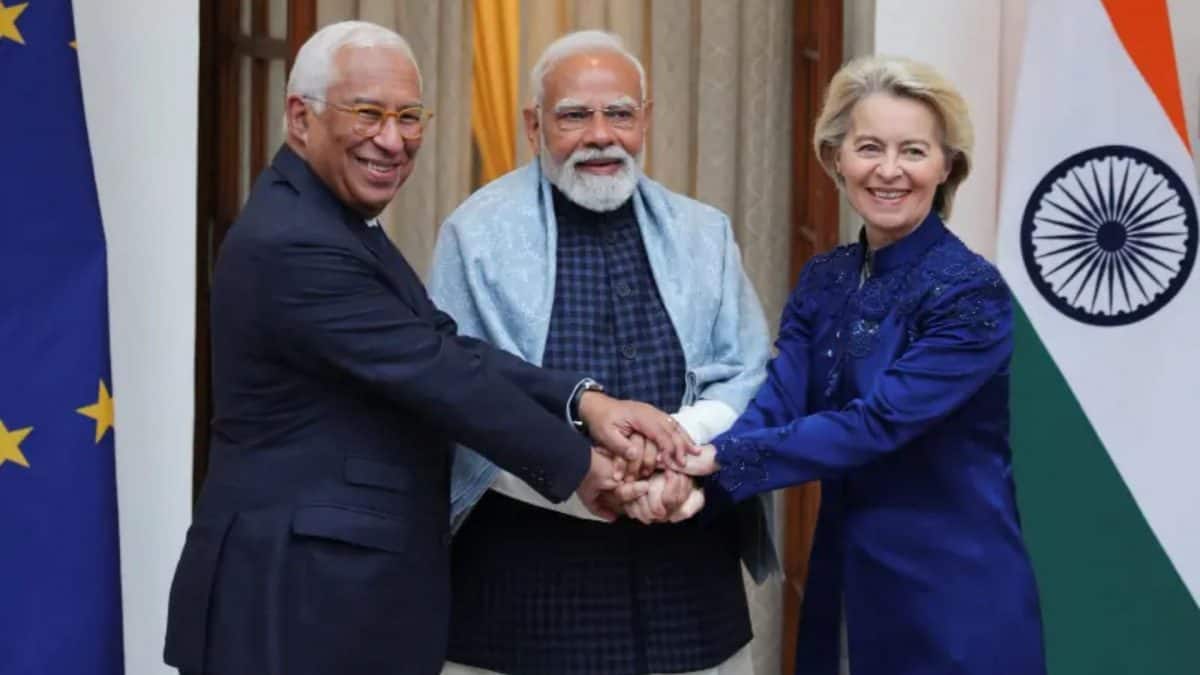
Following the 16th India–EU summit on January 27, a political declaration was signed at the ministerial level, confirming the conclusion of negotiations and agreement on the contents of a free trade agreement. After legal examination and EU ratification, the agreement is expected to enter into force in late 2026.
Economists and trade experts are examining the implications of this FTA for economic interaction, particularly trade flows, between the two sides in the coming years. Our objective is to understand the geopolitical backdrop and broader political dynamics that led to this FTA, the signals it sends to the world, and its likely impact on the relationships among the principal players. What does the FTA say about international politics today?
The Triggers
India and the EU began negotiations for an FTA in 2007 but suspended them in 2013, well before the Modi era began. Even after Narendra Modi became the Prime Minister in 2014, little changed. It was only in June 2022 that threads were picked up, well after India withdrew from the Regional Comprehensive Economic Partnership (Rcep) negotiations at the last minute in November 2019. Gradually, the authorities came to the view that the Indian economy had attained a degree of vitality and maturity that would allow it to compete internationally and that a greater opening of the market would benefit Indian industry. Such thinking put India on the path towards FTA. Besides, as the India-US trade agreement remained stalled through 2025, it prompted New Delhi to give greater impetus to negotiations with the EU.
On the European side, both economic and political considerations supported a trade pact with India. The lure of the vast Indian market was a driver, as was the EU’s desire to balance China’s growing footprint in the European market. Ukraine’s continuing war with Russia caused much dismay and concern for Europe’s economic prospects. Finally, the US handling of transatlantic relations under Trump 2.0 proved the last straw.
Washington’s insistence on weaponising trade, the unilateral imposition of tariffs on its allies, the demand that Europe take charge of its security and increase its share of Nato’s defence budget, and, finally, the acrimonious public row that broke out over the US attempt to “own” Greenland, “either the hard way or the easy way,” convinced the European leaders that the time for decision was now. They were candid in their depiction of the situation in which they found themselves.
“Europe is no longer Washington’s primary centre of gravity,” noted Kaja Kallas, Vice President of the EU Commission and High Representative for Foreign Affairs and Security Policy. She clarified that the EU wanted strong Atlantic ties and that the US would remain Europe’s partner and ally. “But Europe needs to adapt to the new realities.” With the alliance facing severe constraints and the Group of Seven (G7) drifting apart, the second-largest economy found a compelling reason to join forces with the fourth-largest, India. In other words, two rising powers found ample mutual interests and comfort in each other’s arms.
Projection By Two Sides
Instead of relying on interpreters and experts, let us turn to what the European and Indian leaders have said on this historic coming together of the EU and India, and its global impact.
In an interview with an Indian journalist, António Costa, President of the European Council, hit the nail on the head by pointing out that “our trade agreement” is “a very important geopolitical stabiliser and a showcase of how it is possible to protect international rules-based trade.” He also declared that India and the EU are two “very important poles” that are cooperating closely on both trade and strategy. He explained that while the EU does not have its own forces, it has “European missions”, while mentioning India’s significant role in maritime missions – Operation Aspides in the Red Sea and Operation Atlanta in the Mediterranean.
In a similar vein, EU Commission President Ursula von der Leyen, speaking at the Rashtrapati Bhavan banquet, stressed that the India-Europe conversation was about both trade and strategy, i.e., “about more than economics”, adding that “Europe and India are also stepping up strategically.” She noted that political ties between the two sides “have never been stronger.” Agreeing with her, PM Modi observed that cooperation between India and the EU constitutes a “Partnership for the Global Good”. The joint statement has called the FTA “a milestone in India-EU strategic partnership.”
Key Implications
The short point has been that in a fragmented and conflicted world, a big chunk of the G7 and a principal leader of the Global South seek solidarity, stability, and predictability, and respect for international law; they strive to eliminate tariffs instead of imposing or increasing them; and they attempt to contribute to collective security instead of preferring to resolve disputes through the use of coercion and arms. This was indeed a potent and highly relevant message to great powers, such as the US, China, and Russia.
How others, especially in Washington, view this development is of considerable relevance here. U.S. Treasury Secretary Scott Bessent has criticised the EU for concluding a trade deal with India, alleging that Europe is financing the war against itself by purchasing refined Russian oil products from India. Other US officials asserted that, in negotiations with the EU, India secured the upper hand and gained benefits. Expert opinion remains divided on whether the FTA may hasten or hamper the stalled India-US trade agreement.
Finally, some elements of India’s joint statement warrant a close look to discern their geopolitical implications. On the issue of Ukraine, the two sides agreed on a common formulation reaffirming their shared commitment to “sovereignty and territorial integrity”. How will it sit with Russia’s insistence that a substantial part of Ukraine’s territory must be given to Russia as part of a negotiated peace settlement? A reference to reforming the UN Security Council to make it more representative is music to Indian ears, but it is unlikely to see any progress in the foreseeable future.
In West Asia, they have found a way to welcome ‘The Board of Peace’, even as they called for “the two-state solution”. On the Indo-Pacific, they were on the same page, happy to launch the inaugural edition of the forthcoming Consultations on the Indo-Pacific in New Delhi. However, the new US approach to the Indo-Pacific is a challenge in itself.
In effect, India and the EU, through their 16th summit, asserted their foreign policy independence and strategic autonomy from the US. They expressed dissatisfaction with some of its policies but refused to pursue a permanent break. They still hoped that their messages would reach Washington, which then would be more attentive to and respectful of their concerns in the future. Will it?
(Rajiv Bhatia is a Distinguished Fellow at Gateway House Mumbai and a former Indian High Commissioner to Kenya, South Africa, and Lesotho, with extensive diplomatic experience in regional and global groupings. He also served in the Indian Mission to the EU in Brussels. Besides, he is the author of three books on Indian foreign policy. Views expressed in the above piece are personal and solely those of the writer. They do not necessarily reflect Firstpost’s views.)
End of Article

