



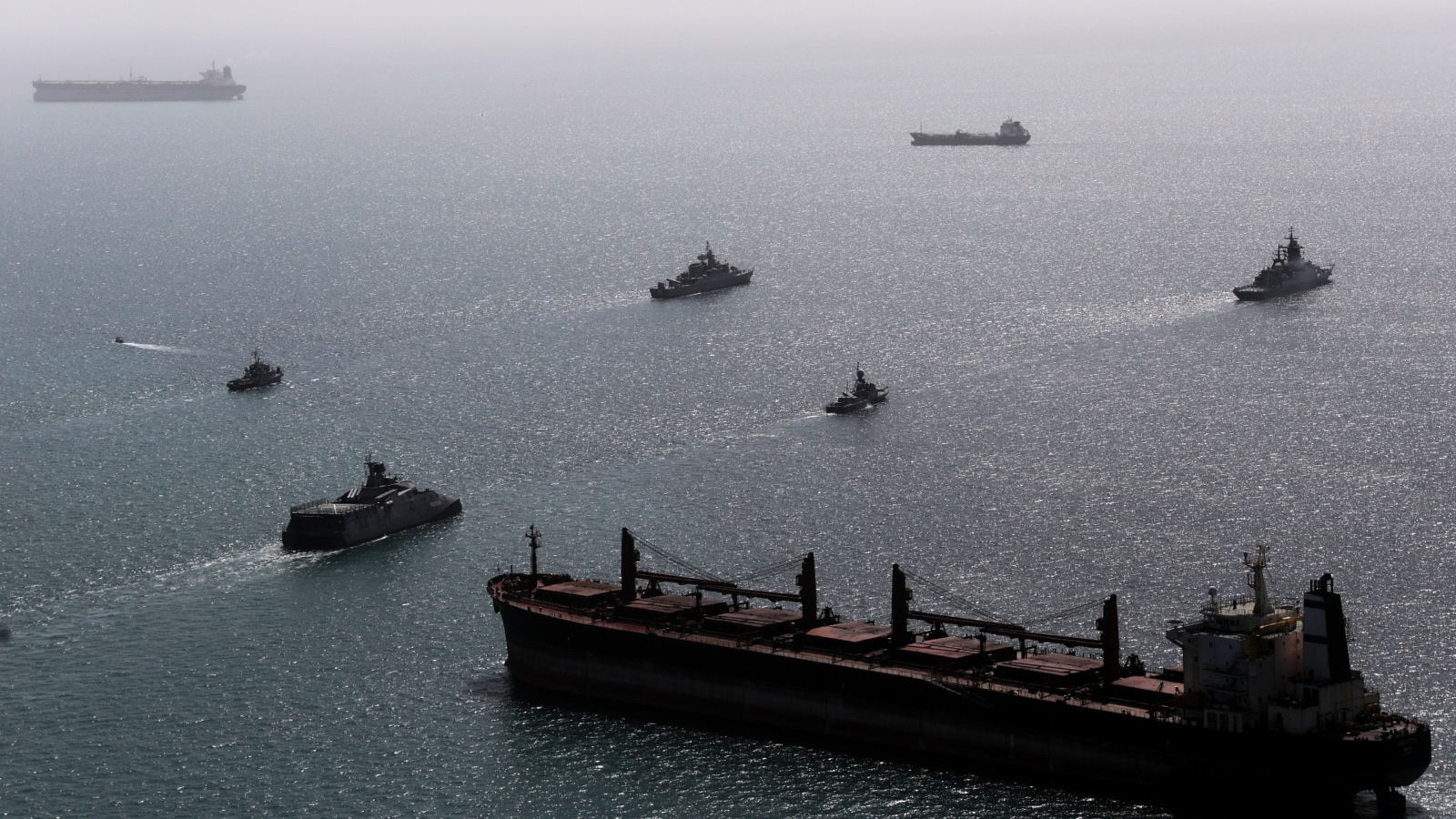
In the early hours of March 4, an Iranian frigate that had recently participated in India’s flagship MILAN naval exercise sank roughly 40 nautical miles south of Sri Lanka. Sri Lankan authorities responded to distress calls reporting a massive underwater explosion. The sinking of the Islamic Republic of Iran Ship (IRIS) Dena means that a warship transiting homeward from a multilateral exercise became a casualty far from the Persian Gulf. Whatever the intent behind the strike, the conflict has moved into the wider Indian Ocean, and the littoral states cannot afford to ignore it.

This incident does not stand alone. Iranian state television has claimed that Revolutionary Guard forces launched missiles at a US Navy warship some 600 kilometres from Iran’s borders in the Indian Ocean, alleging fires onboard. The United States has not confirmed the strike. Meanwhile, Tehran has declared that it has “complete control” over the Strait of Hormuz and warned that vessels transiting the chokepoint risk damage. Washington, in turn, has indicated readiness to escort oil tankers through Gulf shipping routes.
It has also stated that it had destroyed 17 Iranian ships and that its objective was the sinking of “the entire navy”. The US Defence Secretary confirmed that the operation constituted the first American sinking of an enemy ship by torpedo since World War II. At the same time, the Israel Defence Forces indicated that Washington had taken full responsibility for targeting Iran’s maritime activities. This is an inflection point that shows how dramatically the maritime dimension of this conflict has escalated.
Historically, the Indian Ocean has absorbed global rivalries without becoming their central battlefield. Even during the intense Cold War, much of the northern Indian Ocean functioned as a strategic buffer. That insulation now appears thinner, and the structural stakes are significant. The Indian Ocean carries a substantial share of global trade and energy flows linking the Gulf to East Asia. Approximately 80 per cent of global seaborne oil moves across the Indian Ocean. Three critical maritime chokepoints — the Strait of Hormuz, the Strait of Malacca, and Bab el-Mandeb are located along the main shipping routes of the Indian Ocean. Spanning about 70.6 million square kilometres, the ocean links the hydrocarbon-producing Gulf to the industrial economies of East and Southeast Asia. Each year, an estimated 9.8 billion tonnes of cargo transit these waters, accounting for roughly half of global container traffic.
Any disruption, whether through naval escort operations or heightened targeting of warships, reverberates beyond the immediate conflict zone. Submarines, surveillance aircraft, and surface combatants operating in overlapping patterns create compressed decision-making cycles. For littoral states, these dynamics are immediate and pose political pressures. Although Colombo has fulfilled search-and-rescue obligations and safeguarded its maritime responsibilities, it has little interest in being portrayed as a node in someone else’s war.
This episode also revives an older regional aspiration. In the 1970s, Sri Lanka prominently advocated for the first time the idea of the Indian Ocean as a Zone of Peace, seeking to prevent the militarisation of regional waters by external powers. The initiative was never fully realised, and naval conflicts remain a permanent feature of this maritime landscape. But the impulse behind it remains instructive that the Indian Ocean should not serve as an operational extension of distant conflicts.
Today’s legal architecture strengthens that principle. The United Nations Convention on the Law of the Sea establishes navigation rights and responsibilities intended to reduce friction in crowded waters. But law operates most effectively under conditions of restraint. High-seas targeting of naval vessels, expanded missile ranges, and contested claims of chokepoint control test the resilience of that framework.
Even if the waters in question are legally international, they lie within India’s primary sphere of influence. Geography does not confer ownership, but it certainly does confer obligation. If the Indian Ocean begins to host open-ended naval warfare between extra-regional powers, it would raise significant questions regarding India’s credibility as the net security provider in the region.
The challenge, therefore, is two-fold. Operationally, the Indian Ocean littoral states must enhance transparency, information-sharing, and surveillance to minimise miscalculation. Diplomatically, there is a need to strongly signal that the ongoing military conflicts in West Asia should not spill over to the Indian Ocean, as it risks jeopardising global economic stability.
None of this requires unrealistic demilitarisation. Naval presence will persist, and freedom of navigation must continue. But there is a difference between presence and prosecution. If high-seas neutralisation strategies, missile demonstrations, and tanker escort convoys begin to define the maritime environment, escalation could migrate steadily southward.
The Subcontinent’s surrounding waters cannot be sealed off from global conflicts. But neither should they become automatic extensions of wars waged elsewhere. If major powers begin treating the Indian Ocean as a permissive arena for settling distant scores, the risks will not remain confined to regional actors. They will draw in energy markets, naval coalitions, and rival security blocs in ways that widen the conflict beyond its original theatre. Preventing that outcome will require restraint from external powers and coordination among littoral states. The Indian Ocean may not be a literal zone of peace. But it also must not become West Asia’s second front.
The writer is a PhD candidate at the Department of International Relations, Jadavpur University, Kolkata

