



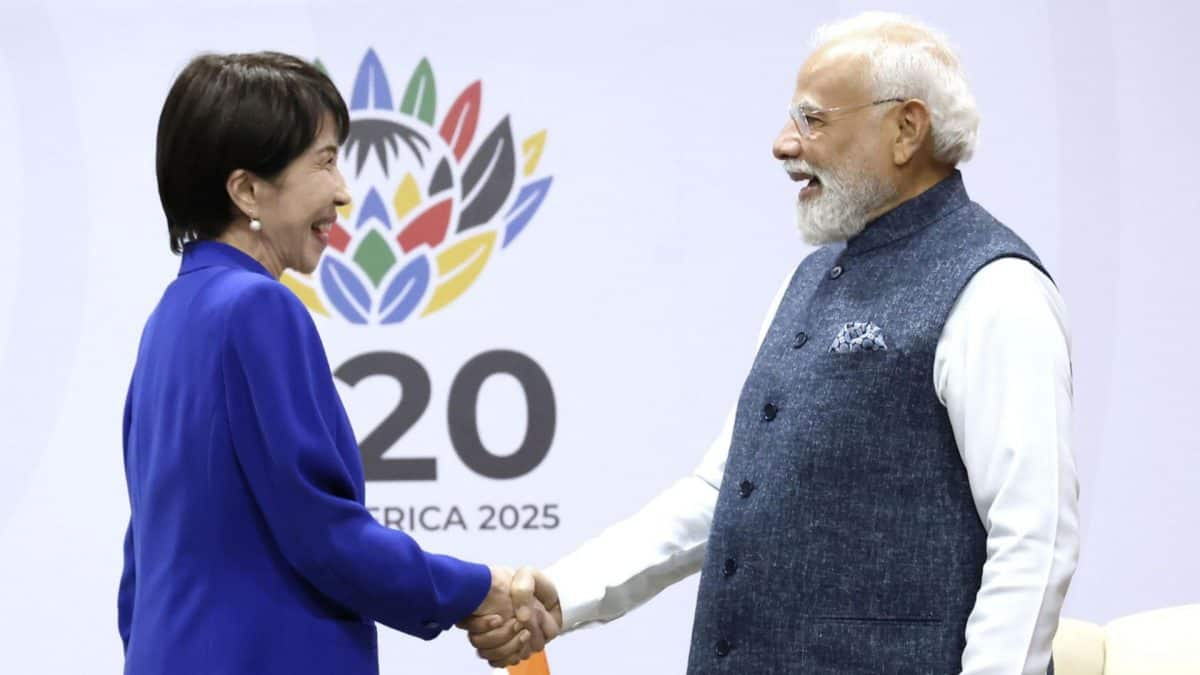
Prime Minister Sanae Takaichi’s commanding electoral victory reassures the India–Japan partnership. Expected to carry forward the legacy of her mentor, the late Shinzo Abe, she inherits a relationship already anchored by Prime Minister Narendra Modi’s November meeting with her in South Africa, where both leaders pledged to advance India-Japan friendship and strengthen the Special Strategic and Global Partnership.
Amid global uncertainty, the priority is reinvigorating economic ties. Bilateral trade has hovered around $23 billion, with India ranking 18th among Japan’s trade partners and Japan 17th for India. As of December 2024, Japanese investment in India stood at $43.28 billion, making Japan the fifth-largest investor—significant growth, though still below potential.
The 2025 Japan Bank of International Cooperation (Jbic) survey ranked India first for four consecutive years in manufacturing and, for the second year running, first in non-manufacturing, supported by over 60 per cent of respondents. The survey covered 1,072 manufacturing firms (50.5 per cent response rate), largely from automobiles, chemicals, electronics and electrical goods, and general machinery, including SMEs. A quarter had production affiliates in India, and over 20 per cent had sales affiliates. Fifty-two per cent expressed satisfaction with operations in India, and a further quarter were more than satisfied.
India ranked second-lowest in average worker wages (with Japan as the benchmark), next to Indonesia. However, inadequate numbers of college graduates and gaps in skilled manpower were cited as weaknesses that could constrain manufacturing and services, underscoring the need for focused skilling and training reforms.
Driven by “China Plus One” risk diversification, Japanese firms remain bullish on overseas expansion. Sectoral expansion intent was strongest in Chemicals (56.5 per cent), Electronics (64.7 per cent) and General Machinery (80.3 per cent). Nearly half (45.8 per cent) aimed to expand in India, compared with 36 per cent in China; 11 firms signalled plans to withdraw from China. Notably, India did not feature among intended exit destinations despite hosting fewer Japanese firms than China.
India retained its top rank as a desirable investment destination, with a record 61.8 per cent (209 companies) linking their future to India. Growth was evident across all four major sectors, with electronics rising sharply under India’s Semiconductor Mission. Among positive factors, 88 per cent cited growth potential and around 40 per cent the current market size; roughly 40 per cent confirmed plans to increase Indian investments. Concerns such as underdeveloped infrastructure and legal execution persist but have improved since the pre-2014 period. Respondents strongly endorsed the government’s infrastructure push under Make in India. The challenge remains persuading the 51 per cent without expansion plans to commit.
Local supply chains now account for 51 per cent of inputs for Japanese firms in India, and 89 per cent of goods produced by Indian subsidiaries are sold domestically—evidence of deepening integration. This trend calls for higher standards and accelerated Make in India efforts to expand India’s vendor base. Maruti Suzuki demonstrates the potential. Companies such as Uniqlo, despite strong Indian demand, source only 15.5 per cent locally (2024), remaining reliant on Vietnam, Bangladesh and China—an opportunity for deeper localisation.
On US tariffs, around 20 per cent of respondents considered diversifying suppliers away from the US, while many preferred relocating networks into the US amid “Buy American” pressures. Only seven cases considered India, mostly shifts from China; more firms looked to Thailand and Vietnam. Nonetheless, diversified manufacturing and local sourcing by Japanese companies are on the rise globally. Indian industry must seize the moment and ensure that domestic supply chains meet the qualitative requirements of Japanese subsidiaries in India.
Sustainability remains uneven. Only 37.7 per cent of manufacturing firms invested in sustainable manufacturing in India, compared with 43.3 per cent in China and 49.2 per cent in Thailand. Among those abstaining, 28 per cent cited higher costs and 23.5 per cent lack of local resources. This suggests that India must strengthen green regulation enforcement and expand its skilled workforce in sustainable development, aligning with Prime Minister Narendra Modi’s 5R framework under Mission LiFE. Initiatives such as the Japan-India Technology Matchmaking Platform (JITMAP), launched in 2016 to promote eco-friendly technologies, deserve renewed emphasis.
In non-manufacturing, 192 firms (25.4 per cent response rate) participated, mainly in wholesale marketing (27.6 per cent), construction (14.1 per cent) and transportation (12.5 per cent). Although only 26.2 per cent currently operate in India, 41.7 per cent view it as a promising medium-term base, and over 60 per cent rated their Indian performance highly.
Construction firms performed strongly amid infrastructure expansion. Beyond long-standing players like Komatsu and Shimizu, Sumitomo Corporation recently formed the first Japanese real-estate joint venture with India’s Krishna Group in Gurugram. One-third of wholesale respondents expressed interest in entering India, reflecting Make in India’s momentum. Ventures such as Asuku India and Arahata-en illustrate niche success. Streamlining Bureau of Indian Standards certification could further ease entry.
Overall, Japan Inc’s confidence in India is rising: many transportation and construction firms are reinvesting profits locally. Logistics majors such as Nissin Transportation and Seino Holdings are pursuing Indian joint ventures, with Seino partnering with Mahindra Logistics in 2024. Power and gas firms are also assessing India despite market concentration. Osaka Gas (CNG networks across 12 sites in South India and Rajasthan, 2021) and Shizuoka Gas (CNG supply in Gujarat and Punjab) offer instructive precedents.
Prospects for stronger India-Japan ties are favourable, with the next summit expected to take place in India ahead of the 75th anniversary of diplomatic relations in 2027. Following India’s recent trade agreements with the European Union, the United Kingdom, Oman, New Zealand and Australia, and a framework for an interim trade agreement with the US as well, the moment is ripe to revisit the 2011 India-Japan Comprehensive Economic Partnership Agreement (CEPA) to strengthen goods trade, rules of origin and services.
The Jbic findings are optimistic and show Japanese firms steadily shedding hesitation and placing long-term bets on the Indian economy. Remaining barriers—particularly in dual-use technologies such as carbon fibre used in drones and unmanned systems—must be addressed at a time when both sides have expressed a desire to deepen cooperation in the defence sector. A forward-looking reset can ensure that the partnership reaches its full potential.
(The writer, a former Ambassador to Japan, is the Director General of the Manohar Parrikar Institute for Defence Studies and Analyses. Views expressed in the above piece are personal and solely those of the author. They do not necessarily reflect Firstpost’s views.)
End of Article

