



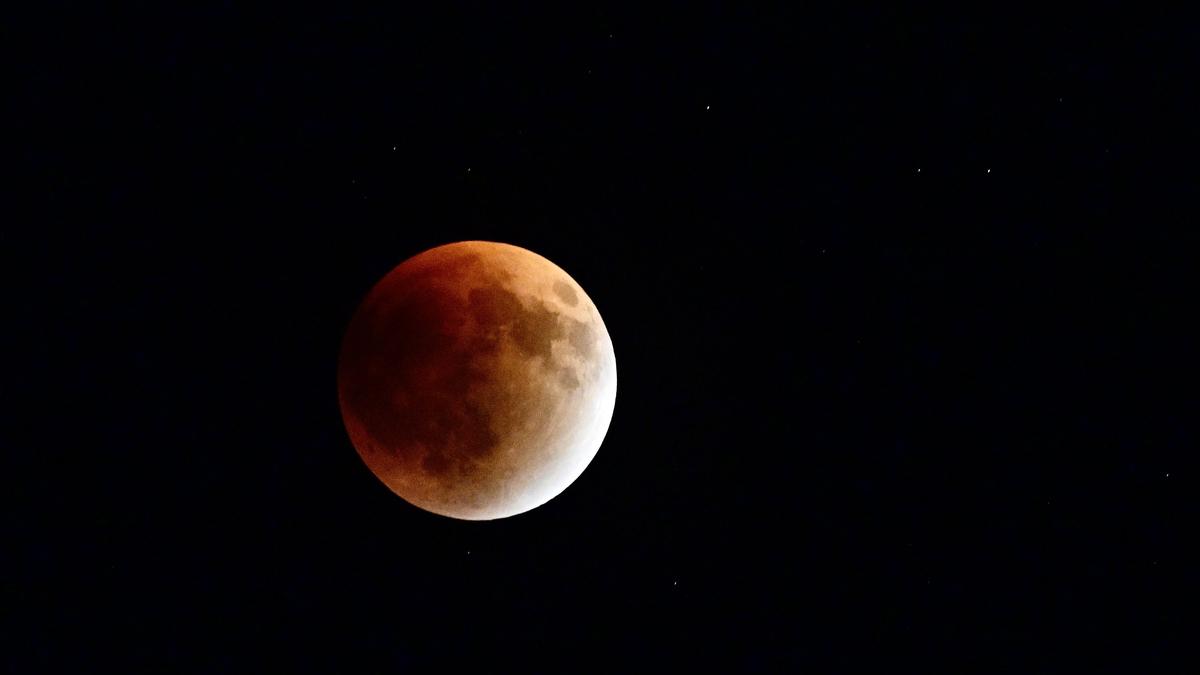
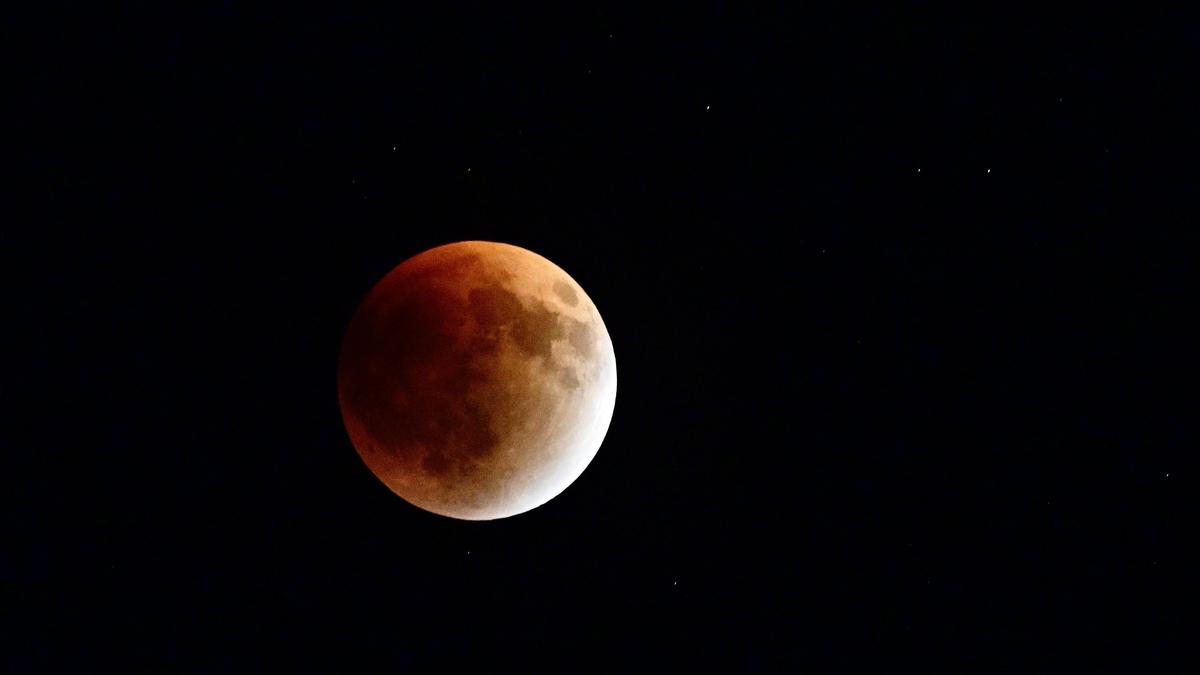
People can witness a rare celestial phenomenon, the total lunar eclipse Blood Moon, because of its colour during totality. File
| Photo Credit: K. Murali Kumar
A total lunar eclipse will occur on Tuesday (March 3, 2026), and many places in India will be able to view the celestial event. Here is everything you need to know about the event!
What is a lunar eclipse?
A lunar eclipse is a celestial event that occurs when Earth passes directly between the Sun and the Moon, casting its shadow across the lunar surface. This alignment can only happen during a full moon.
At totality the moon appears in red colour due to Rayleigh Scattering which is the varying dispersion of all ranges of colours in inverse proportion to their wavelength by the Earth’s atmosphere. The red colour is scattered less compared to other colours and so falls on the moon making it look red.
Types of lunar eclipse
Total lunar eclipse: The Moon moves entirely into the darkest part of the Earth’s shadow, creating what is called a “Blood Moon,” where the moon appears reddish-orange due to sunlight refracting through Earth’s atmosphere.
Partial lunar eclipse: Only a portion of the Moon enters the darkest part of the Earth’s shadow, making an appearance as if a bite has been taken out of our planet’s satellite.
Penumbral lunar eclipse: The Moon passes through Earth’s faint outer shadow, and the eclipse is so subtle that it is often very difficult to see it with the naked eye.
When, where and how to watch the lunar eclipse
According to a notification issued by the India’s Ministry of Earth Sciences, the total lunar eclipse will occur on March 3, 2026. Most places in India will observe the end of the lunar eclipse at the time of moonrise, except some places in the Northeast and the Andaman and Nicobar Islands, where the end of the totality phase of the eclipse will also be visible. In places such as Chennai and Kanniyakumari, the eclipse will be visible for up to 31 minutes, according to the India Meteorological Department.
The eclipse will begin at 3.20 p.m. IST and end at 6.48 p.m. IST. The totality, or the moment when the Moon is entirely engulfed in the Earth’s shadow, will begin at 4.34 p.m. IST and end at 5.33 p.m. IST.
Also Read | Total lunar eclipse enthrals skywatchers; clouds play spoilsport
The last lunar eclipse visible from India was on September 7 and September 8, 2025, and it was a total lunar eclipse.
The next lunar eclipse will be visible from India on July 6–7, 2028 and will be a partial lunar eclipse. The next total lunar eclipse will be visible from India on December 31, 2028.
Published – March 01, 2026 11:44 am IST

