



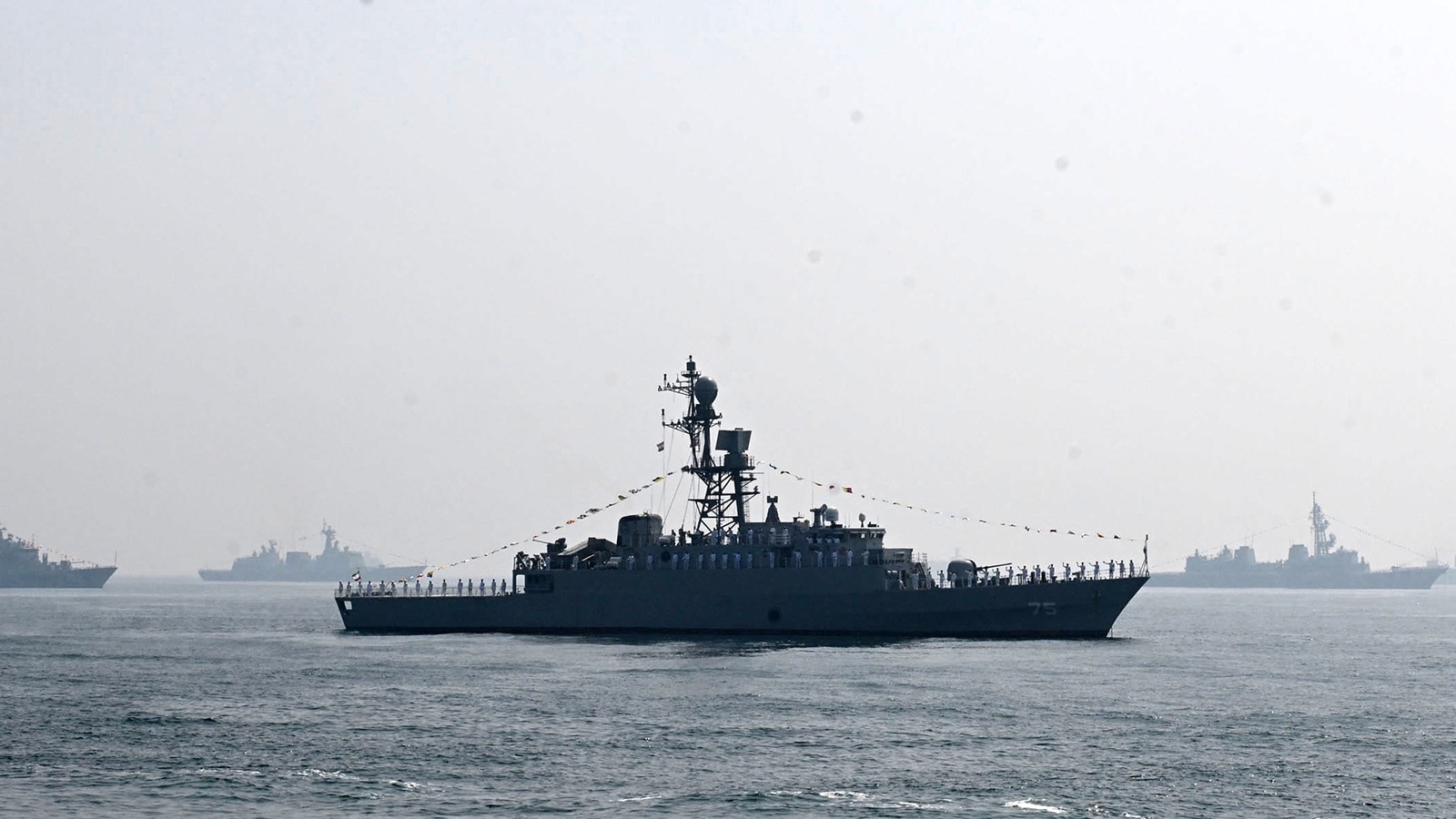
The torpedoing of the Iranian frigate IRIS Dena, 40 miles off the coast of Galle, Sri Lanka, in the early hours of March 4, offered India a blinding flash of harsh reality: The conflict we thought was 3,000 km away in the Persian Gulf had arrived at our doorstep.
By releasing periscope-camera footage of a submarine-launched torpedo detonating under the stern of the ill-fated Dena, the Pentagon provided a cold-blooded demonstration of the US Navy’s reach. The sinking of an Iranian warship homeward-bound from the Indian Navy’s Visakhapatnam base, where it had been a guest for the International Fleet Review (IFR), must have been a profound shock to its hosts.

The destruction of the Dena by a single Mark 48 torpedo — described by US Defence Secretary Pete Hegseth as a “quiet death” — signals that Washington is no longer content to contain the US-Israel-Iran conflict within the Persian Gulf. By striking near Sri Lanka, Washington has declared that there are no “safe” waters for its adversaries. The message is clear: The capability to strike is, in itself, the only logic that matters in the era of “Operation Epic Fury”.
The uncanny sequence of recent events witnessed across the world, from Eastern Europe and the Middle East to Colombia, and now the Persian Gulf, should serve as a stark reminder that the hallowed principles of “state sovereignty” and “non-interference”, that lay at the heart of the 1648 Treaty of Westphalia, and were enshrined in the 1945 UN Charter, have become little more than relics.
Far more apposite to our fraught present situation is the ancient verdict of the Athenian strategist Thucydides: “The strong do what they can, and the weak suffer what they must.” In this grim 2026 replay, the “strong”, embodied by a Virginia-class nuclear attack submarine – possibly the most powerful weapon platform afloat – has dispatched a “weak” Iranian frigate that naively presumed that international waters would grant it impunity.
Much of the indignation in India is fixated on the personal affront rendered: The Iranian vessel and its 180 sailors were recently guests of the Indian Navy. Yet the harsh truth is that once the vessel departed India’s territorial waters, we owed her no sovereign protection. With Iran and the US locked in open conflict, any warship flying a belligerent’s flag becomes, by the inexorable logic of war, a legitimate target.
However, there are more cogent reasons why sinking the Dena in such proximity to the Indian peninsula was an ill-considered and needlessly escalatory action. While the conflict had largely remained confined to land or localised littoral zones, this kinetic action off Galle — a focal point of East-West shipping — has opened a new, global dimension to the war.
The shipping world, already spooked by the threatened blockage of the Strait of Hormuz, is reeling. War-risk premiums have surged by up to 80 per cent, with some insurers cancelling coverage entirely in the Persian Gulf and Red Sea. Combined with the rerouting of ships via the Cape of Good Hope, freight rates are spiking. The ultimate cost will be borne by the poor common citizen in developing nations.
Decades after the concept of an Indian Ocean Zone of Peace was buried, these waters have become the focus of international maritime cooperation. Through initiatives like SAGAR, India has fostered a stable transit corridor for the world’s energy and trade. This is the lens through which New Delhi views the sinking of the Dena: A gratuitous disruption of a hard-won regional peace and tranquillity, by a friend, a “strategic partner” as well as a “major defence partner”.
The US rationale for dramatically shifting the theatre of war to the South Asian maritime domain is, perhaps, rooted in its 2026 doctrine of Deterrence by Denial. By targeting a ship returning from a high-profile diplomatic and military mission in India, the US may be signalling three objectives: (a) neutralising Iran’s naval reach in the eastern Indian Ocean; (b) demonstrating to Beijing that the US maintains total escalation dominance over critical sea lines of communication; and (c) signalling to regional powers that the era of comfortable maritime neutrality is ending as the Indian Ocean becomes a primary zone of kinetic enforcement.
Secretary Hegseth’s claim that this was the first torpedo sinking of an enemy ship since WWII is historically inaccurate. A notable post-WWII precedent is the 1982 sinking of the General Belgrano by a Royal Navy nuclear submarine during the Falklands War. While that strike was a strategic gain, it became a long-term diplomatic embarrassment for London. The Belgrano was sunk outside the “Exclusion Zone” established by the UK, leading to accusations of “state piracy” and “unnecessary escalation” that haunted Margaret Thatcher’s government for decades.
Finally, note needs to be taken of US Secretary Hegseth’s public rhetoric, which marks a radical departure from traditional US military-diplomatic restraint. His open advocacy of unrestricted violence (“raining death and destruction all day long” on Iran), his disdain for international institutions, and “rules of engagement” are disquieting to say the least.
Such shrill rhetoric can have unforeseen and unintended consequences, particularly when two of the three primary belligerents are nuclear-armed. Fortunately, New Delhi maintains friendly, functional ties with all parties. It is now the urgent task of Indian diplomacy and statesmanship to persuade these actors to impose limits on this conflict before the “logic of war” consumes the global commons and inflicts irreparable harm on mankind.
The writer is a former Indian Navy chief

