



4 min readMar 16, 2026 07:12 PM IST
First published on: Mar 16, 2026 at 07:12 PM IST
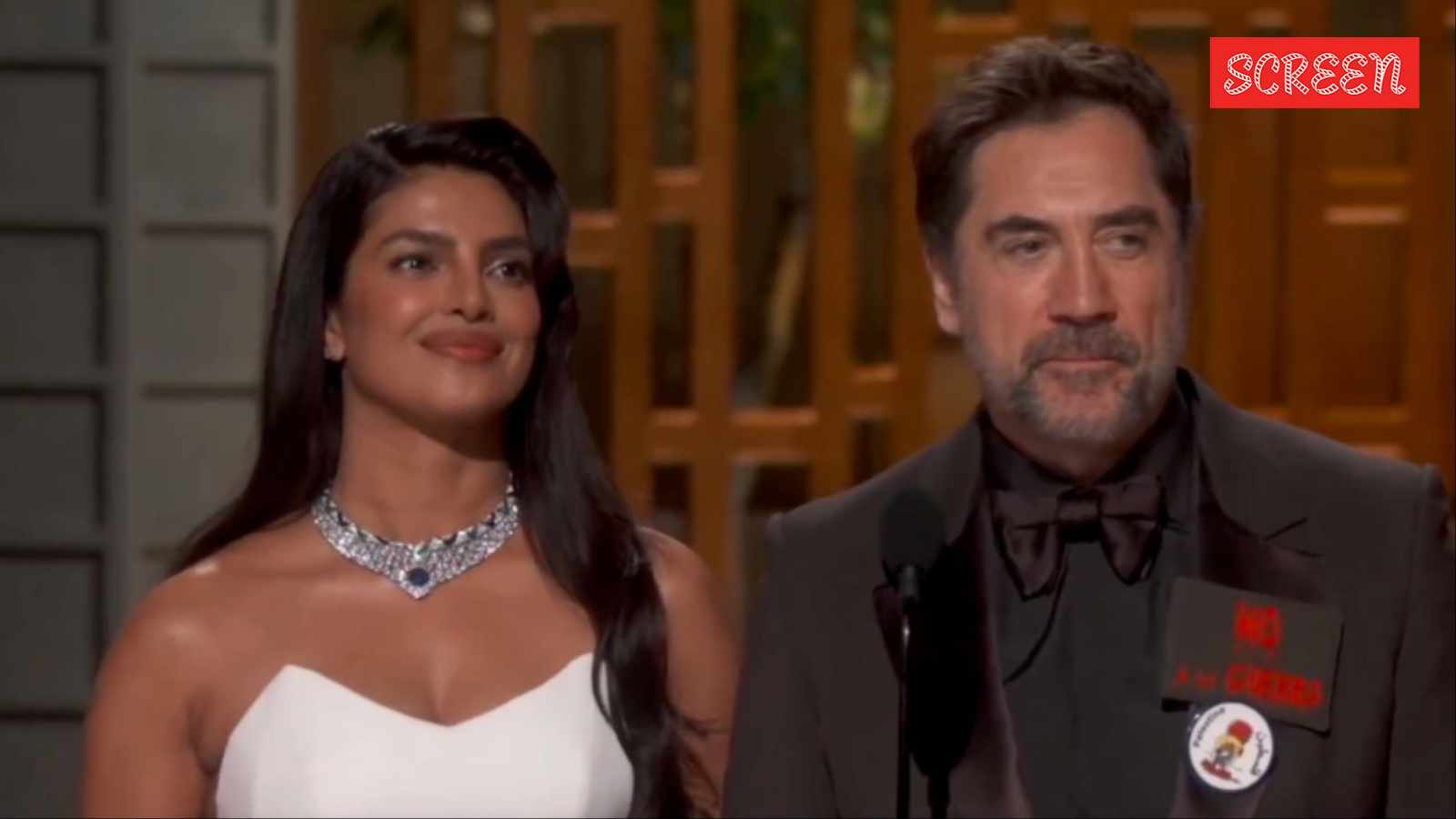
The stage was set at the 98th Academy Awards for the clash of two politically charged films — the Ryan Coogler-directed Sinners and One Battle After Another, directed by Paul Thomas Anderson. Yet the most overtly political moment came when the Joachim Trier-directed Sentimental Value won the Oscar for Best International Feature Film. As soon as Javier Bardem walked onto the stage, accompanied by Priyanka Chopra Jonas, he leaned towards the mic and uttered, “No to war and free Palestine.” The audience responded with loud applause.
The Spanish actor is known for making his politics clear and, at times, wearing it on his tuxedo. He wore a pin that said “No a la guerra (no to war)” and another that is a Palestinian symbol of resistance. After the ceremony, USA Today showed him an old photograph of himself protesting and wearing the same “No a la guerra” pin while opposing the Iraq War in 2003. Bardem said he would tell his younger self to keep on doing what he had been doing.

At the beginning of the evening, host Conan O’Brien said, “I warn you, tonight could get political.” And it did. It was a refreshing change after the controversy triggered by the jury head of the 2026 edition of the Berlinale, Wim Wenders, who, when asked about Gaza and the German government’s support for Israel, said, “We should stay out of politics.”
Often, artists and filmmakers have used film festivals and award ceremonies to make political statements. At the 2017 Golden Globes, Meryl Streep delivered a powerful speech criticising Donald Trump and celebrating Hollywood’s diversity. The Cannes Film Festival has witnessed many such protests, including in 2018 when 82 female film personalities marched to highlight the low number of women featured in the competition compared to men.
This year’s awards race was dominated by films with strong social and political messages, including One Battle After Another, which won six awards including Best Picture and Best Director, and Sinners, which took home four awards including Best Actor and Best Original Screenplay. Several others such as The Secret Agent, It Was Just An Accident, The Voice of Hind Rajab, and the winner for Best Documentary Feature, Mr Nobody Against Putin, are strongly political. The fact that these films have been frontrunners for top international awards shows that the audience understands cinema is political.
When popular figures such as Bardem or Streep make strong political statements, that makes others think and maybe, eventually, encourages them to speak up. Saying that he wrote One Battle After Another for his children, Anderson said this was his way of saying, “sorry for the housekeeping mess that we left in this world we’re handing off to them”, while also believing that “they will hopefully be the generation that brings us some common sense and decency”. Is the next generation paying heed, and will they take up this battle?
David Borenstein, co-director of Best Documentary Feature winner Mr Nobody Against Putin, said in his acceptance speech, “When a government murders people on the streets of our major cities, when we don’t say anything when oligarchs take over the media and control how we produce it and consume it — we all face a moral choice. But luckily, even a nobody is more powerful than we think.”
After creating history with the first ever Best International Feature Film award for a Norwegian film, Trier chose to talk about “beautiful films that reflect our present crisis and the crisis of the past”. Paraphrasing American writer James Baldwin, he said, “all adults are responsible for all children, and let’s not vote for politicians who don’t take this seriously into account”.
It would have been easier for these artistes to revel in their achievements and enjoy a martini. What makes these moments truly significant, however, is the stand they choose to take.
The writer is associate editor, The Indian Express. alaka.sahani@expressindia.com

