



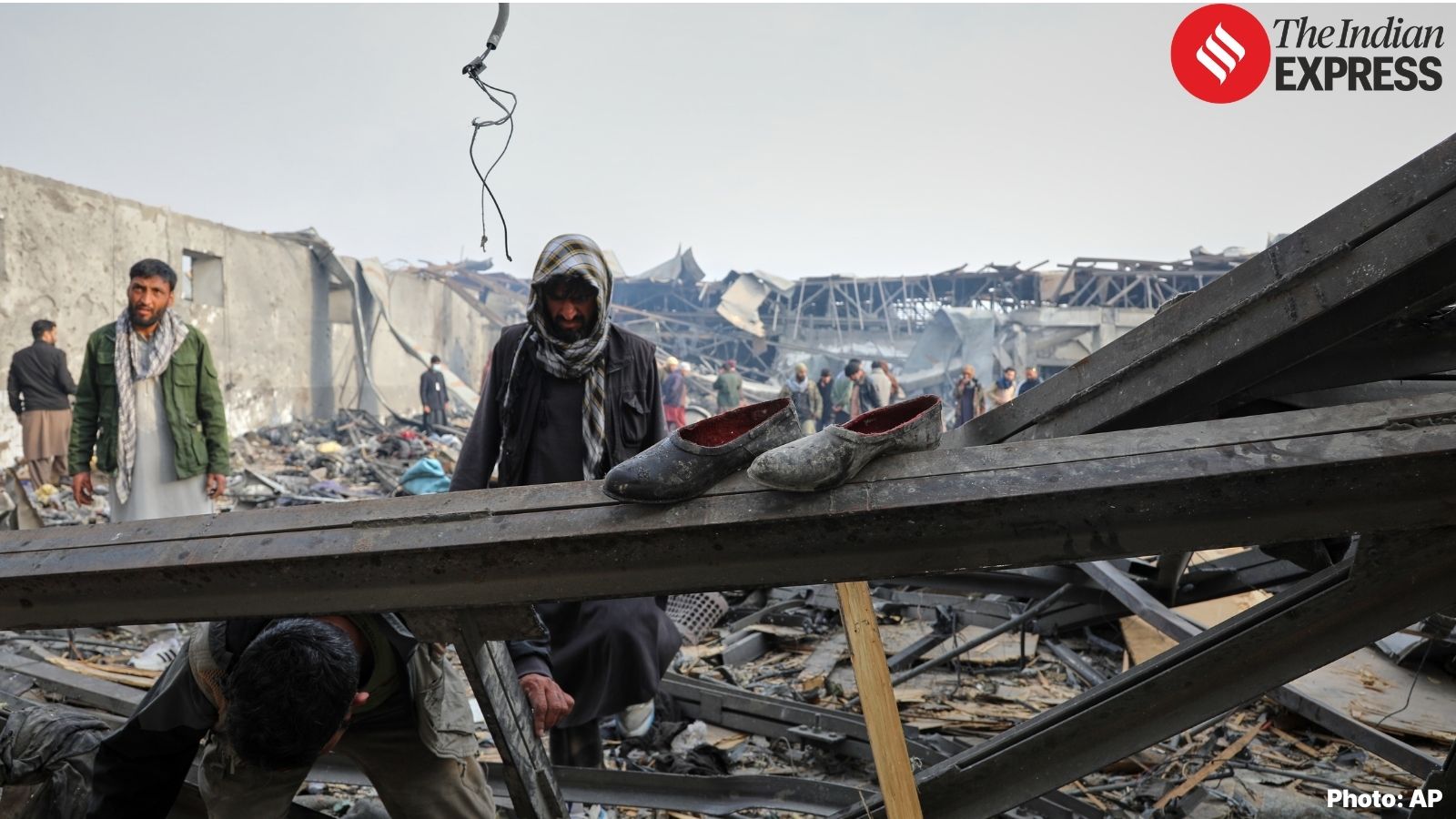
At a moment when the West Asia conflict threatens Afghanistan’s western lifeline, Pakistan has chosen to double down. On March 16, at least 400 people were killed and 250 injured in an airstrike by Rawalpindi on a drug users’ rehabilitation hospital in Kabul.

Pakistan has long presented itself to the international community as a partner in regional stability while simultaneously running the networks that destabilise it. The pattern is documented: Harbouring terrorists while claiming to fight terrorism; providing sanctuary to Lashkar-e-Taiba and Jaish-e-Mohammed while signing international counterterrorism commitments.
This double game has always had costs. Now those costs are being presented to Afghan civilians.
On March 10, India’s Permanent Representative to the United Nations, Ambassador Harish Parvathaneni, did something rare for an era of carefully hedged multilateral diplomacy. He called it what it was. Standing before the Security Council, he expressed India’s “grave concern on the practice of trade and transit terrorism by denial of passage for trade and cynical closure of access for a landlocked country.” He added that it was “hypocritical to espouse high principles of international law and Islamic solidarity on the one hand, while mercilessly carrying out airstrikes during the holy month of Ramadan” on the other.
The phrase “trade and transit terrorism” will linger. Afghanistan has no independent access to global commerce. For decades, that geographic reality made Pakistan the gatekeeper of Afghan economic life.
Pakistan understood this and used it. Long before the Taliban returned to Kabul in August 2021, Islamabad had established a durable pattern: Open the door when Afghanistan complies, shut it when it does not. Deny Indian goods transit through Pakistani territory to Afghan markets. Selectively throttle transit trade whenever Kabul showed any sign of an independent foreign policy. The leverage was structural, and it was never left unused for long.
Pakistan’s calculation was straightforward: A Taliban government in Kabul would be a client state and a buffer against Indian influence, encompassing the “strategic depth” Pakistan’s military establishment had long coveted.
Then the Taliban took over and ignored Islamabad.
The humiliation of that outcome explains everything that has followed. Pakistan’s use of trade and transit closures is the fury of a patron whose proxy refused to be leashed. The demand that Kabul crack down on the Tehreek-e-Taliban Pakistan, a legitimate security concern, has been wielded simultaneously as a precondition for restoring basic commerce to 40 million people. The message is not subtle: Comply, or your population will starve and/or face bombs.
India’s statement at the UNSC was not only a condemnation, but a continuation of long-term engagement. The centrepiece of this engagement is the Chabahar corridor, a strategic investment that directly addresses Afghanistan’s geographic vulnerability. The Delaram-Zaranj highway was constructed precisely to provide Afghanistan with an alternative trade route bypassing Pakistan entirely, connecting to Iran’s road network and onward to Chabahar port on the Gulf of Oman.
Moreover, the Strait of Hormuz, through which Afghan goods have moved via Chabahar to the Indian Ocean, has become a conflict zone. The road that India built, the port India developed, the humanitarian corridor that had moved millions of tonnes of food to Afghan families — all of it now sits in the shadow of a war Afghanistan had no part in starting and no power to stop.
The food security situation in Afghanistan was already catastrophic before the current escalation. Decades of conflict, the economic shock of the Taliban takeover, the collapse of international aid flows, and the forced return of over two million Afghan nationals from Pakistan in 2025 had already pushed millions toward acute food insecurity.
Ambassador Parvathaneni called on the international community to move away from a “business as usual approach” and to “adopt nimble policy instruments that bring sustainable benefits for the Afghan people.” The deeper requirement is a fundamental reassessment of the international community’s tolerance for Pakistan’s double game. The combination of proxy terrorism, civilian airstrikes, forced deportations, and transit blockades directed simultaneously at Afghanistan cannot continue to be treated as a bilateral dispute requiring diplomatic patience.
India’s voice at the Security Council mattered not merely as a diplomatic intervention, but as a statement of principle: That geography must never be weaponised, that the vulnerabilities of landlocked peoples must not be exploited.
The writer is a PhD research scholar in International Relations at the Symbiosis School of International Studies, Pune

