



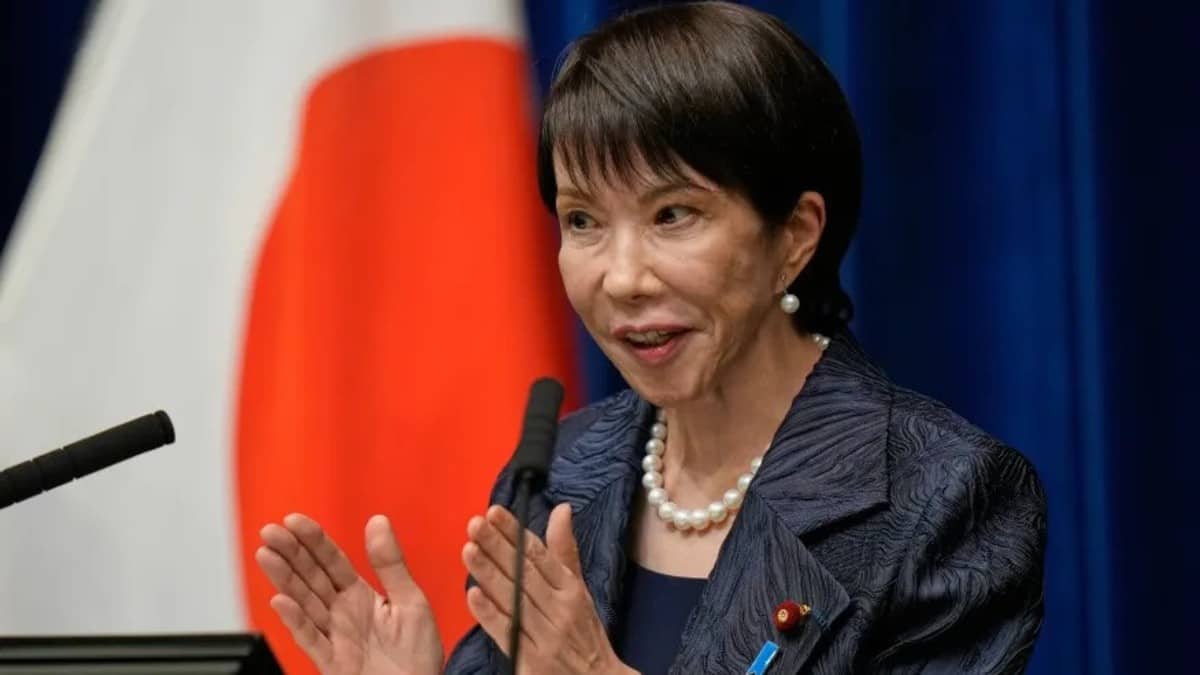
The election of February 8, with approximately 105 million registered voters and 4.5 million already casting their ballots in early voting, has produced a decisive mandate in favour of Prime Minister Sanae Takaichi. The key issues of the election included rising living costs, increasing consumer prices—particularly for rice as a staple food—sluggish economic growth and low wages, and the soaring prices of property in major Japanese cities. According to the IMF, the Japanese economy is forecast to grow just 0.7 per cent in 2026, down from 1.1 per cent in 2025, well below the ‘goldilocks’ growth rate of 2-3 per cent.
Results of the just-held election have been a watershed moment when the Liberal Democratic Party (LDP) and its coalition partner, the Japan Innovation Party, known as Ishin, have garnered a solid majority out of 465 seats in the Lower House of the Japanese Diet. Winning 310 seats or more would give the ruling bloc a two-thirds majority for the first time since elections in 2017 when Takaichi’s mentor, the late Shinzo Abe, was the PM. With a bumper majority, it also means that she can override the Upper House of Parliament, where the LDP coalition lacks a majority.
This record victory was just viewed as improbable, as the LDP was engulfed with a series of allegations related to slush fund scandals over the alleged use of campaign funds, the debate over Japan’s pacifist constitution, and Japan’s security concerns with China and a host of countries in Northeast Asia, including North Korea. This historic victory is a significant boost from the bare minimum majority of 233 which Prime Minister Sanae Takaichi, Japan’s first female prime minister, is currently holding.
The electoral outcome is also a serious setback for the main opposition bloc that constituted the Democratic Party of Japan and Komeito. The ultra-right party, Sanseito, which had fielded 190 candidates and was inspired by Donald Trump’s Maga movement in the US, even fared worse. Other political outfits, such as the Japanese Communist Party, the Democratic Party for the People, the Social Democratic Party, etc, had similar electoral setbacks. Although Sanae Takaichi took a calculated and risky political gamble, which some Japanese political observers called Sanae-mania/Sana-katsu, by calling a snap election and by defying conventional wisdom in Japan’s typically cautious political culture.
A supermajority of seats may provide her much-needed leeway in revisiting some of the key decisions which she either inherited or had to embrace due to the LDP’s slender majority earlier. These include whether to retain or reduce or rescind the decision of having 8 per cent sales tax on food supplies, the heaviest debt burden in the developed world, the weakening of the Japanese currency yen, Japanese investors’ low confidence in Japan’s government bonds and uncertainty over the Bank of Japan coming to the economic rescue of the government in power.
Youth Outreach
In Japan’s contemporary political landscape, the youth population has generally been disinterested in taking active stands. However, PM Sanae Takaichi has been a remarkable exception, and according to some opinion polls, her popularity level among youth has been a phenomenal 90 per cent, which is unprecedented. Her own personal approval ratings are almost double that of the LDP, a traditionally male-dominated party.
In the October 2025 election, which witnessed the resignation of outgoing prime minister Shigeru Ishiba and brought Sanae Takaichi to the PM chair, just 36 per cent of those in the 21 to 24 age group had voted in her favour. PM Takaichi has over 2.6 million followers on X, whereas, as a way of comparison, the main leader of the opposition, Yoshihiko Noda, has around 64,000 followers. The 64-year-old Takaichi’s personal handbag she carries, her pink pen and even her favourite snacks are a rage among Japanese youth and have catapulted her to being a fashion icon. Takaichi’s viral posts in social media, which she has harnessed effectively to her advantage, including the clips of her drumming to the hit song ‘Golde’ from Netflix’s K-pop Demon Hunters with South Korea’s President Lee Jae-Myung or singing to Italy’s PM Giorgia Meloni by wishing her a sweet ‘Happy Birthday’ in Italian, have become folklore.
Women Support
Sanae Takaichi is an arch-conservative, the daughter of a car company employee as her father and a police officer as her mother, who has drawn inspiration and takes pride in being a protégé of Britain’s former prime minister Margaret Thatcher, who herself was the daughter of a shopkeeper. Takaichi can hardly be called a votary of feminists. She has opposed allowing female members of the imperial family to become reigning empresses. She has maintained that married couples should use a single surname, typically the husband’s, in keeping with Japan’s traditional social norms. PM Sanae Takaichi has also avoided, as a female, awarding trophies in the sacred Sumo wrestling arenas. The fact that female voters have also voted overwhelmingly in her favour speaks volumes of her immense popularity across gender.
China Factor
Relations between China and Japan have deteriorated in recent months due to PM Takaichi’s stand that Japan would respond militarily if China attacked Taiwan. As a result, Japan warned its citizens to stay safe in China, while Beijing urged its citizens to avoid travelling to Japan. With heavy historical baggage ranging from the Nanjing massacre, textbook controversy, visits to the controversial Yasukuni shrine, etc, the competitive nature of Japan-China relations in the coming months will depend a lot on how PM Takaichi handles China’s supreme leader, Xi Jinping. It is possible that PM Takaichi may request an early meeting with Xi in order to diffuse the standoff and recalibrate the bilateral relationship to a more predictable level.
The US Angle
The United States and Japan have a long-standing security and economic relationship, including the former providing a nuclear umbrella to Japan through its military bases in Okinawa and other islands. If Japan undergoes major reforms in its constitution, particularly in the revision of Article 9 and the Self-Defence Forces (SDF), it remains to be seen how the US reacts to Japan’s position on this issue.
For the immediate future, due to PM Takaichi’s close personal equation with President Donald Trump, the threatened 25 per cent tariff and import levies on Japan were lowered to 15 per cent as Japan committed to a $550 billion trade investment deal with the US. Already with President Trump inviting PM Takaichi on March 19 to visit the White House, and Trump praising her in glowing terms as ‘she has already proven to be a strong, powerful, and strong leader and one that truly loves her country’ and Takaichi reciprocating to Trump as a ‘partner in a new golden era’, the personal chemistry and bonhomie may bode well for PM Takaichi in fortifying her position as the PM.
Equation with India
Takaichi is committed to a vibrant and robust bilateral relationship with India and to strengthening the Special Strategic and Global Partnership and Comprehensive Economic Partnership Agreement. At her meeting with PM Modi on the sidelines of the G20 summit in Johannesburg, South Africa, on November 23, 2025, both leaders agreed to enhance their partnership in a wide range of areas in economy, trade, defence, cyber security, artificial intelligence, semiconductors, critical minerals, and people-to-people exchanges, as well as on the larger focus on a ‘Free and Open Indo-Pacific’ for maintaining regional stability among the Quad group and the Indian Ocean region.
Future Challenges
A resounding victory across the board may propel Takaichi to initiate new domestic reforms and take bolder foreign policy initiatives. Even issues such as foreigners’ entry into Japan, who constituted 2.5 million in 2025, have been a contentious subject, as they fulfill Japan’s employment gap and yet are being perceived as diluting the homogenous societal norm by the huge swathe of conservative voters across Japanese prefectures.
For the LDP, which has been in power for the most part in the post-World War II phase, the challenge is onerous. Although Takaichi may enjoy the proverbial political honeymoon phase for a while, in the longer term, she has to do a lot of balancing acts in ensuring her popular base while steering the country forward amidst regional and global tumult and geopolitical unpredictability.
(Mohammed Badrul Alam is Director of Research; professor and former head, Department of Political Science, Faculty of Social Sciences, Jamia Millia Islamia University, New Delhi. The views expressed are personal and do not necessarily reflect Firstpost’s views.)
End of Article

