



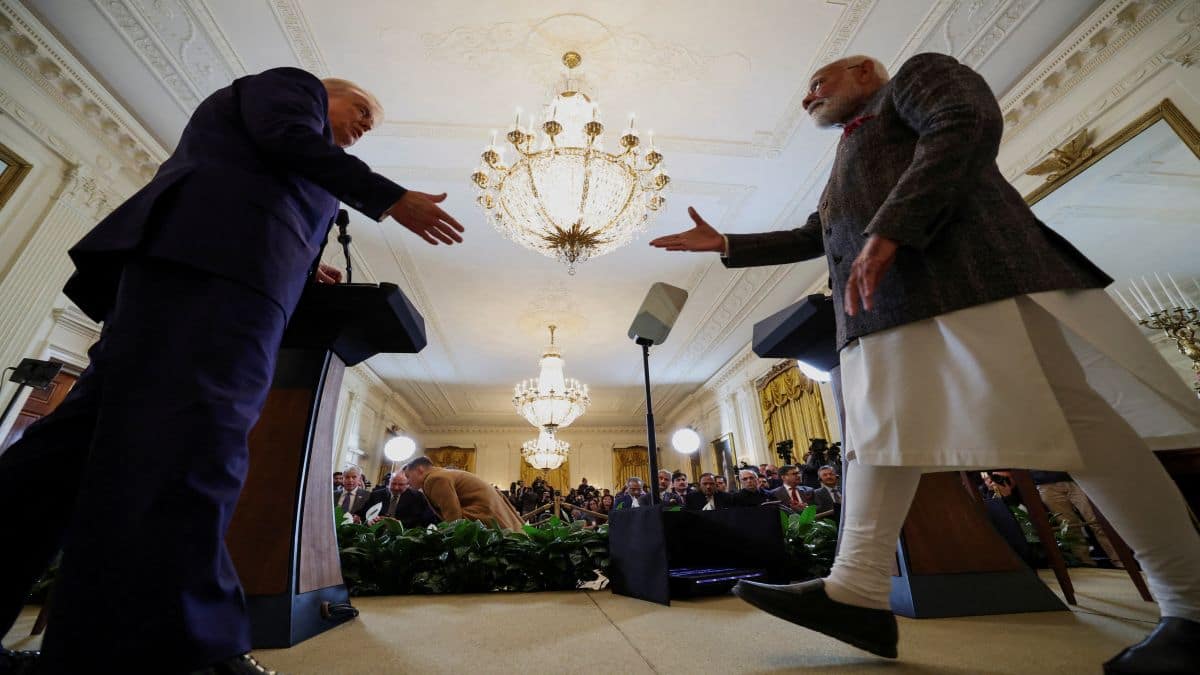
I am beginning to feel quite like ‘The Boy Who Cried Wolf’, who was destined to be ignored. For, I was sceptical last week about the India-EU free trade agreement. Now I am equally sceptical about the India-US trade ‘deal’, which actually a sort of statement of direction about the way to an actual deal. But I have reasons for that.
Reason No. 1: Trump’s Exaggeration and U-Turns
The very first reason for the scepticism about the India-US lovefest is that it was announced by President Donald Trump, who, in the past six months, has, in his whimsical way, executed any number of U-turns, as well as Z-turns and various other pretzel-logic twists, so much so that anything he says, and its opposite, can be equally true, in a quantum Schrodinger’s Cat sort of way. It is prudent not to take him at face value when he swears eternal allegiance to India. Again.
Quoth he: “It was an Honor to speak with Prime Minister Modi, of India, this morning. He is one of my greatest friends, and a Powerful and Respected Leader of his Country. We spoke about many things, including Trade, and ending the War with Russia and Ukraine. He agreed to stop buying Russian Oil, and to buy much more from the United States and, potentially, Venezuela. This will help END THE WAR in Ukraine, which is taking place right now, with thousands of people dying each and every week! Out of friendship and respect for Prime Minister Modi and, as per his request, effective immediately, we agreed to a Trade Deal between the United States and India, whereby the United States will charge a reduced Reciprocal Tariff, lowering it from 25% to 18%. They will likewise move forward to reduce their Tariffs and Non Tariff Barriers against the United States, to ZERO. The Prime Minister also committed to “BUY AMERICAN,” at a much higher level, in addition to over $500 BILLION DOLLARS of U.S. Energy, Technology, Agricultural, Coal, and many other products. Our amazing relationship with India will be even stronger going forward. Prime Minister Modi and I are two people that GET THINGS DONE, something that cannot be said for most. Thank you for your attention to this matter!”
Okay. Very interesting. There has been no Indian readout corroborating a number of these claims, especially on agriculture, which I imagine is a red line, a no-go, for India.
Besides, these are supposed to be ‘reciprocal’ tariffs. If Indian tariffs go to zero on US products, why is the US imposing 18 per cent on Indian products?
Reason No. 2: Desperation of ‘Jilted Lovers’
The ‘shotgun wedding’ vibe was present in the India-EU FTA as well: a sort of desperation. There is not much choice: you simply have to do this. I am not the only one saying this. Here is a tweet from a senior EU leader, the former PM of Sweden and co-chair of the EU Council for foreign relations.
Of course you could say that he would say this, wouldn’t he? But it happens to be true. The number of suitors is declining rapidly, so you compromise.
But that is not a recipe for the longevity of the relationship, nor for faithfulness. You can expect er… adultery (early and often). The roving eye roveth.
Reason No. 3: Agriculture and Dairy Red Lines
We really don’t know much about the fine print. I am aware that sales and marketing people tend to promise anything (even things they are completely aware are impossible) just to get the sale. Thus, when India diversifies away from the US market, and its Q3 numbers are not badly affected by the Trump tariffs, it is incumbent upon Trump and Navarro, Bessent, Lutnick et al to reverse their previous abuse and be all milk and honey.
The problem here, as always, is the agriculture and dairy product front. It is an absolute red line for India: no government can afford to piss off its farmers nor to open up the country, home of much of the world’s genetic diversity, to genetically modified organisms (GMO), including terminator seeds (that would forever put farmers at the mercy of Cargill and friends).
Not only that, but non-veg milk (that is, milk from cows that have been fed, among other things, ground-up animal bodies) is abhorrent to a large number of Indians. Not to mention the risk of things like Creuzfeldt-Jakob disease or mad cow disease (transmitted via feed that includes the ground-up brains of diseased cattle; see also the fatal brain disease Kuru, transmitted between cannibals in Papua New Guinea).
The US rather urgently needs to get rid of its soybean and corn mountains and milk lakes (in contrast with the EU’s butter mountain and wine lakes), and in both, exporters salivate at the prospect of the proverbial billion-customer market. (The Chinese expertly used this rather illusory meme to attract foreign makers of consumer goods. That didn’t end well).
In the case of India, there is no demand for soybeans, and the one place where I can see demand for corn is in ethanol, especially for blending into petrol. That would be a win-win, because it would reduce the need for India to grow highly thirsty sugarcane, thus drawing down the already alarmingly depleted water table.
Reason No. 4: Russian Oil and Energy in General
The unseemly pressure over Russian oil raises hackles on the Indian side. After all, this is not the only time India has been pushed to the wall by American sanctions: there was the post-’Buddha is smiling’ period and the prevention of the sale of ex-Soviet cryogenic rocket technology, as immortalised in Nambi Narayanan’s story in Rocketry: The Nambi Effect. Earlier, there was the embargo on supercomputers.
In each of these cases, India rode out the sanctions and denials. But the question arises: why should India not use Russian oil if it makes commercial sense to India? Just because there is a conflict between Russia and Ukraine? That is really not India’s problem: India does not have a dog in that fight.
Now there is the allegedly impending US attack on Iran. India has been denied Iranian oil for some time, and now under US pressure, it is being forced to ramp down its involvement in Chabahar Port in Iran, which India built and views as a gateway to Central Asia. Notably, China continues to import Iranian crude. Is India getting some relief there?
It is not realistic to imagine that large amounts of Venezuelan crude will now flow to India if it abjures the Russian stuff. For one, even though Reliance’s Jamnagar refinery can process the heavy, sour Venezuelan oil, it is said that
Venezuela will take some time and a lot of money to ramp up its output because of years of neglect, lack of naphtha to dilute and pump out the crude, and so on.
Reason No. 5: Non-Tariff Barriers and Subsidies
The US claims that India will drop all its non-tariff barriers, but what is the guarantee that the US will not raise an impenetrable wall on their side? It is a simple matter to impose difficult-to-comply-with rules that basically say, “Your products are not welcome.” These may include environmental, carbon tax, quality, and various other demands.
For example, there is the Merchant Marine Act of 1920 that insists that only American-owned/built/crewed ships can transport goods between US ports. Then there are Buy American Act procurement restrictions that handicap foreign-origin products.
The US Farm Bill provides gigantic subsidies for five major crops – corn, soy, wheat, rice and cotton – amounting to $9.3 billion in 2024. Reports suggest that crop insurance and new benefits from the ‘bridge payments’ announced in 2025 may add another $10 billion+ to this sum. That is an enormous subsidy, pricing competitors out of the market.
Reason No. 6: Loss of Trust
Finally, there is a sixth and critical reason: the loss of trust. For the longest time, India had convinced itself that it was an essential strategic partner to the US, if for nothing else to contain China. But that illusion is now gone, quite possibly because the US has decided to create a G2 condominium with China and
retreat into Fortress America. The US administration now considers India, at best, a transactional vassal and, at worst, a potential rival to apply the Thucydides Trap to: and what is better than to do war by economic means? India has to adjust.
On the other hand, there are indeed positives. In the interest of fairness, here are the immediate views of Citibank and Bank of America, who both considered it a net positive for India.
If you accept the tariff reductions by the US at face value, then India is doing marginally better than several other nations, including Vietnam, Thailand and Bangladesh. Ironically, Trump’s recent best-friend-forever Pakistan is hit with 19 per cent. There was a video circulating about Raghuram Rajan, the economist who wants to be to Rahul Gandhi who Manmohan Singh was to his mother, gloating earlier that India was suffering from 50 per cent tariffs compared to Pakistan’s 19 per cent.
That brings up one more observation: the Opposition parties in India are screaming bloody murder about this supposed India-US ‘deal’ not because they claim India is getting a bad deal, but apparently because they think India is getting a good deal. They should see Trump’s latest triumph.
Opposition, fear not: Trump is making even more entertaining claims about his ‘deal’ with Xi. The sum and substance: “Please buy my soybeans.” This, despite the fact that China is the biggest buyer of oil from both Russia (48 per cent of exports) and Iran (80 per cent). Clearly, there is a lot of marketing going on, and it’s too early to tell what the reality is. The devil is in the details.
(The writer has been a conservative columnist for over 25 years. His academic interest is innovation. Views expressed are personal and solely those of the author. They do not necessarily reflect Firstpost’s views.)
End of Article

