



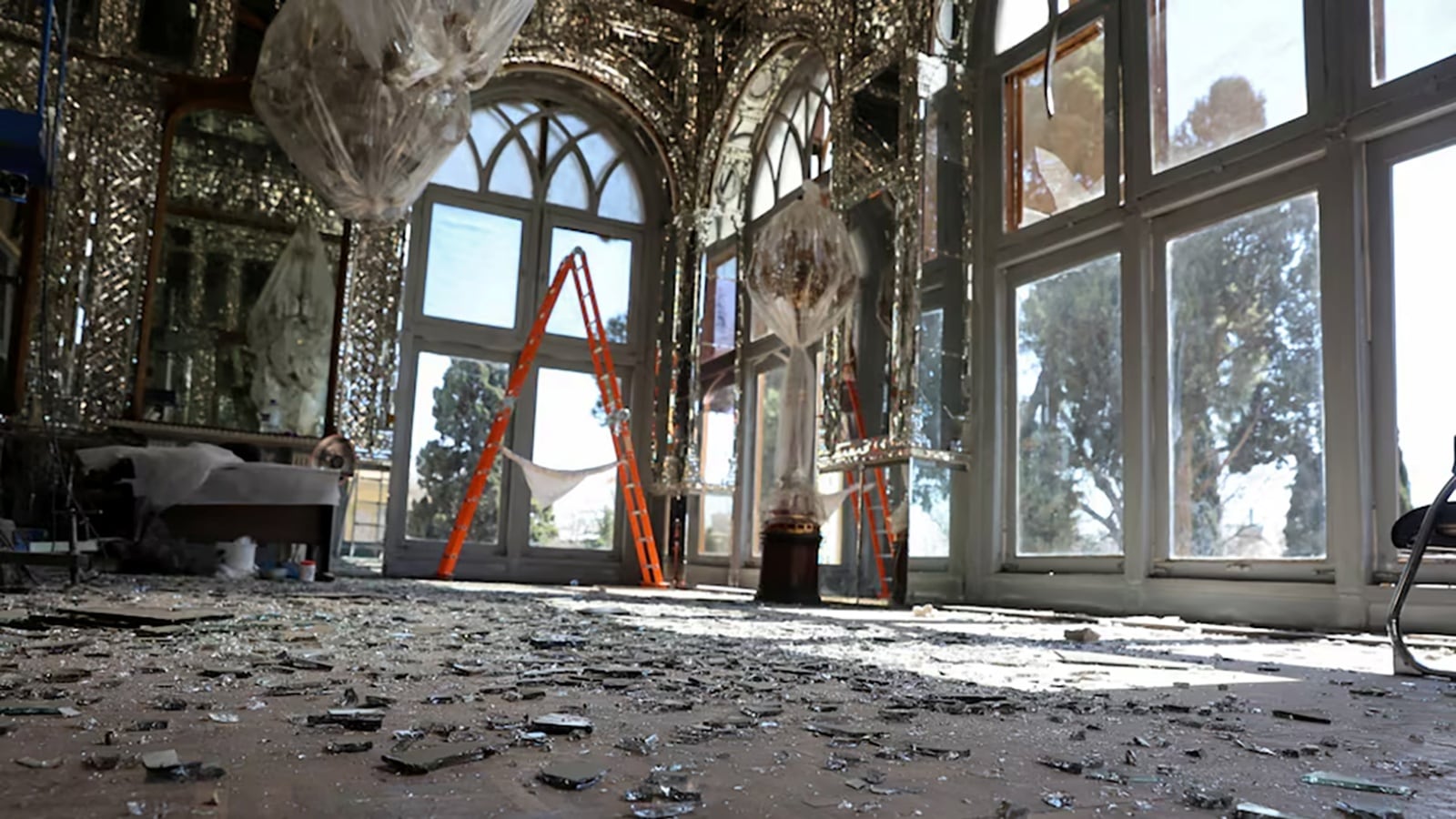
In March 2026, the cultural heart of Tehran sustained a profound wound. Following military strikes by American and Israeli forces, Iran’s Ministry of Cultural Heritage confirmed catastrophic damage to the Golestan Palace (Kākh-e Golestān), a UNESCO World Heritage site dating back to the 16th century. The palace’s famed Talar-e Ayeneh (Hall of Mirrors), a shimmering expanse of geometric glass, was reduced to debris, with officials estimating a 15-year restoration timeline. While contemporary discourse focuses on the geopolitical violation of the 1954 Hague Convention, a precise architectural analysis reveals a more subtle historical tragedy: the severing of tangible links to the Persianate world that once unified the artistic traditions of Safavid Iran and Mughal India.
To comprehend the architectural significance of Golestan Palace, and thus the magnitude of its recent destruction, one must first situate it within the transregional cultural order that the historian Richard Eaton has termed the “Persianate Empire.” This was not a political empire but a sprawling, millennium-long cosmopolitan zone stretching from the Balkans to the Deccan, held together by Persian as the lingua franca of high culture, administration, and courtly refinement. Within this world, the relationship between Safavid Iran and Mughal India was foundational and deeply paradoxical: they were ideological rivals. Iran was staunchly Twelver Shi’a, while the Mughals, a Sunni dynasty with Sufi eclecticism, contested territory and sectarian legitimacy. Yet they remained bound by a shared artistic vocabulary, a common pool of itinerant artists and architects, and a mutual reverence for the Timurid heritage. This dynamic of political hostility coexisting with cultural kinship meant that aesthetic forms migrated fluidly between Isfahan and Lahore, creating a unified Persianate visual language.

The flow, however, was never unidirectional. Mughal architecture, in its formative phase under Humayun and Akbar, borrowed heavily from Safavid models, from the four-aiwan plan and the hasht bihisht (eight-paradise) layout to the refined use of glazed tilework and the charbagh garden (see my paper on Iranian influence on Mughal Architecture). By the seventeenth century, however, the creative energy reversed: Iranian courtly and religious architecture began absorbing Indian elements, particularly in decorative motifs, the integration of jharokha balconies into palace façades, and the lavish use of coloured stone inlay, techniques perfected in the Subcontinent that subsequently appeared in Safavid Isfahan and, later, Qajar Tehran.
Golestan, built centuries later under the Qajars, was the ultimate heir to this layered tradition, a synthesis of Safavid craft, European neoclassicism, and the enduring Mughal-inflected sensibilities that had long defined royal architecture across the Persianate world.
The Mughal Resonance: A Shared Aesthetic
To understand the Mughal influence on Golestan, one must first distinguish the palace’s primary architectural identity. Although its foundations were laid under the Safavids (1501–1736) and expanded by the Zands, the existing complex is overwhelmingly a product of the Qajar era (1794–1925), particularly the reign of Naser al-Din Shah (r. 1848–1896). The Qajars pursued a policy of architectural synthesis, merging traditional Persian crafts with European Neoclassical elements. What is often labelled ‘Mughal influence’ at Golestan is more accurately understood as a late manifestation of a common Timurid-Persianate visual grammar.
The most significant point of convergence is the Talar-e Ayeneh (Hall of Mirrors), which was destroyed in the recent strikes. Constructed in 1874, this hall utilised cut glass to create a dazzling play of light and space, a technique that had reached its zenith in Safavid Iran during the 17th century. This aesthetic was exported to the Subcontinent, where it evolved into the Sheesh Mahal (Palace of Mirrors) complexes in Lahore and Agra Fort. While the Qajar version was heavily influenced by the Baroque excess they observed in Europe, the technical execution of ayeneh-kari, the painstaking process of setting small convex mirrors into plaster in intricate geometric or floral patterns, remained a direct descendant of the Safavid craft tradition that also nourished Mughal art.
Furthermore, the spatial organisation of the Khalvat-e Karim Khani, a terrace dating to 1759, reflects a typology familiar to students of Mughal architecture: a raised, open-fronted pavilion with a small marble throne and a water channel fed by an underground qanat (kariz). This integration of hydraulic engineering with royal seating mirrors the Jharokha (balcony) traditions of Mughal courts, where the emperor would appear before subjects. Although functionally different, the underlying concept of a royal space defined by water, geometry, and axial symmetry is a shared element of the Persianate architectural language, codified under the Timurids and disseminated across both the Iranian Plateau and the Indian Subcontinent.
The Damage: Erasure and International Law
The recent damage goes beyond physical destruction; it represents an erasure of the cultural continuum linking West and South Asia. The strikes, which targeted a nearby police station, generated blast waves that shattered the intricate mirror mosaics and cracked the load-bearing masonry of the Shams-ol-Emareh (Edifice of the Sun). Unlike the deliberate destruction of heritage seen in other conflicts, this damage is primarily attributed to the proximity of military targets to historically significant urban centres.
Iranian officials have confirmed that at least 108 historical sites were damaged across the country, with Golestan suffering the most symbolic loss. The response from the international community, led by UNESCO, has been to remind belligerents of their obligations under the 1954 Hague Convention for the Protection of Cultural Property in the Event of Armed Conflict. However, the deployment of “blue shields” and the sharing of GIS coordinates proved ineffective against the kinetic force of modern warfare.
As scholar Naghmeh Sohrabi (a contemporary historian of modern Iran and the Middle East) noted, these sites are “living, breathing monuments to beauty and creation” that transcend ideology. Their destruction highlights a critical vulnerability: international law remains robust in principle but fragile in enforcement when placed against strategic military objectives.
The destruction of Golestan Palace is a wound to the collective memory of the Persianate world. The Mughal and Qajar courts, though often political rivals, were part of the same artistic civilisation, shaped by centuries of mutual borrowing. The shattered mirrors of the Talar-e Ayeneh are metaphorically resonant – they reflect a heritage that is itself fragmented, a shared legacy of form, light, and hydraulic engineering that unites Tehran with Delhi and Isfahan.
As Iran prepares for a lengthy 15-year restoration, the global community faces a dual challenge: enforcing the legal protections designed to safeguard such sites and recognising that cultural heritage is not a luxury of peace, but a fundamental component of human identity that must be defended even amid conflict. The fragility of Golestan’s mirrors serves as a stark reminder: that in modern warfare, the “collateral damage” to civilisation may be irreversible.
The writer is professor of medieval Indian history at AMU

