



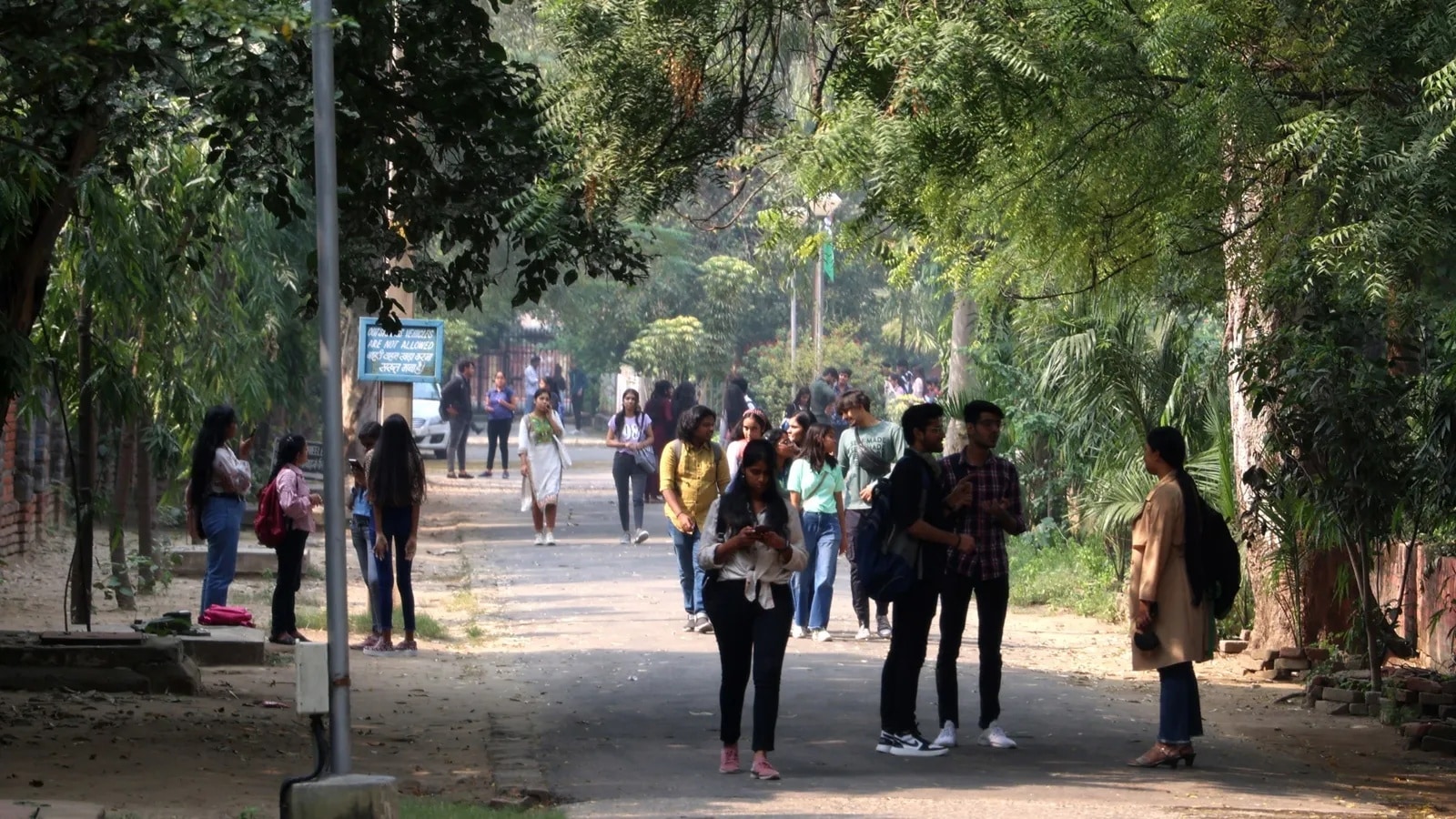
Budgets are often read as lists: New institutions announced, capacities expanded, and allocations increased. Yet, the true measure of an education budget lies not in what it builds, but in what it enables in principle, on intellectual and social grounds. The Union Budget 2026–27, with its emphasis on design education, STEM access, university-industry linkage, and focus on scientific infrastructure, shows a clear intent: India’s future competitiveness will depend less on scale alone and more on the quality and coherence of its educational ecosystem.
At a time when AI is reshaping how knowledge is produced, transmitted, and applied, education systems across the world are grappling with a common question — how do we prepare young talent not just for jobs that exist today, but for ones that will be imagined in the future, especially at a time of geopolitical shifts and an evolving policy landscape?

The solution does not lie in privileging one discipline over another, educating in silos, or in narrowly aligning education with immediate market needs. Instead, it lies in cultivating intellectual breadth, ethical grounding, and the capacity to learn across domains, qualities that have long defined strong education systems. In ancient Nalanda, for example, the university had no divisions between subjects. Everybody had to learn some basic subjects such as Astronomy, Law, Literature, Theology, and Mathematics.
Several strands of this year’s Budget, taken together, gesture towards such a vision. The continued emphasis on future-ready skills, interdisciplinary learning, and innovation-led education acknowledges that technical proficiency alone is insufficient in an AI-rich world. As machines become better at recognising and interpreting patterns, human value increasingly resides in areas such as critical thinking, creativity, contextual judgement, and the ability to integrate insights across disciplines.
The Budget also recognises that the relationship between education and employment can no longer be viewed as linear or static. The announcement of a high-powered standing committee is a timely step to examine the links between education, employment, and enterprise, particularly in the context of the services sector and emerging technologies. If approached thoughtfully, such a forum can support higher education institutions still grappling with aligning curriculum, pedagogy, and infrastructure with evolving market realities.
Equally significant is the enduring focus on access and inclusion. In recent years, there has been growing and consistent participation of women in national scientific and technological projects — in building the Chenab Bridge or in ISRO’s Mars Orbiter mission, for instance. Nonetheless, women in tier 2-3 regions continue to face structural barriers in STEM. Investments aimed at improving participation, particularly of young women in STEM-intensive institutions, address a structural weakness in India’s talent pipeline. Diversity in classrooms is a driver of better science, better design, and better decision-making. When students from varied backgrounds encounter one another, they challenge assumptions, widen perspectives, and enrich the learning environment in ways no curriculum reform can achieve on its own.
The Budget’s attention to design education and creative capabilities, especially in the eastern region, is also noteworthy. The Indian design industry is expanding rapidly, and yet there is a shortage of designers. Today, design thinking sits at the intersection of technology, arts, humanities, and social environment. Such thinking requires empathy as much as engineering, imagination as much as analysis. By recognising design as central to national capacity-building, policy is showing a clear commitment to democratising access and strengthening talent pipelines in next-generation fields.
Most importantly, the Budget’s focus on building scientific infrastructure, particularly in astronomy, plays a transformative role. Investments in upgrading the Himalayan Chandra Telescope and advancing plans for the National Large Optical Telescope in Ladakh mark a long-awaited moment for India’s astronomical community. These facilities anchor a thriving national ecosystem of researchers, and of high-tech small-scale industry. They also enable Indian scientists to lead frontier science from Indian soil and offer students direct access to world-class observational platforms. Support for modern planetariums signals a commitment to linking the highest level of research to public awareness and communicating the excitement to younger generations.
Just as the success of the Chandrayaan-3 mission captured the imagination of students across India — making astrophysics a visible and viable career path — and as the country prepares for its first human spaceflight mission under Gaganyaan, the installation of these telescopes can play a similarly catalytic role.
What ties these diverse initiatives together is the possibility of a more integrated educational imagination. Universities must break down the walls between traditional subject categories and function as spaces where engineers learn to think ethically, scientists engage with History and Philosophy, designers grapple with social realities, and students learn to communicate across differences. This is particularly critical in the age of AI, where decisions shaped by algorithms will have deep societal consequences.
The progressive outlook provided by the National Education Policy, 2020 gave a clear direction for higher education institutions to pivot towards a more future-looking, interdisciplinary mode of education system. As the world is changing fast, higher education institutions will need to fine-tune further to align with the shifts, something the Budget has captured very well.
With a young population and growing global influence, India can redefine what educational excellence looks like in an AI world, while charting a credible path towards the Viksit Bharat mission. The Budget gestures towards this possibility by recognising that education, science, design, and inclusion are deeply interconnected. The task ahead is to ensure that these strands are woven into a coherent whole — one that prepares students not just to participate in the future, but to shape it thoughtfully and responsibly.
The writer is vice-chancellor and professor of Physics, Ashoka University, Delhi-NCR. Opinions are personal

