



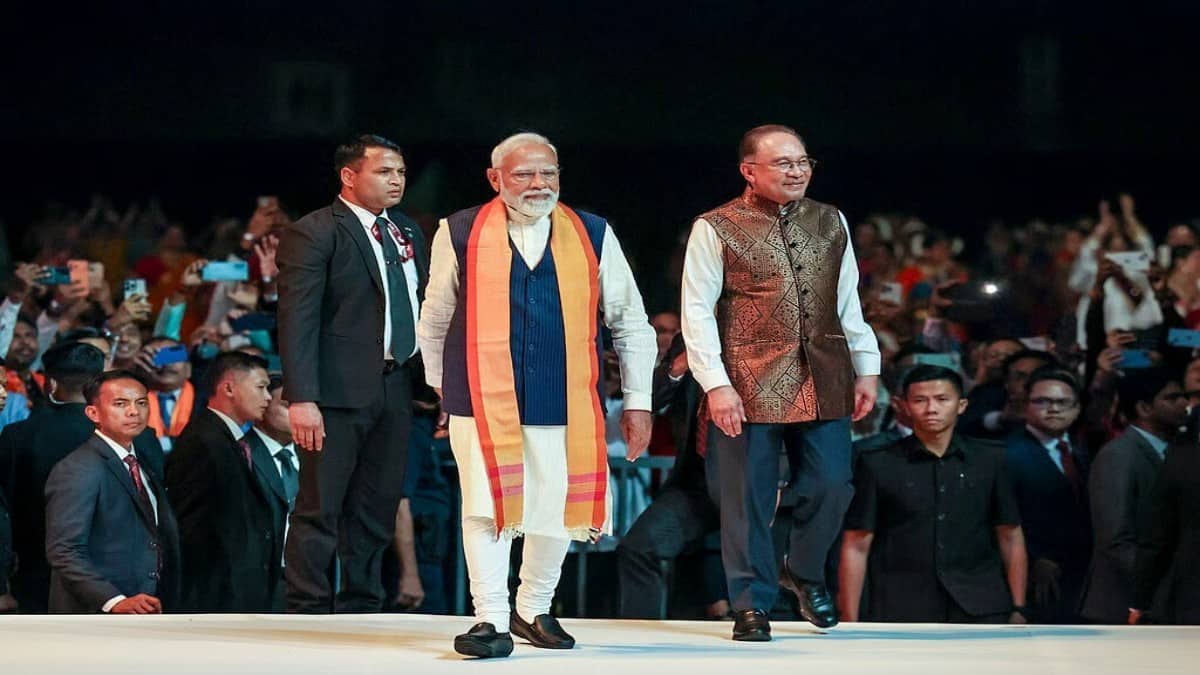
Prime Minister Narendra Modi is in Malaysia for his two-day official visit (February 7-8), setting the stage to bring greater synergy to the consequential India-Malaysia relationship. The visit is expected to reaffirm India’s commitment to strengthening bilateral ties to even greater heights. It follows Malaysian Prime Minister Dato’ Seri Anwar Ibrahim’s visit to India in August 2024, which elevated the relationship from an ‘Enhanced Strategic Partnership’ to a ‘Comprehensive Strategic Partnership.’ PM Modi’s visit also highlights India’s remarkable soft power outreach, coinciding with celebrations with the vibrant Indian diaspora in Malaysia during the Thaipusam festival, underscoring India’s cultural diversity and uniqueness.
Historical Linkages
India and Malaysia have shared historical and cultural linkages in terms of trade, civilisation, and people-to-people contacts. Under the Chola empire between the 9th and 13th centuries, Indian traders and merchants established secured maritime routes, introducing Buddhism and Hinduism to the Malay Peninsula. The term ‘Merdeka’ (independence in Malaysia) originates from the Sanskrit word ‘Maha-ridhika’, meaning ‘great prosperity’. The migration of Indians, particularly from South India during the British colonial era, led to an increasing flow of migration from India, mainly to the rubber plantations of Malaysia.
When the Federation of Malaya (later renamed as Malaysia) was created in 1957, India was among the first countries to recognise it. In the 1950s and 1960s, the founder of modern Malaysia, Prime Minister Tunku Abdul Rehman, made conscious efforts to cultivate close relations with India’s political leadership. Under India’s Act East policy that was enacted in 2014, Malaysia was a key partner for India’s engagement with Southeast Asia and other countries of Asean and Asia-Pacific. India and Malaysia have also complimented each other in a number of global bodies, such as the UN, G-20, Non-Aligment Movement, East Asia Summit, Commonwealth of Nations, etc. India too has supported Malaysia’s vision of ‘geoeconomic magnanimity’ that was articulated at the 2025 Asean summit in Kuala Lumpur, as it perfectly aligned with India’s outreach to the Global South and in bridging the divide between the North and South.
Trade and Commerce
Bilateral trade between India and Malaysia has reached a record high of $19.5 billion. Malaysia is India’s 13th largest trading partner. Malaysia also ranks as the 20th largest investor in India, with an FDI inflow of $1.16 billion during the 2000-2022 period. There is a target to achieve a comprehensive economic cooperation agreement to reach $2 trillion by 2030. Malaysia is India’s third-largest trading partner within Asean. The planned visit by PM Modi fits into India’s broader engagement with Malaysia for sustained political dialogue and economic integration.
Both countries also subscribe to a free, open and inclusive Indo-Pacific region. With Malaysia maintaining largely a position of neutrality and as the country is in close proximity to the Strait of Malacca, it makes it a significant player to be courted by all the major powers, including India, the US and China. Both India and Malaysia have adhered to freedom of navigation in accordance with established international law, which also includes Malaysia’s plan for oil and gas exploration in the oil-rich Sarawak state on Borneo Island in the South China Sea, thus demonstrating Malaysia’s commitment to maritime sovereignty.
Defence Cooperation
India and Malaysia have strengthened defence ties within the ambit of a comprehensive strategic partnership focusing on maritime security, counterterrorism, and cybersecurity. Under the India-Malaysia Security Dialogue, a series of military exercises were operationalised, which included the naval exercise Samudra Laksamana from February 28 to March 2, 2024, off the coast of Visakhapatnam; Harimau Shakti at Bentona Camp, Malaysia, from December 2 to 15, 2024; and the bilateral air exercise Udara Shakti in Kuantar Malaya from August 5 to 10, 2024. The 13th Malaysia-India Defence Cooperation Committee Meeting (Midcom), which took place on February 19, 2025, focused on defence industrial collaboration, establishing a Su-30 maintenance forum and a strategic affairs working group.
India established the first regional HAL office in Kuala Lumpur in July 2023, with huge potential for co-design, co-production, and co-development. The Coast Guards of the two countries have made regular port calls, with the Indian Coast Guard ship ICGS Samudra Peheredar making a port call at Pulak Indah Naval Base at Port Klang, May 22-28, 2023, and at Sepanggar Naval Base, Kota Kinabalu, May 9-12, 2024. During PM Modi’s visit, meaningful negotiations are likely for Malaysia to opt for BrahMos missiles, which other Southeast Asian countries such as the Philippines, Indonesia and Vietnam have shown keen interest in. India may also try to convince Malaysian leadership to opt for Tejas aircraft, which Malaysia has resisted so far while opting for South Korean FA-50 jets.
Indian Diaspora, Cultural and Educational Outreach
Malaysia hosts nearly 3 million Persons of Indian Origin (PIOs), which is the second largest PIO population after the US. Malaysia, being a multi-religious country, has over 20,000 Hindu temples and 120 gurudwaras, apart from hundreds of mosques. With the naming of the India Cultural Center after Netaji Subhash Chandra Bose by PM Narendra Modi during his previous visit to Malaysia in 2015, this center has become the main hub showcasing the distinctive cultural heritage of India.
The Indian Council for Cultural Relations (ICCR), through a conference entitled Samagam in April 2024, has taken proactive steps by popularising various Indian languages, including Tamil, Malayalam, and Telugu. Representatives from the Indian diaspora from Malaysia have always taken keen interest in the Pravasi Bharatiya Diwas enclave that is held in various Indian cities annually.
In the education sector, currently over 9000 students from Malaysia study and do research at various universities and institutes in India. From the Indian side, some 3000 students pursue study and research at Malaysia-based institutions of higher learning. With a generous offer from ICCR in the form of fellowships and with over 500 MoUs being signed with Indian universities, the educational linkages between the two countries are likely to grow significantly higher in the coming years. The Ministry of Ayush from the Government of India has instituted dedicated scholarships for the study of Ayurveda and traditional medicines, including Siddha, Unani and homoeopathic medicines.
The Indian Scholarship Trust Fund that was launched by PM Modi in 2015 is likely to get a higher budget allocation beyond the initial allotment of Malaysian Ringgit (RM) 3 million. It is also likely that under India’s New Education Policy, NEP-2020, Indian universities may be interested in setting up campuses in Malaysia, with top Malaysian universities also setting up satellite campuses in India on a reciprocal basis.
Discussions are currently underway for the establishment of the Tiruvalluvar Chair of Indian Studies in Malaysia. To promote tourism, Malaysia has instituted visa-free travel for Indian nationals since 2023. India recently has extended registration for Overseas Citizens of India (OCI) to the 6th generation of PIO descendants. India has also allowed gratis e-tourist visas for 30 days for Malaysian nationals.
Challenges and Opportunities
In spite of China being Malaysia’s largest trading partner, exceeding $100 billion, and Malaysia opting for ‘quiet diplomacy’ in the South China Sea in deference to China’s sensitivity, global economic volatility, and intense competition with comparatively lower-cost producers like Vietnam, Laos, Thailand, and Cambodia, there are ample opportunities for both India and Malaysia to boost trade by emphasising core and critical sectors such as semiconductors, AI, renewable energy, fintech, 5G, aerospace, startup alliances, etc.
Similarly, in the defence sector, opportunities do exist for Indian companies to collaborate with their Malaysian counterparts to develop defence technology parks and SEZs geared exclusively for defence research. A more Comprehensive Economic Partnership Agreement (CEPA) may be planned to reach a bilateral trade target of $25 billion in 2026, which will be up from $20 billion in FY 2023-24, with an enhanced focus on palm oil, petroleum products and electronic items and on diversifying commodities strategically.
Both countries can focus on areas such as worker mobility, digital technology, culture, tourism, India’s education, India’s Unified Payment Interface, Ayurveda and traditional medicines. A proactive, long-term perspective between India and Malaysia is likely to be a win-win proposition for both countries.
(Mohammed Badrul Alam is Director of Research; professor and former head, Department of Political Science, Faculty of Social Sciences, Jamia Millia Islamia University, New Delhi. The views expressed are personal and do not necessarily reflect Firstpost’s views.)
End of Article

