



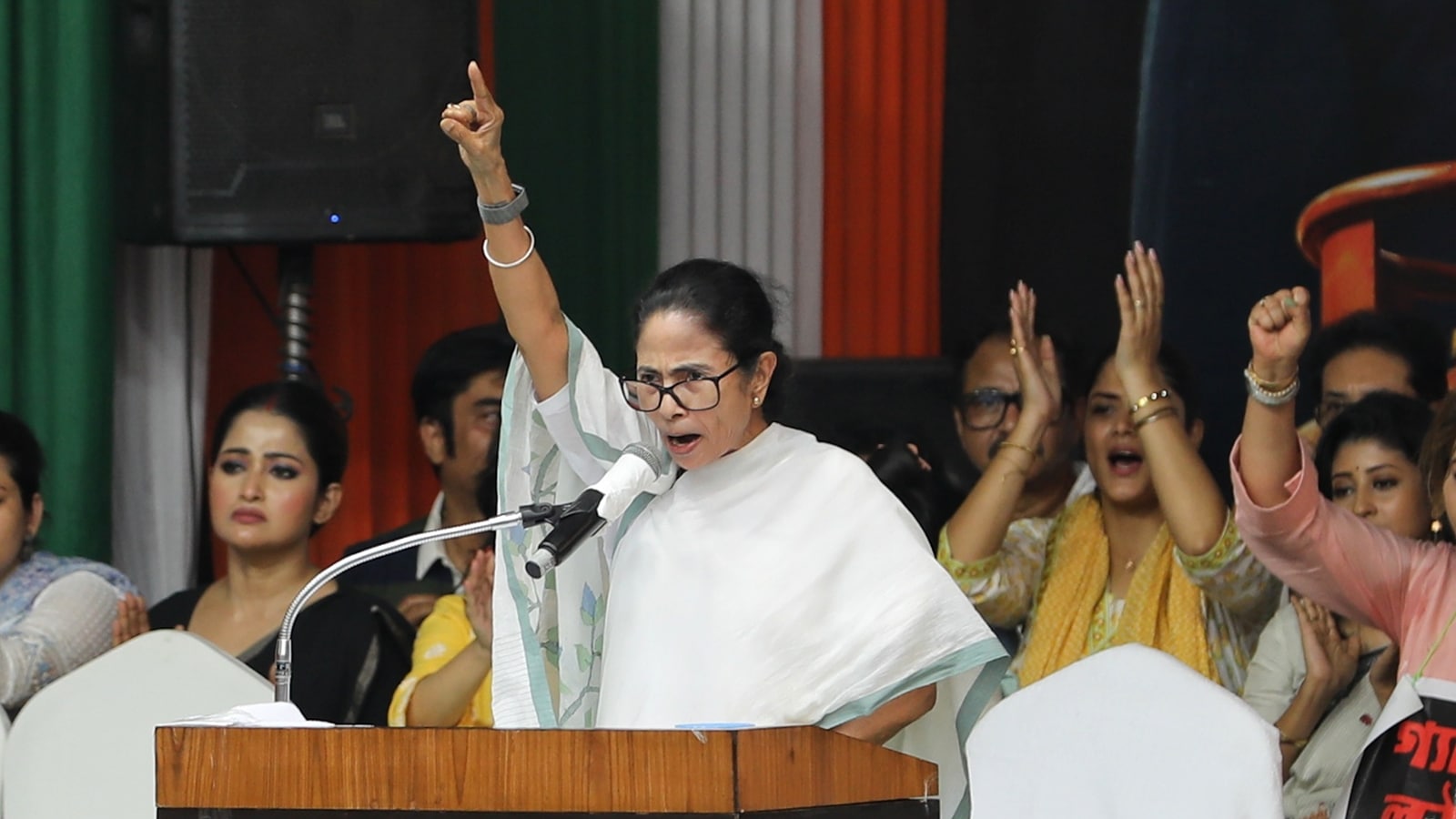
There is no development left,” claimed West Bengal (WB) Chief Minister Mamata Banerjee while launching the TMC manifesto for the upcoming Assembly elections. However, consider the per capita income (PCI) numbers of WB: In 1960-61, when Congress held office in the state, WB ranked second in the country on a PCI basis, just behind Maharashtra. By the time the Left Front took over in 1977, it had slipped to the fifth position. And when Mamata Banerjee’s Trinamool Congress took over the reins in 2011, the state had fallen to the 17th position. Three terms later, WB ranks 16th, with a PCI of Rs 1,63,467 — well below the national average of Rs 2,05,324 and far behind Telangana’s Rs 3,87,623.
This is not to suggest that WB has stagnated in the past five decades. On social indicators, the state’s story is more impressive. Female literacy among the 15-49 age group stands at 93.1 per cent (according to the Sample Registration System, or SRS, 2023). At 1.3, WB’s total fertility rate is in line with the southern states, such as Kerala and Tamil Nadu (SRS, 2023). This has translated into a population growth rate of just 0.5 per cent per annum, against India’s 0.9 per cent, and Bihar’s 1.43 per cent. Why haven’t these gains translated into higher incomes?

One reason is the state’s consistent failure to attract and retain private investment. The pivotal moment came in 2008, when the late Ratan Tata announced that Tata Motors would withdraw from the Nano plant in Singur, attributing the decision to Mamata Banerjee’s anti-land acquisition agitation against the Left Front government. The signal to corporate boardrooms across India outlasted the episode: WB was not a safe destination for long-term capital.
After coming to power, Banerjee did little to reverse this perception. In 2013, the West Bengal Incentive Scheme (WBIS) was introduced to promote industrial growth through a range of fiscal incentives. In April 2025, the state passed the Revocation Act, retrospectively withdrawing three decades of promised industrial incentives to free up resources for welfare schemes targeting disadvantaged groups.
Companies that invested on the basis of those incentives now face serious financial losses, with outstanding claims wiped off the books overnight, making fresh investments difficult. In 2023-24, WB’s Gross Fixed Capital Formation (GFCF) stood at just 1.2 per cent of its GDP — nearly half of India’s 2.3 per cent. The picture worsens when one looks at Net Fixed Capital Formation (NFCF) — a mere 0.4 per cent of GDP, compared to 1.1 per cent for India. This sharp drop reflects the high level of depreciation, which accounts for 64 per cent of GFCF in WB, much higher than India’s 51 per cent. Ultimately, sustained growth and employment generation depend on private investment. Freebies can temporarily cushion poverty; only industry can alleviate it. WB appears to have forgotten this lesson.
The growth data underscore the problem. Between 2011-12 and 2024-25, at constant (2011-12) prices, WB’s GDP grew at an average annual growth rate (AAGR) of 4.8 per cent, well below the national figure of 6.2 per cent. Bihar with an AAGR of 6.5 per cent, UP with 6.1 per cent, Odisha with 6.3 per cent, Jharkhand with 5.6 per cent, and Assam with 7 per cent fared better. The picture is even more concerning in agriculture, which employs 38.2 per cent of the state’s workforce. The sector grew at an AAGR of just 2.9 per cent in WB, and the state fared poorly compared to India’s AAGR of 4 per cent. In comparison, Bihar’s agriculture AAGR stood at 3.9 per cent, UP’s 5.7 per cent, Odisha’s 4.6 per cent, Jharkhand’s 5.9 per cent, and Assam ‘s 6.3 per cent during the same period.
This is puzzling because WB is a leading producer of vegetables, including cabbage, brinjal and cauliflower. The problem comes after the harvest. Typically, a farmer receives roughly a third of what the consumer pays. The remaining two-thirds dissipates in the supply chain, or is simply lost. The state government did try to build vegetable value chains on the lines of SAFAL in Delhi (SUFAL Bangla), but the results have been limited at best. What WB actually needs is serious agri-processing investment — a PepsiCo doing contract farming with potato farmers, processors in fisheries, and direct pipelines into high-value domestic and export markets.
WB is not short of resources. It lacks the political will to invest, modernise, and compete. Take jute. WB produces 80 per cent of India’s jute, 6.8 million tonnes in 2024-25, and has 88 of India’s 118 jute mills. By any measure, it should be the global capital of jute — a natural fibre. Instead, most of the output goes into making sacks for foodgrains and sugar, sold largely to the government. Bangladesh, starting from scratch after 1971, diversified, modernised, and captured international markets. Darjeeling tea tells the same story: It lost the branding war to Ceylon Tea, whose lion logo guarantees certified quality standards enforced centrally by the Sri Lanka Tea Board. Darjeeling tea, fragmented across individual estates with no unified quality enforcement and a GI tag routinely abused by fraudulent blenders, could offer no such assurance.
Mamata Banerjee’s answer to all of this is freebies (revdis). Lakshmir Bhandar, her flagship direct cash transfer scheme for women, costs Rs 27,500 crore, nearly 7 per cent of the state’s total budget expenditure of Rs 3.96 lakh crore in 2026-27. There is no major plan for industrialisation or agro-processing supply chain investment. WB’s public debt-GDP ratio was 34 per cent in 2023-24, next only to Punjab’s 40 per cent, among major states. This is because the welfare schemes are being funded not from growth dividends but from borrowed money. Today’s freebies are tomorrow’s fiscal crisis.
So, what will decide the 2026 elections? Religion? Revdis? Or the Special Intensive Revision controversy? We wish that it will be decided on the basis of the TMC’s performance in the past 15 years.
Gulati is distinguished professor and Chanda a research assistant at ICRIER. Views are personal

