



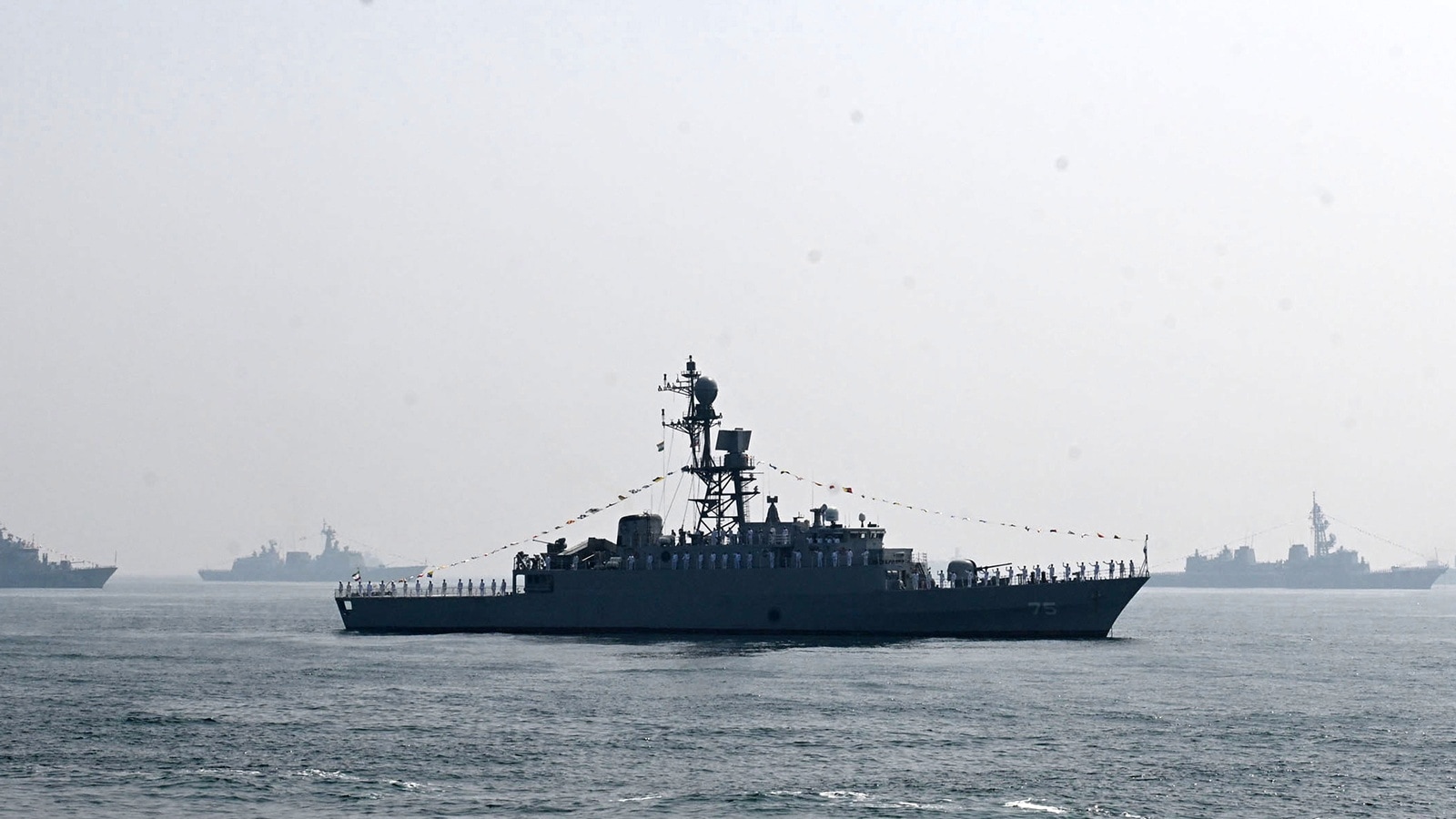
The sinking of the Iranian naval ship IRIS Dena by a US submarine in the Indian Ocean off Sri Lanka’s coast, in international waters, on March 4, raises awkward and complex political, diplomatic, and military questions for India.
This act of war took place soon after the IRIS Dena participated in India’s International Fleet Review (IFR) at Visakhapatnam in February. This was a major national maritime event graced by the Indian President and has an inherent military symbolism.

Akin to the ashwamedha yagna of old, international fleet reviews conducted by major maritime powers are a demonstration of professional naval credibility and an acknowledgement by the regional and global peer group of the host nation’s sovereignty and primacy in the proximate maritime domain.
Given that the Dena was sunk 40 nautical miles from Sri Lanka, the politico-diplomatic optics are embarrassing for India, to say the least. Egg on the face comes to mind.
The related military questions are also complex and discomforting. The Dena was sunk by a US naval nuclear-powered submarine. It is being claimed as the first such “kill” by an American “boat” since the end of World War II.
Delhi will be in a catch-22 situation over this issue, which raises two questions: One, was India unaware of such submarine activity in its proximate waters? If yes, this raises further questions on the competence index of India’s underwater domain awareness.
Two, if India was aware of such activity, was Delhi informed/apprised of the proposed US action when the Dena departed Visakhapatnam for Iranian waters? An affirmative answer to both these questions could lead to potentially discordant consequences for India, both in the domestic and regional context.
Hopefully, more details will emerge in the near future about the sequence of events that led to the sinking of the Iranian warship.
The Sri Lankan government and navy are to be applauded for providing swift SAR (search and rescue) and picking up the survivors. But here is another nettlesome question: Why did India not contribute to this SAR effort? Even if warships were not available in the vicinity and Colombo was deemed capable of handling this SAR exigency, could the Indian Navy have provided aerial surveillance support to the Sri Lankan effort?
The US has justified this act as one of targeting an enemy warship in international waters. It will be further justified as there being no mercy in war. However, American compliance with international humanitarian law and the maritime code regarding saving lives at sea is a gray zone when it comes to what happened to the Dena. My sense is this will be debated in professional circles for a long time.
It is nobody’s case that an attacking submarine would loiter to pick up survivors. But to flip the scenario — had a US platform been in similarly dire straits and there were American survivors at sea to be picked up — what would the Indian and regional response have been?
The more critical and adverse fallout of the Dena sinking is that a regional war, which was geographically limited and confined to air power and missile strikes, has now been expanded to the global maritime domain.
The Indian Ocean region has critical global shipping lanes, including ones for hydrocarbon/energy imports used by all the major Asian economies. India relies on almost 88 per cent of the imported crude oil that transits these sea lines and is vulnerable to escalation. Wider conflict spillover could disrupt sea lines of communication, raise insurance costs, and trigger rerouting, thereby impacting India’s economy and energy security.
India has always been wary of major power conflicts spreading into the South Asian neighbourhood. There is a sense of uneasy deja vu about Iran. In 1979, the Iranian Revolution and the Soviet invasion of Afghanistan roiled the region for decades.
The probability that the Dena is the trigger for something similar cannot be ruled out. A dispassionate discussion in India and with the affected regional nations is warranted.
The sinking of the Dena should not become an arid and polarising debate in India.
The writer is director, Society for Policy Studies, New Delhi

