



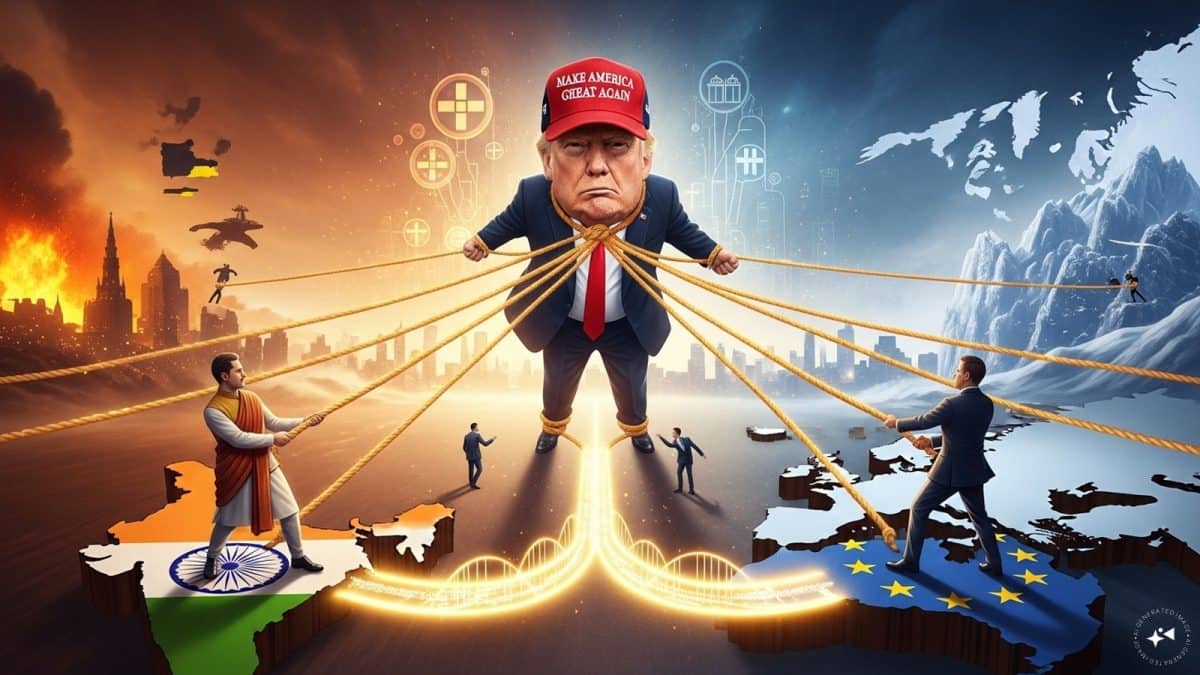
After success in Venezuela, failure in resolving the Russia-Ukraine conflict, and stalling strikes in Iran, US President Donald Trump is turning his attention to annexing Greenland. His belief is that Greenland, which controls routes to the Arctic, is now in the crosshairs of Russia and China and could be taken over by them if the US does not act first, a claim which is difficult to believe.
Both Russia and China have countered by mentioning they have no interest in Greenland. An added reason for Trump’s interest could be resources which the region possesses, which would benefit them and reduce their global dependency.
Trump is backed in his views by his close advisors as well as members of his party in both houses. Post his demand for annexation of Greenland, the US Secretary of State, Marc Rubio, held a discussion with his counterparts from Denmark and Greenland. This was inconclusive, after which Trump toughened his stand.
Trump considered purchasing Greenland from Denmark, but this does not appear to be working out. Both Denmark and the government of Greenland have turned down any offer of making it the US’s fifty-first state. Denmark has also warned that any US action to militarily annex Greenland would mean the end of Nato. The reality is that Greenland has become a bone of contention between the US and his European allies in Nato.
To push his plan, Trump threatened tariffs on European nations which stand in his way of annexing Greenland. He tweeted that he would be imposing an additional 10 per cent tariff on Denmark, Norway, Sweden, France, Germany, the UK, the Netherlands and Finland commencing on February 1. These would be increased to 25 per cent from June 1 in case no deal is concluded.
Europe had reluctantly accepted 15 per cent tariffs from the US while charging zero per cent to many US products, solely to maintain the transatlantic alliance. It is unlikely to accept an additional 10 per cent. It would prefer negotiations but is also willing to counter. How the US would also implement tariffs on select nations within the EU is unknown, especially as the continent is one entity and there are nations, part of the EU, maintaining silence on Greenland.
It is not that the US has no military access to Greenland. As per a 1951 agreement, the US had bases in Greenland but over the years reduced troop deployment in the region. In the early fifties, the US held 17 bases with thousands of troops, which has shrunk to one base currently. Its base is at Pituffik in the northwestern part of the island, hosting about 200 troops. It has missile warning, missile defence and space surveillance systems.
It has been the US which has reduced its force levels in Greenland voluntarily, not under pressure. If the US already has an agreement on bases on Greenland, why does it desire its annexation? This remains unanswered. It could ideally discuss redeployment of troops and not annexation.
The US interest is more towards minerals found on the island. As per a 2023 survey, 25 out of 34 minerals discovered in Greenland are ‘critical raw materials’. For the indigenous Greenlandic Inuit, the extraction of minerals is unacceptable, a reason why they have not been touched. The US may not adhere to their customs.
In response to the US threat of annexation, European nations symbolically participated in exercises with Denmark in Greenland. France sent 15 soldiers, and Germany 13, while Norway and Sweden also participated. The nations termed these troops as reconnaissance elements, but they were more a sign of solidarity. It was this solidarity against the US which added to Trump’s anger.
Europe, for once, is displaying spine and standing tall to US threats. French President Emmanuel Macron stated, ‘Tariff threats are unacceptable in this context… We will not be swayed by any intimidation.’ He added that Europe must activate its powerful ‘anti-coercion instrument’, implying curbing imports of goods and services from the US. Swedish PM Ulf Kristersson mentioned, ‘We won’t let ourselves be blackmailed.’ European Commission President Ursula von der Leyen tweeted, ‘Territorial integrity and sovereignty are fundamental principles of international law.’ Whether Europe will continue to display this unity is to be seen.
Russia is adding to the confusion by playing one side versus the other in its game of narratives. Russian presidential envoy Kirill Dmitriev warned Europe that it should not ‘provoke their daddy’, hinting at Nato Secretary General Mark Rutte addressing Trump as ‘daddy’ during a Nato summit last year, where Trump chastised both Iran and Israel for violating a US-brokered ceasefire. Former Russian President Dmitry Medvedev posted on X, ‘What (will they) do?! … Nuke the US? They’ll just s*** their pants and give up Greenland.’
Europe cannot be seen as bending to Trump based on Russian comments despite it weakening Nato. No wonder Kaja Kallas, the EU’s foreign affairs chief, stated on X, ‘China and Russia must be having a field day.’
If Trump uses military force to take over Greenland, he legalises hostile takeover of territories. This will justify Russian annexation of Crimea as well as of lands it controls in Ukraine and China in its future attempt to take over Taiwan, all on grounds of national security. Simultaneously, it is fracturing the one institution which has stood together since the Second World War, Nato. There is also no doubt that a weak Nato, as well as a fractured relationship between Europe and the US, would benefit Russia, especially as the Ukraine war continues.
Trump has played the tariff card once too often. Some nations have bent, while a few, like India and China, have stood their ground. They have retaliated to the tariffs in their own silent way. India hit back by imposing 30 per cent tariffs on US pulse crops from November 1 last year, forcing senators to write to Trump on this. China has yet to import US agricultural products. Europe has now begun displaying its intent. Unless it stands firm, it will continue being bullied by Trump, who only understands strength.
It could also be that Trump is pressurising Europe because of Ukraine. It is Europe which is standing alongside Ukrainian President Volodymyr Zelenskyy against US pressures, forcing Trump to comment, ‘I think Ukraine is less ready to make a deal.’ Greenland is just an excuse, while the target is to get Europe to back down from supporting Ukraine by imposing tariffs. Trump is aware that Europe does not possess the ability to defend itself and needs US backing.
Trump has also begun believing he is God and can take what he wants and also punish whomever he wants with tariffs, especially after his success in Venezuela. If he has to be stopped, then Europe must stand together and not bend like they have been doing. India and China are two nations they need to emulate.
The India-EU trade deal, likely to be inked in the coming days, following the EU-Mercosur (comprising Brazil, Argentina, Paraguay and Uruguay) trade agreement, would be a gamechanger and could counter Trump’s attempts to pressurise Europe into towing his line based on increased tariffs.
(The author is a former Indian Army officer, strategic analyst and columnist. Views expressed in the above piece are personal and solely those of the author. They do not necessarily reflect Firstpost’s views.)
End of Article

