



India’s multilateral approach has paid good dividends in terms of diversification of its collaborators and markets, and kept its growth trajectory intact and expanding, despite punitive tariffs imposed by the US
The 27-member EU, supported by its neighbouring countries, mostly in Eastern Europe, who also want to join it, is a very large and influential economic unit. Croatia was a recent entrant after many years of adjustments and preparation. The EU is a $22.52 trillion conglomerate on a nominal basis or $30.18 trillion on a purchasing power parity basis. Great Britain, no longer in the EU after Brexit, has already signed its own separate FTA with India recently.
The 32-member Nato, also largely European, is intertwined in many ways with the EU. The EU rivals the United States in heft and size, and as India’s negotiations with both approach closure, the FTA with the EU is likely to be signed first. It will no doubt have a knock-on effect on the India-US interim trade agreement too.
Agricultural products have been left out of the draft agreements in both cases because of Indian red lines. It employs large numbers working in, and dependent on, this sector, who cannot be allowed to be adversely affected by foreign, often highly subsidised, competition. But for a long time, this area of possible business was keenly debated between the negotiating teams and took up much time.
As the old structures of the World Trade Organisation (WTO) and similar bodies, including those associated with the United Nations (UN), fall into disrepute, ineffectiveness, and disuse, these FTAs between countries and groups of countries are gaining massive importance. India, as the leader of Brics at present and with strong ties with the G-20/21, the Global South, and the African Union, is pursuing many other bilateral agreements and cooperation.
The advanced countries, many hampered by low population and sluggish growth, are also looking for stimulation for the technological prowess in their economies, and an alternative to excessive dependence on China. India is an obvious alternative in principle, as demonstrated by US giant Apple, though it will have to be built up, just as China once was.
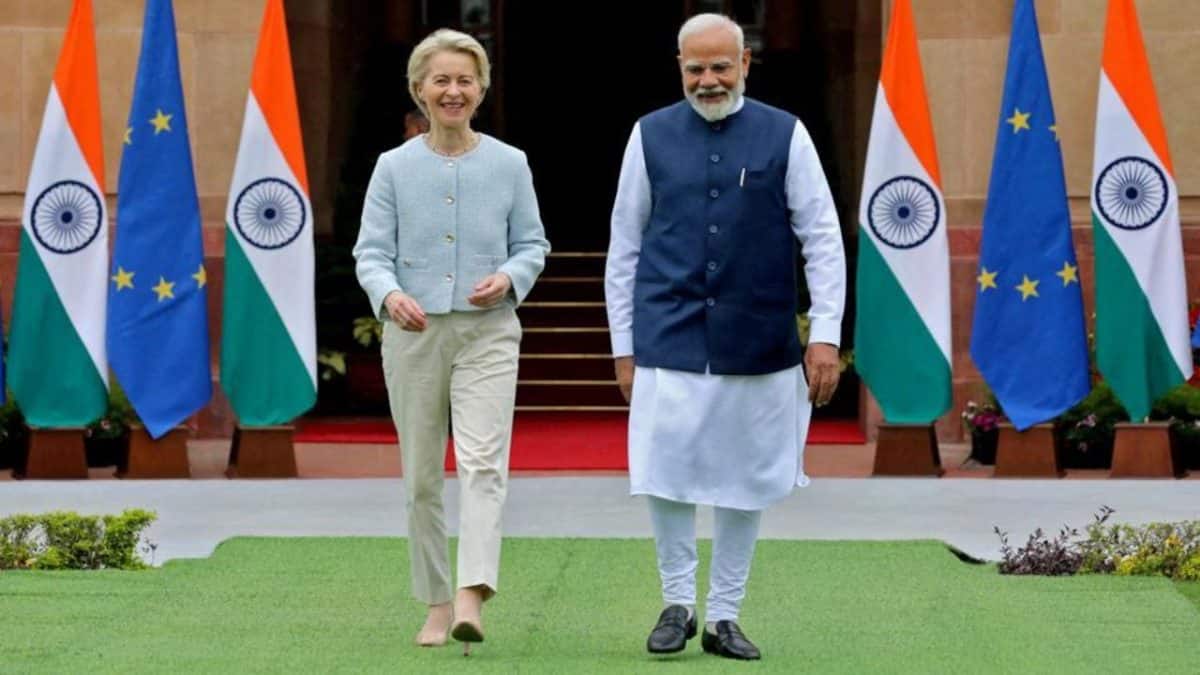
The current European Commission President, German and a woman, Ursula von der Leyen, in the top job as of 2019, recently called the imminent Free Trade Agreement with India the ‘mother of all deals’.
Coming in the backdrop of an aggressively tariffing United States, the prospect of trading freely with nearly 2 billion people representing almost 25 per cent of the world’s GDP is an exciting prospect indeed.
After long years of negotiating, the India-EU FTA is likely to be signed on February 27, after the President of the EU Council, Antonio Costa, and the President of the European Commission, Ursula von der Leyen, grace the occasion as chief guests on India’s 77th Republic Day on the January 26, 2026.
The world has changed a great deal in US President Donald Trump’s second term. The emphasis on ‘America First’ has added some urgency as well as flexibility to the FTA negotiating process.
The EU has also just announced this week in Brussels that it will proceed with a security and defence partnership with India, as per the EU Foreign Policy Chief Kaja Kallas. Both France and Germany are negotiating mega deals in fighter aircraft and submarine collaborations presently, amongst other things. India is also favoured in the defence and other related and unrelated spheres by the United States, Israel, Russia, Brazil, Spain, Japan, South Korea, and Britain, with various projects underway and under consideration.
India is also keen to make its own civilian aircraft, ships and tankers, its own computer chips in collaboration with Taiwan, other electronics manufacturing and assembly, rare earth mining and development, nuclear energy, railway and metro modernisation and development, in addition to a massive defence manufacturing push encompassing the army, navy, air force, space, satellite, deep-sea, and intelligence sectors.
From the Indian point of view, an FTA with the EU will boost technology absorption under its aatmanirbhar programmes in diverse fields, double the exports to Europe, lead to greater employment opportunities and exchanges, including education and medical science, robotics, drones, UAVs, and progress in IT and AI adoption all to an unprecedented degree. Indian-trained and -educated manpower is a strength not only in India but in Europe as well. The EU-India FTA will be the biggest for India so far, representing a decisive entry into a global value chain.
The prospect of India signing the interim trade agreement with the US, recently endorsed by President Trump at Davos, despite the 50 per cent tariffs imposed on India, will redouble India’s position in the global value chain, with many leading American companies choosing to set up development centres in India. These include Google and Amazon. Once the EU-India FTA becomes a reality, the Americans will be keen to proceed with the India-US interim trade deal at the earliest too.
India’s multilateral approach has paid good dividends in terms of diversification of its collaborators and markets, and kept its growth trajectory intact and expanding, despite punitive tariffs imposed by the US. These tariffs are likely to be reduced shortly to no more than 15 per cent, even as other countries in the littoral, who have been granted lower tariff rates compared to India, have not managed to keep pace with it.
It now seems certain that not only will India become the third-largest economy in the world after the US and China by 2028 or 2030, but it will also become a middle-income economy with a per capita income of over $4,000 despite its massive, globe-beating population.
India is also edging closer to China in economic matters as its border tensions come under better control. This is important from the point of view of not being allied to any power blocs, but pursuing its strategic and national interest first. This is favoured, of course, by India’s long-term friend and ally Russia for balance, and makes it clear to those inimical to India’s progress that dogma is not a guiding principle for India.
As India strengthens its relationship with countries in West Asia, Greece, Cyprus, Israel, Egypt, Oman, Saudi Arabia, Armenia, Nigeria, Ethiopia, and with those in the Asia-Pacific such as Malaysia, Indonesia, the Philippines, Vietnam, and Thailand, it gains rich dividends from its non-discriminatory and independent foreign policy. In time, India will be featured in most geo-political and strategic crossroads as a viable and valuable partner.
(The writer is a Delhi-based political commentator. Views expressed in the above piece are personal and solely those of the author. They do not necessarily reflect Firstpost’s views.)
End of Article

