



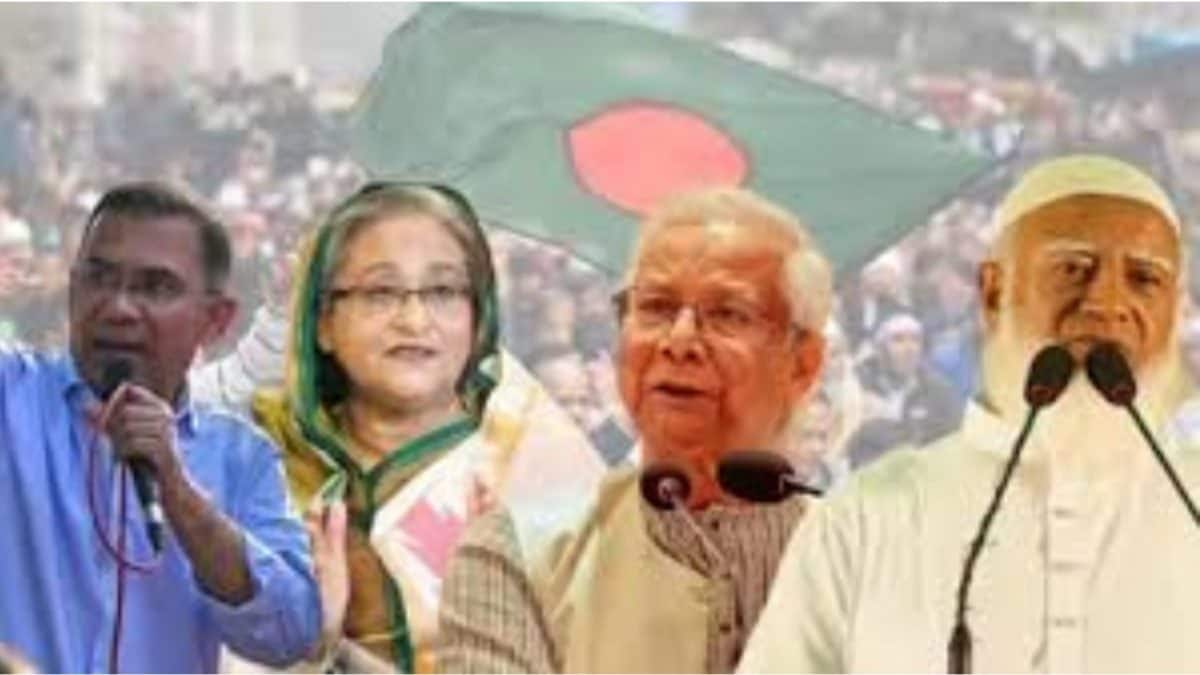
Bangladesh stands at a critical juncture. As the country goes to the elections today, the real question is no longer whether Jamaat-e-Islami can return to politics — it already has. The question is what its return signifies.
Is Jamaat simply a political party engaged in democratic competition, or does it remain an ideological movement with global ties, a complex and debated historical background, and notable flexibility?
After the 2024 student-led ‘uprising’ that removed Sheikh Hasina from power, the interim government lifted the longstanding ban on the outfit in August 2024. The Supreme Court of Bangladesh officially reinstated its registration in June 2025. Currently, Jamaat heads an 11-party coalition that includes the National Citizen Party, formed by student leaders in 2024, and is competing for approximately 224 seats in the election scheduled for 12 February 2026.
Pre-election polling suggests a bipolar contest with the Bangladesh Nationalist Party (BNP), placing Jamaat closer to national power than at any time since independence.
This resurgence extends beyond Bangladesh’s borders, heightening security concerns on India’s eastern border and reigniting ongoing debates in Britain regarding diaspora representation, charity governance and Islamist activism.
1971: The Enduring Wound in Bangladesh’s Politics
Jamaat’s relationship with Bangladesh is inseparable from the country’s birth. During the 1971 Liberation War, the party opposed independence and aligned with Pakistan’s military. Members were accused of collaborating in atrocities against pro-independence activists, intellectuals and minorities — a legacy deeply embedded in national memory and reinforced by the International Crimes Tribunal trials. When people think of the 1971 genocide, Pakistan and Jamaat are the first names that come to mind. They were the perpetrators of crimes against humanity. No amount of revisionism or criticism of the tribunals will change that.
For many Bangladeshis, Jamaat is first judged through this historical lens. Contemporary promises or policy platforms remain secondary to the unresolved trauma of 1971.
The case of Chowdhury Mueen-Uddin shows how this history still has international repercussions. Convicted in absentia by Bangladesh’s tribunal in 2013 for alleged war crimes, he has been residing in the UK, denying the allegations. His previous positions in groups like Muslim Aid have led to ongoing scrutiny of charitable organisations and possible connections to extremism. Some senior Turkish politicians continue to consider him a high-ranking member of Jamaat.
In November 2025, the UK Home Secretary publicly apologised in court and paid £225,000 in libel damages following a lengthy legal case. The court found the allegations — originating from the Bangladeshi tribunal — to be unsubstantiated and defamatory. This incident highlights a broader issue: Bangladesh’s efforts to seek historical justice clash with the legal and evidentiary requirements of diaspora nations.
Pakistan’s Islamisation and the Afghan Jihad Legacy
Understanding Jamaat’s evolution requires looking beyond Bangladesh to Pakistan’s Islamisation under General Zia-ul-Haq after 1977. Zia’s project was not merely religious conservatism; it was a deliberate effort to embed Islamist actors within state institutions and national security structures. Jamaat-e-Islami became a key ideological partner in this transformation. Analysts and former officials have long argued that Zia encouraged members of Pakistan’s military and intelligence services to engage with, and in some cases join, Jamaat as part of a broader effort to align the state with Islamist political thought.
The Soviet invasion of Afghanistan in 1979 then globalised this ecosystem. Pakistan became the central hub of the anti-Soviet jihad, backed by Saudi Arabia, the United States and other partners. During this period, Islamist organisations built deep operational networks across charities, student movements, mosques and diaspora communities.
Jamaat’s disciplined organisational structure — combining political activism, social welfare and religious mobilisation — enabled it to expand its influence significantly during this era. The relationships, funding channels and personal networks forged in the 1980s did not disappear with the end of the Afghan war. Instead, they evolved and spread across South Asia, the Middle East and diaspora hubs, including London.
Transnational Networks and Post-9/11 Scrutiny
After the Afghan war, the rise of global jihadist militancy brought new scrutiny to Islamist networks and charitable ecosystems connected to South Asia.
Investigations and security analyses over the past two decades have repeatedly examined the overlap between humanitarian work, ideological activism and militant financing. These debates remain contested, but they have shaped policy discussions in multiple countries.
One recurring concern has been the movement of personnel between security institutions, Islamist organisations and charities. For example, Muslim Aid’s Pakistan office was previously headed by Khaled Latif Mughal, a former Director-General of Pakistan’s Inter-Services Intelligence (ISI). Such appointments have fuelled long-standing debates in Britain and elsewhere about governance, oversight and the blurred boundaries that can exist between humanitarian work, politics and security networks.
Jamaat-linked charities have also faced accusations in international investigations into support networks linked to militant groups, including claims tied to the Bali bombings and to Hamas. These allegations remain disputed and politically sensitive, yet they continue to shape how security agencies and policymakers assess Islamist charitable ecosystems.
Documents retrieved from Osama bin Laden’s Abbottabad compound mention contacts with a London-based Islamic relief organisation, although surveillance ensured no misappropriation of funds and the identities were not verified. Khaled Sheikh Mohammed was captured at a Jamaat-e-Islami safe house in Pakistan, and some analysts suggest that Jamaat-linked networks may have protected bin Laden. Journalist Syed Saleem Shahzad was killed while probing these connections.
Overall, these episodes have reinforced security analysts’ view that Jamaat’s historical networks extend well beyond electoral politics. Although the party denies extremism and stresses democratic involvement, critics contend that its ideological foundations, institutional ties and past associations warrant ongoing scrutiny.
As Jamaat moves closer to national power, questions about extremism, political Islam and long-term strategic intent are returning to the centre of policy debate in South Asia, India and the United Kingdom.
Bangladesh at a Crossroads
Jamaat’s revival occurs amid the institutional upheaval following the 2024 uprising. Reframed as a disciplined, anti-corruption and welfare-oriented party, it is gaining support from disillusioned voters, especially younger, educated groups seeking alternatives to traditional political elites. Its messaging now emphasises governance, social justice and economic reform.
Yet ideology cannot be separated from political branding.
Jamaat-e-Islami is more than just a conservative party. It is founded on the principles of Abu al-A’la al-Mawdudi, who dismissed secular democracy and promoted an Islamic state based on divine sovereignty. In this view, democracy is permissible only when it functions within religious boundaries; ultimately, political power comes from God, not the electorate.
This ideological legacy matters. It explains why Jamaat has historically been seen not merely as a political actor but as part of a broader Islamist movement seeking long-term societal transformation.
The party is undoubtedly under pressure to moderate as it seeks electoral legitimacy and coalition partners. The central question is whether participation in democratic politics will permanently reshape the movement — or whether power could revive its original ideological project.
This dilemma is not theoretical. It echoes the trajectory of the Muslim Brotherhood in Egypt, which moved from opposition to government before collapsing amid polarisation, mistrust and fears of ideological overreach.
Bangladesh now faces a similar uncertainty.
Implications for India
For India, Jamaat’s rise reinforces perceptions of the eastern border as both a migration challenge and an ideological security frontier.
Fears of cross-border radicalisation, long present in Indian strategic discourse, gain renewed urgency. Jamaat has publicly pledged constructive relations with India, but scepticism persists amid wider regional concerns about extremism and stability.
Implications for Britain
In Britain, the implications are less geopolitical but no less sensitive.
Diaspora institutions influenced by South Asian Islamist traditions may face renewed scrutiny over representation, overseas alignments and historical associations. The Mueen-Uddin case demonstrates the friction that can emerge between Bangladesh’s accountability agenda and Britain’s legal and evidentiary framework. Mawdudi’s influence on British Muslims has waned since a series of exposés on associated networks. The British government encouraged groups linked to Jamaat to develop political ties in the 1990s, but later distanced itself after concerns emerged about their perceived stance on community cohesion and pluralism.
The Broader Stakes
Jamaat’s resurgence therefore represents more than a domestic political shift. It reopens unresolved historical questions inside Bangladesh, heightens security concerns in India and renews debates in Britain about diaspora politics and institutional oversight. At its core lies a deeper question about the future direction of political Islam in South Asia.
Is Jamaat evolving into a conventional democratic party shaped by electoral realities and coalition politics? Or is it a movement temporarily moderating its language while maintaining a long-term ideological project rooted in Islamist governance?
The experience of Islamist movements elsewhere offers no simple answer. Participation in democratic systems has sometimes encouraged moderation, but in other cases it has deepened polarisation and mistrust once power was within reach.
Bangladesh is now entering an uncertain phase. Jamaat’s return to the centre of electoral politics signals a new and potentially volatile chapter in the country’s political development — one whose implications will be felt well beyond Bangladesh.
(The author is a strategist in international relations and economic development. Views expressed in the above piece are personal and solely those of the author. They do not necessarily reflect Firstpost’s views.)
End of Article

