



When cricketing legend Sachin Tendulkar first saw tigress Junabai in the buffer zone of Madnapur at the Tadoba-Andhari Tiger Reserve in Maharashtra, Sunil Mehta told the ‘god of cricket’ that he had “just licked the opium”. When a puzzled Sachin asked why Sunil, pioneer of the COCOON community-based Nature conservancy model, replied, “When you go back to your busy schedule in Mumbai, you will start missing it here. You will come back again, and again, and again. That’s the power of the tiger.” Evidently, Sachin has frequently visited Tadoba and Gothangaon for tiger safaris, most recently in November 2024, to commemorate the 10th anniversary celebrations of Sunil’s The Bamboo Forest safari lodge in Tadoba.
If comparing the thrill of tiger safaris with an opioid high seems like a stretch, it only takes an afternoon at the Umred Pauni Karhandla Wildlife Sanctuary, Maharashtra, to understand the pull.Minutes after you reach the sanctuary’s Gothangaon gate, the guide announces loudly, “Tiger sighting has started. Please hold on,” as he hops onto your safari vehicle — it is also a signal to the driver to gear up. For the next 20 minutes, you hold onto dear life as you are propelled through the thick wilderness on a vehicle moving at a speed only trained safari drivers are allowed to drive. The rocky terrain might throw you up and down in the air, big spiders from the webs you drive through might fall on you, while a skewed-off twine might slap you across the face — “it’s all part of the experience,” you are assured.
But the safaris are not just about high-speed Jumanji rides. The real thrill comes when you try to be as still as the forest on a windless sunny day; it is in staking out, keeping your eyes peeled to spot orange hide or just about anything that moves through the outgrowth, and allowing naturalists and wildlife guides to track the movements of the big cats. As Arjun Manjunath, associate director, The Bamboo Forest Nature Conservancy, puts it, “The thrill is in what happens before you see a tiger.” Unlike African safaris — where there are open savannas, and animals can be seen from kilometres away — here, you need to search for a tiger, he adds.

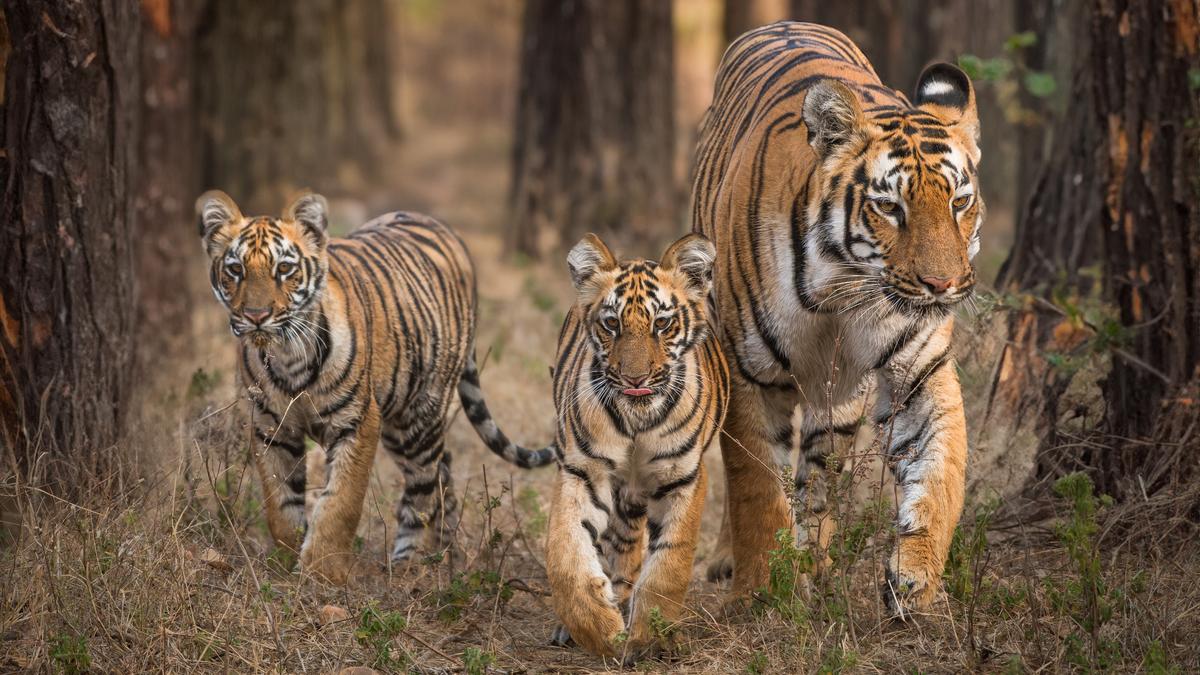
Cubs of tigress Bubbly
| Photo Credit:
Sharath UG
During the safari, guides and naturalists use pugmarks on the soil and animal calls — animals like spotted deer and monkeys give out distress calls when they see a tiger — to track the tiger. “When an apex predator moves through the jungle, from the smallest bird to the largest elephant, every species announces the presence of this powerful animal. This ensures you keep all your eyes, ears, and senses open,” says Arjun.
He also advises you to lend an ear to what your naturalist has to say about it — be it the animal’s behaviour, its features, or just about anything fascinating about tiger ecology.
Ankita Pathak has been working for over a year as a naturalist at The Bamboo Forest Nature Conservancy in Gothangaon. “A tiger safari is not just about going out and coming back. When you’re on a safari, you understand all that you pass through — woodlands, grasslands, wetlands — and the naturalist explains why the habitat changes.”
She adds that while it is okay for tourists to be quite fixated on the big cat, it is ideal to be interested in all that these magnificent ancient woods have to offer. “We explain how birds play a huge role in this whole activity. Peacocks give calls when they spot leopards. Rufous treepies give alarm calls when they see tigers. So it’s not just about tigers — it’s about understanding birds, herbivores, small mammals, and insects. When a predator moves, the entire forest comes alive.”
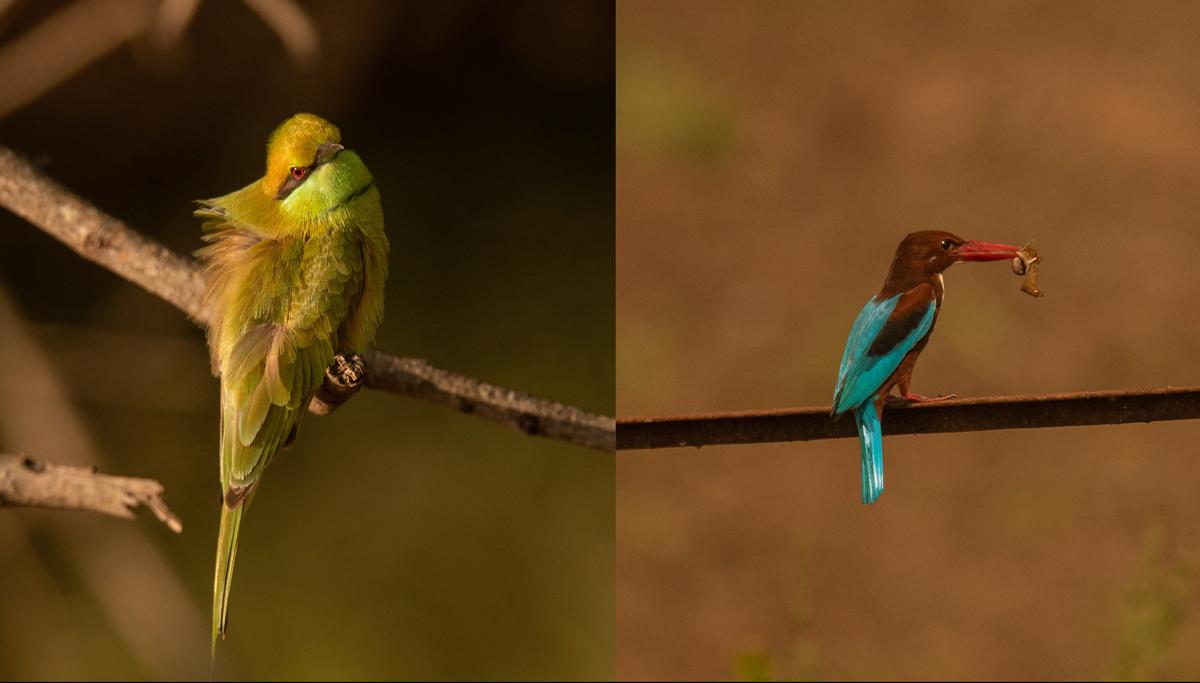
Asian green bee-eater and white-throated kingfisher in Tadoba
| Photo Credit:
Bhuvanesh Chandar
“The whole purpose of us accompanying guests is to finally convert them into ambassadors of wildlife conservation,” pitches in Arjun, adding that safaris also attract many great personalities through which private entities like The Bamboo Forest facilitate CSR activities that help the local communities. The revenue generated by tiger safaris also helps the villages, which otherwise would still be in the thick of animal-human conflict, says Arjun.
But sometimes you may not even see a tiger on a safari, and that is all right. Ankita assures that naturalists do enough homework to ensure guests get to see a tiger. Even during the safari, the experts are constantly coordinating using walkie-talkies and mobile phones, passing on crucial information. “Full-day safari vehicles cover additional routes, and we get information from those vehicles too, so that sightings can be communicated efficiently. But tigers are unpredictable; it’s all about being in the right place at the right time,” says Ankita.
Sometimes, some shy tigers choose paths that are not frequented by vehicles, she adds. “We explain territory-mapping to guests — that is, where a tiger is likely to be and why. Moreover, even if the guests miss a sighting, we show them indirect evidence — scratch marks, rake markings, pugmarks, birds, butterflies, tiger moths — and all these are part of the experience. We communicate clearly with guests and understand what they want from the safari.”
Sunil reminisces about how a trip to the Sariska Tiger Reserve as a child changed his life forever. “Later, when the Sariska poaching happened” — when it was revealed that the reserve that had 16 tigers in 2002 was left with zero tigers by 2005 — “I was shocked.” That ushered in everything that followed for Sunil, including the founding of The Bamboo Forest Experience. Sunil stresses how seeing a tiger in a zoo comes nowhere close to seeing it in its own natural habitat.
Meanwhile, Anoopama Mukerjee Lohana, experiential wellness hospitality consultant and wellness director, The Bamboo Forest Experience, has just three letters to convince you to go on a wildlife safari — A.Q.I. “If you want to breathe fresh air, come to the forest. Being in the forest balances you, slows you down, and calms you,” she adds.
Now, if you are familiar with tiger safaris, you might wonder what is so special about the Tadoba-Andhari Tiger Reserve or the Umred Pauni Karhandla Wildlife Sanctuary. After all, popular national parks like Pench, Jim Corbett and Ranthambore come to mind when one thinks of tigers. Arjun and Sunil say that the regions of Tadoba and Gothangaon have been seeing a steady rise in tourists. “As a naturalist, I have been to over 38 tiger reserves in the country, apart from many wildlife sanctuaries. 15 years ago, many did not know about Tadoba; the tiger reserve had over 25 tigers then. Now, it has over 100, and people are getting a real taste of wildlife tourism,” says Arjun.
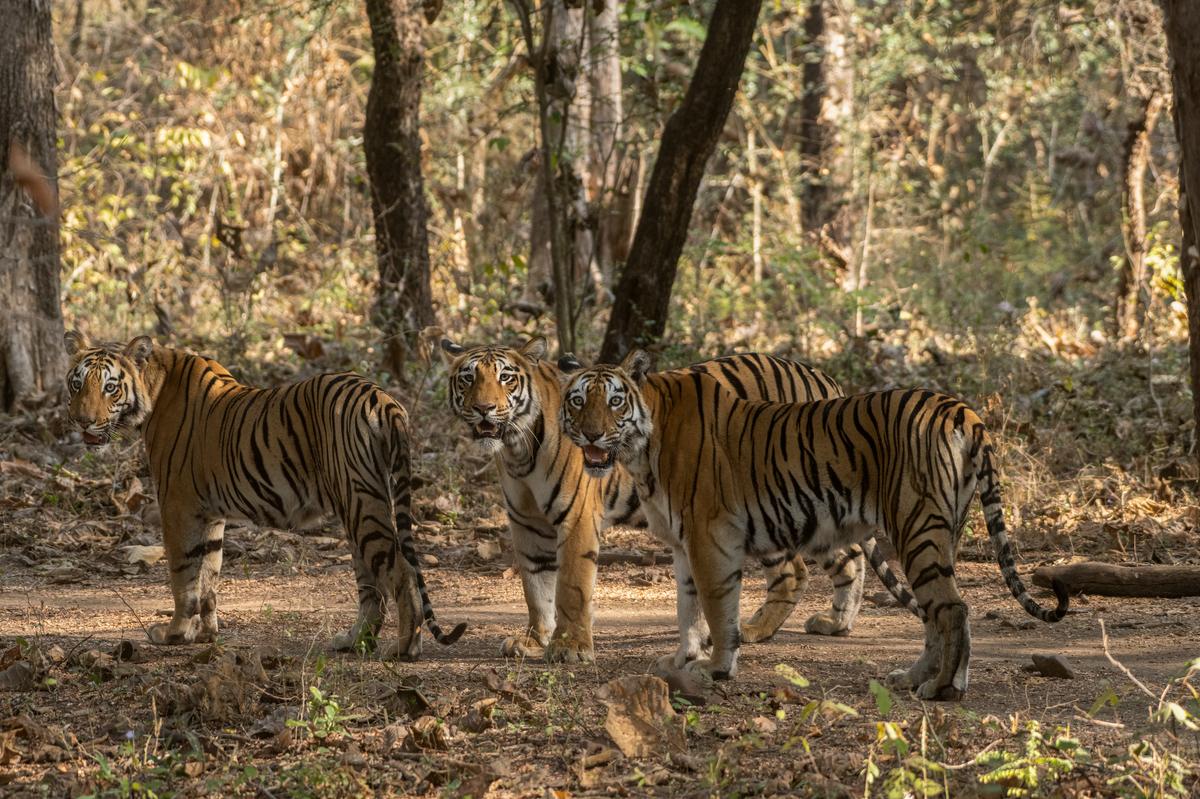
Tigress Bhanuskindi with her cubs at the Tadoba-Andhari Tiger Reserve
| Photo Credit:
Sharath UG
Umred Pauni Karhandla, in particular, benefits from its unique location, he adds. “It lies exactly between Tadoba and Pench, right along the Wainganga River. This space, spanning 189 square kilometres, acts as a great place for tigers to disperse. It is part of the Eastern Vidarbha tiger corridor, and if a tiger decides to leave its natural territory and move out, Umred Pauni Karhandla is a great place where they can halt, explore the region, take over territory, or push out older males,” says Arjun, adding that the presence of around 36 large water bodies, apart from the backwaters of the Wainganga River, also makes it a birding hotspot. “This place attracts a lot of winter migrant birds. Last year, while going on safaris in and around the conservancy, we recorded around 360 species of birds — migratory, passage visitors, resident birds, and summer visitors,” he adds.
As we speak, there are six breeding females with cubs at the wildlife sanctuary, like Fairy, Collarwali, X-Mark, F1, F2 and Shadow. “Breeding females indicate the health of an ecosystem. If prey density isn’t strong, breeding wouldn’t happen,” says Arjun, adding that Shadow’s daughter from the first litter is expected to become the seventh breeding female soon. “The region also has male tigers like M4, J-Mark and Patil.”
It was well past 10 when I wrapped up my interviews, and Sunil, packing his safari gear in a jiffy, asked me to hurry up and tag along — someone had notified his team of a call near the Nature conservancy, and Sunil was positive that it was F2 with her cubs. After two safaris at Tadoba and Gothangaon and a two-hour road trip between, one should retire to their room. But just the prospect of getting to see a magnificent tigress, with her young adult cubs, in the thick of the dark, jolted me awake. Perhaps Sunil Mehta was not exaggerating — tiger safaris can narcotise one as much as a Sachin Tendulkar cover drive.
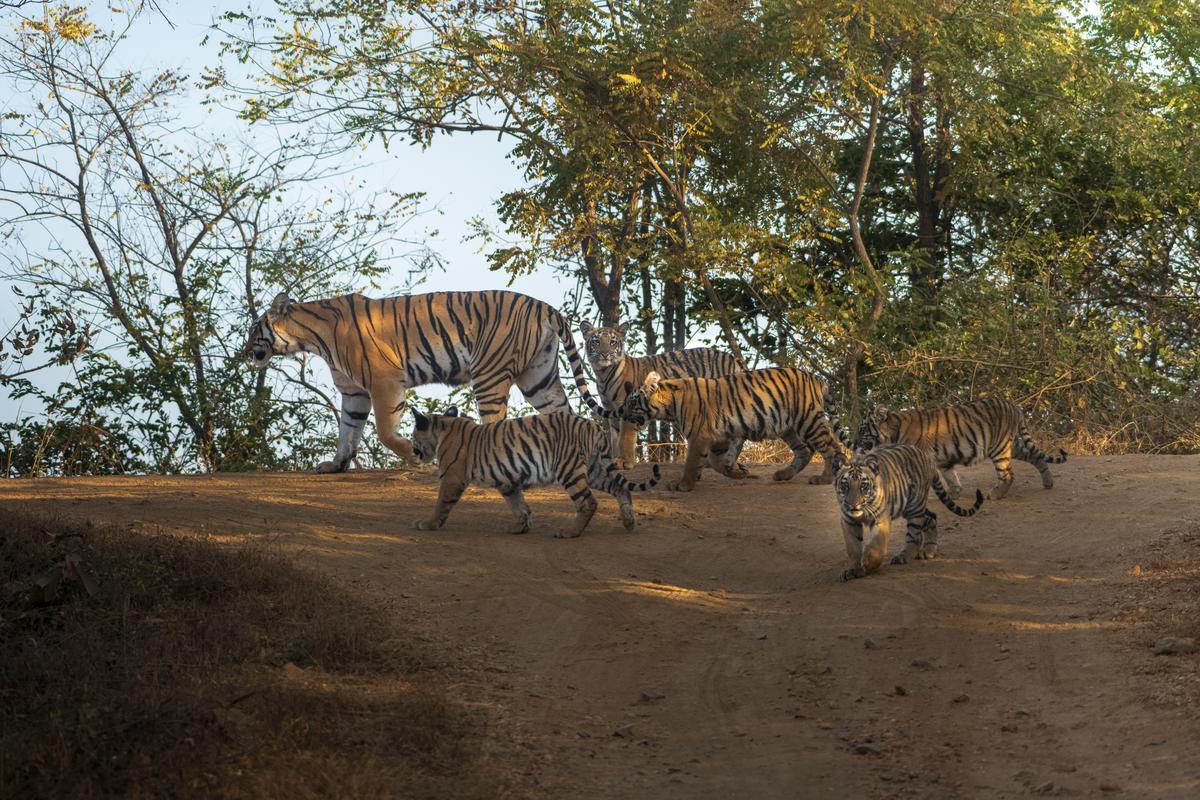
Tigress F2 with her cubs in Gothangaon
| Photo Credit:
Sharath UG
Wilderness and wellness:
Apart from the chance to see tigers, the Bamboo Forest Experience Safari Lodge at Tadoba and the Nature conservancy at Gothangaon offer guests a unique spa experience that integrates wellness and wilderness. “These have been niche spaces. Now, post-pandemic, people are travelling more and reconnecting with their roots to experience wellness on a daily basis. Approximately 78% of global travel by 2028 is expected to turn to green prescriptions,” — a term used for a prescription to spend more time in Nature to heal oneself — “and spiritual wellness. That’s where the concept to marry wellness and wilderness came about,” adds Anoopama
“It’s the most natural movement for personal wellness. There’s a global renaissance happening, in which people are going back to Nature-based, earth-first concepts, especially Ayurveda.” She explains how many of these wellness schools, be it Siddha, Shaman, and the old Tibetan ways of healing, were born in the forest. “So, we are basically bringing them back home. Wilderness and wellness were born out of each other, which is why your mind and body balance and restore when you step foot into a forest,” says Anoopama, adding that more modalities like Amazonian and Tibetan will be brought into the modules in the near future.
Everything one experiences at the Bamboo Forest Experience has wellness integrated on a sensorial level. “It’s everything you smell — the fragrance changes according to the season. The towels, the welcome drinks and the beverages offered before safaris are all customised to suit the season.” So even those who are interested in just the safaris can experience an elevated spa experience. “We also offer night tea and Nabhi oil to our guests so that they get a taste of what wellness in the forest can feel like,” says Anoopama.
An interesting aspect of the Ayurvedic meals served at the properties is that they get customised as per your Dosha something that is ascertained by an in-house medical professional.
Each course of the meal is prepared with each of the six Rasas (tastes) in Ayurveda. For instance, in one of the menus that was served to me, the meal started with a sweet dish, like roh di kheer, and was followed by a detox rainbow salad that is meant to appeal to sour taste buds. The starters — the bitter karela besan bites and the pungent ragi millet chips with green chilli thechaa — were finger-licking good, quite in contrast to what one might expect from a health-oriented meal. I was then served some delicious new baby potatoes with salted curry leaves tempering, and the meal ended with a lauki paalak kofta and bhakri , which made for an astringent addition to the menu. “A lot of people think healthy food is all boiled food. We don’t want that trigger. So here it’s a soft but firm, and deep wellness,” informs Anoopama.

