





For nearly two decades, our relationship with mobile technology has been governed by a single, undisputed design: the app icon grid.Ever since Apple launched the App Store in 2008, the burden of digital logistics has rested firmly on the user.Need a taxi? Open an app. Want to order dinner? Open another app. Pay a bill? Another app. Book a flight, check the news, edit a photo, send money, check your fitness, reserve a hotel, translate a menu, buy groceries — there is an app for everything.The modern smartphone is essentially a container filled with hundreds of miniature software silos, each demanding its own login, interface, permissions, subscriptions and updates.
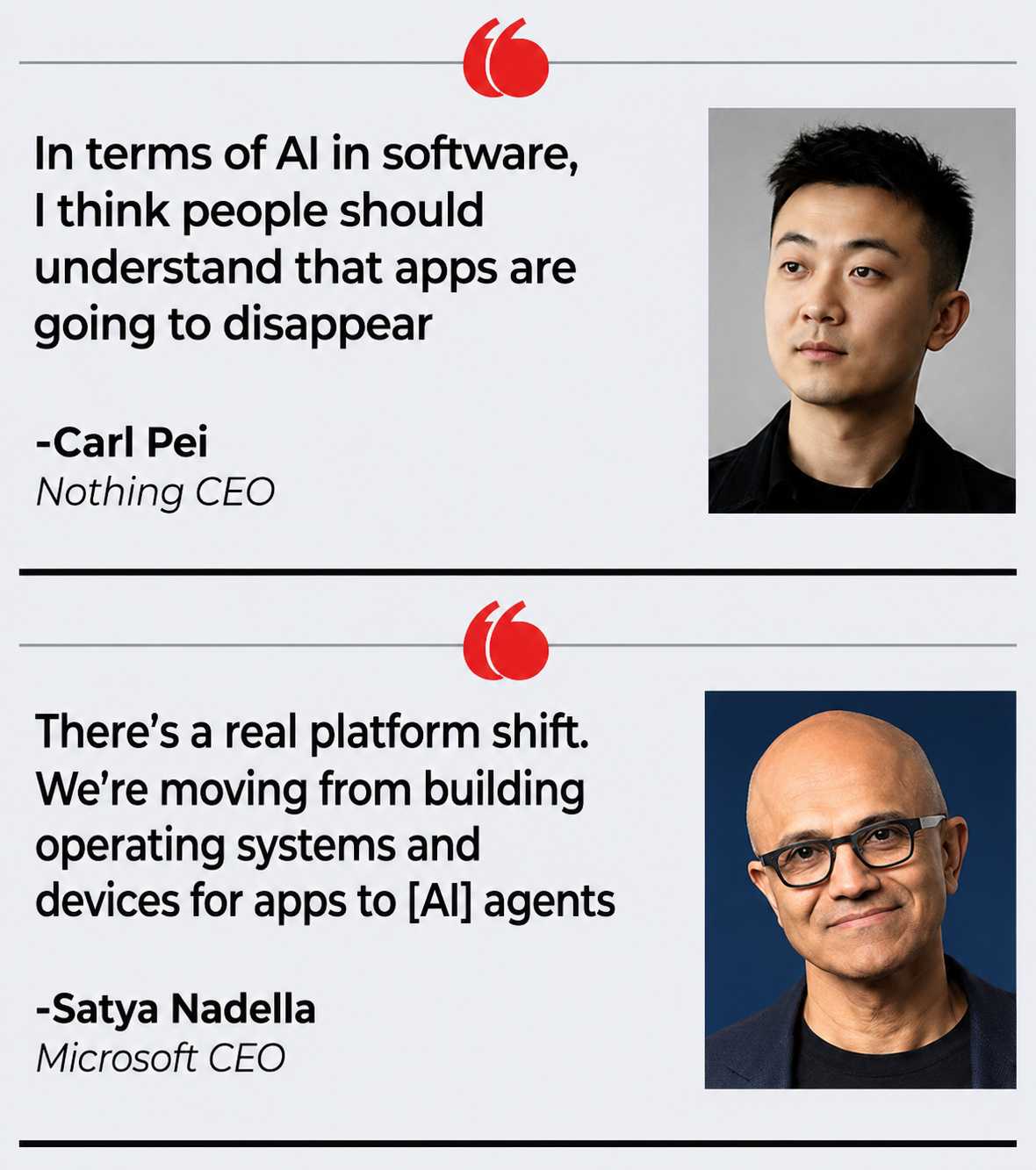
The era of scrolling through grids of colourful icons and hunting for the ‘right’ app is ending.
App Store and Google Play became the gateways to this digital universe, spawning a multi-billion-dollar economy that transformed companies like Apple and Google into the world’s most powerful software gatekeepers.This model is about to collapse.The era of scrolling through grids of colourful icons and hunting for the ‘right’ app is ending.We are on the precipice of the biggest shift in consumer technology since the multi-touch screen: the rise of the ‘AI-first’ smartphone.
What is an AI-first phone?
Today’s smartphones are built around apps because software was designed for humans to navigate manually. Every service has its own interface. Every company competes for a permanent place on the home screen. Success is measured by daily active users opening an app multiple times a day.AI-first smartphones promise a radically different future — one where users rarely think about apps at all.The devices are designed around small language models (SLMs) and multimodal AI agents that will run locally on your phone for quick, privacy‑sensitive tasks; and hand-off heavier reasoning to edge or cloud computing.
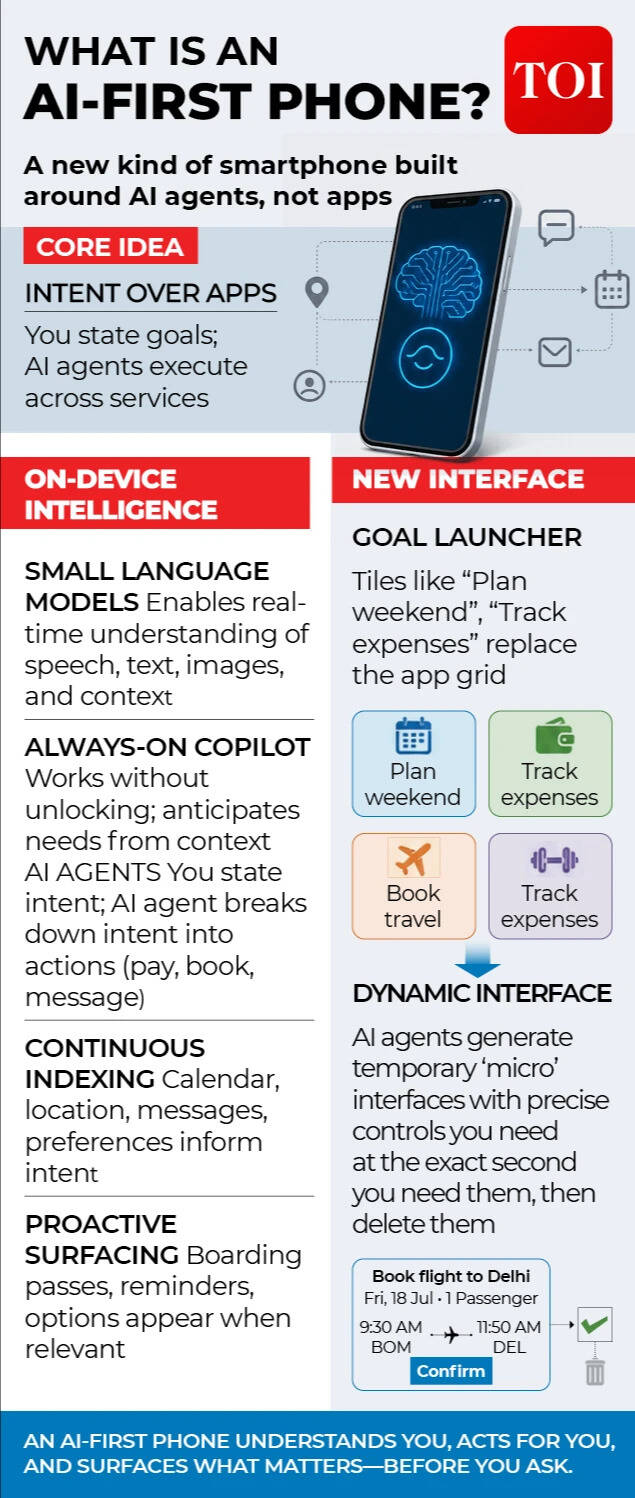
AI-first smartphones promise a radically different future — one where users rarely think about apps at all.
The phones will discard the traditional operating system architecture of home screens, file systems, and sandboxed apps.In their place will be an ‘Intent Engine’ — a continuous, real-time operating layer powered by AI agents.Instead of interacting with software through apps, users will express their intent to AI agents.When a user expresses a goal — whether spoken, typed, or inferred through context — the phone’s core AI agent will break down that intent into logical sub-tasks, assign actions to underlying services, and compile the result into a custom, dynamically generated view.
What will it look like?
In practice, the home screen will become a goal launcher, not an app grid.You might see tiles like ‘Plan my weekend’, ‘What’s in the news?’, or ‘Track expenses’, each invoking an agent that orchestrates the underlying services.Without the structural necessity of cramming dozens of app icons onto a home screen, phone hardware can evolve beyond the glass slab.While touchscreens will remain vital for rich visual consumption, hardware design will prioritise contextual inputs: micro-cameras, directional arrays, health sensors, and ambient displays. The primary interface becomes voice, gesture, and subtle visual cues.Because the device is powered by an overarching agent rather than hundreds of disparate software platforms, phone performance will be pristine. Storage constraints shift from managing gigabytes of cached app binaries to hosting optimised, localised neural networks.
A day with an AI‑first phone
Consider a typical scenario on a contemporary device versus an AI-first phone:
- App-centric workflow: You decide to take a last-minute weekend trip. You open a search engine to find destinations, launch a travel aggregator app to search flights, hop into a hotel app to compare rooms, open a weather app to pack appropriately, and manually copy-paste reservation details into your calendar and communication apps. You tap dozens of buttons and navigate through multiple distinct user interfaces.
- The AI-first workflow: You simply say, “Find me a relaxing beach getaway for this weekend under Rs20,000 total, handle the bookings, and make sure I’m home by Sunday night for dinner.”
The phone’s AI agent does not “open” an app. It queries hundreds of services simultaneously.It evaluates airline availability, checks boutique hotel inventory, verifies your personal calendar for conflicts, pulls your saved dietary preferences for in-flight meals, and presents a single, unified execution card: “Flight booked on Carrier X, room reserved at Hotel Y, total cost Rs18,780. Confirm payment via Biometrics?”With one tap or voice confirmation, the entire transaction settles.You never browsed an app, never logged into a third-party interface, and never manually transferred a single byte of data.When you arrive at the airport the agent surfaces your boarding pass and gate changes without you opening an airline or travel app or email.
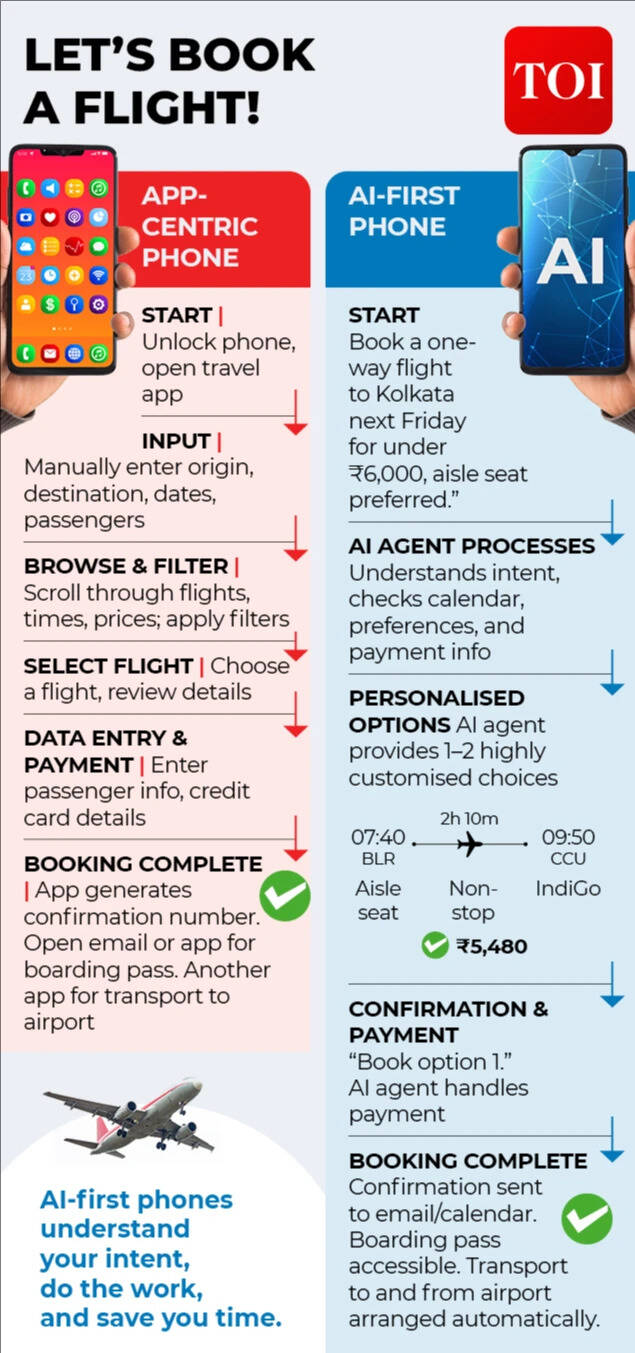
This might all sound like sci-fi, but phones with such capabilities are already on the way.
When you land, the AI agent has already arranged a rental car for your transport.When you need to pay a parking fee, it identifies the lot operator, fetches terms, and pays via biometric authentication — no apps required.Over time, the phone learns your preferences and constraints, making these interactions faster and more anticipatory.Health apps would stop being destinations and become background services.Instead of jumping between sleep, fitness, medication, diet, and doctor apps, you could simply say, “Help me recover from a bad week of sleep” or “Book the earliest endocrinologist in my network,” and the phone would pull data from wearables, records, pharmacies, labs, and calendars to act on your behalf.That would make health management far more proactive. The phone could spot problems early — a rising resting heart rate, missed medication, or a sleep pattern going off track — and respond before you even open an app.The same shift would hit financial apps even harder.Rather than using separate banking, payments, budgeting, tax, and bill-pay apps, you could say, “Pay my credit card, move the rest to savings, and warn me if travel spending goes over budget,” and the phone would handle it in the background.This might all sound like sci-fi, but phones with such capabilities are already in the advanced production stage and the underlying technology has already been proven. As AI automates more of our routine digital interactions, the focus will shift from managing apps to engaging with curated experiences, from structured wellness journeys to step-by-step lessons in finance and investing.
What this means for platforms, business models
The app store model has been the single most lucrative cash cow in modern technology history.Platforms like Apple and Google extract up to a 30% commission on digital purchases, while controlling distribution, user acquisition, and developer access.
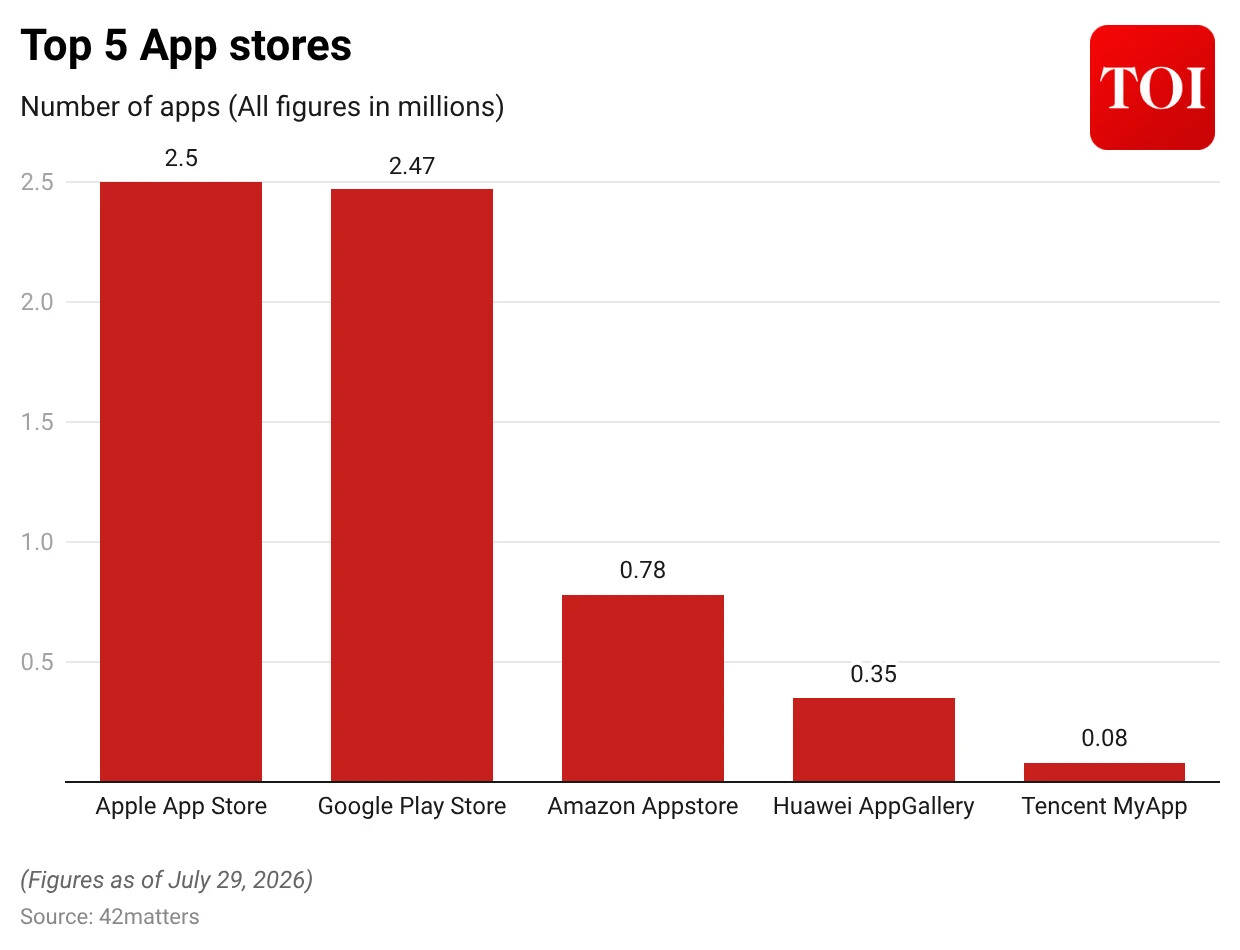
The rise of agentic AI threatens to disassemble this walled-garden economy entirely.Market research firm Gartner last year projected that mobile app usage will drop 25% by 2027 as AI assistants absorb routine tasks, a trend already visible in how people use AI tools instead of opening multiple apps for research, drafting, and scheduling.App stores were built for a world where software arrived as siloed products with their own user interfaces (UI) and update cycles.AI agents invert that model:
- No downloads, no updates: Users won’t install a parking app, they will ask an AI agent to pay for parking, and it will fetch the operator’s terms and then complete the payment.
- One interface, many back‑ends: The conversational layer replaces hundreds of bespoke interfaces. The value shifts from designing a tap‑heavy UI to ensuring your service is reliably callable by AI agents, which means having a robust Application Programming Interface (API), a set of rules that lets different softwares talk to each other.
- Discovery moves from stores to agents: Instead of optimising for store rankings, companies will optimise for being the agent’s trusted choice — based on price, reliability, speed, and policy compliance.
The app economy won’t vanish overnight, but its centre of gravity will move:
- App stores as service registries: Stores may evolve into curated directories of agent‑callable services (APIs) with verified security, privacy, and compliance badges — less about installs, more about trust.
- Monetisation shifts: Revenue models may tilt toward per‑action fees, subscriptions, and revenue share on agent‑completed transactions rather than one‑time downloads or ad‑heavy freemium apps.
- Developer pivot: Teams will build “agent skills” and robust APIs, not just UIs. The competitive edge becomes reliability, speed, and transparent pricing that AI agents can compare.
Brands will no longer compete on who has the slickest app design or the most addicting engagement loops; they will compete on execution speed, data reliability, and service quality.A food delivery service won’t win customers by optimising ‘dark patterns’ in its app; it will win because its backend API offers the fastest delivery times and lowest rates when an AI agent compares options on behalf of a user.Businesses won’t simply ask:“How do we rank first on Google?”They’ll ask:“How do we become our customer’s AI’s preferred choice?”
The end of the app as we know it?
Predictions about the death of apps should be treated cautiously. Email survived instant messaging. Websites survived social media. Desktop software survived cloud computing.Apps are unlikely to vanish completely.Many professional tools, creative applications, games and specialised software will still benefit from rich, dedicated user interfaces. A graphic designer editing a complex image or a gamer playing a visually intensive title will continue to rely on purpose-built applications.But for the vast majority of everyday smartphone interactions, the trend points in a different direction.Booking travel, paying bills, getting news updates, shopping, scheduling appointments, managing subscriptions and countless other routine tasks are increasingly suited to conversational AI that can coordinate multiple services behind the scenes.Just as few people think about the networking protocols that power the internet, future users may stop thinking about apps altogether. They will simply tell their phones what they want, and the AI will decide how to make it happen.If the smartphone era was defined by tapping icons, the next chapter may be defined by something far simpler: asking.And when software becomes something you ask rather than something you open, the app store no longer sits at the center of the mobile experience. It becomes the plumbing behind it.For users, the payoff is simplicity: fewer icons, fewer logins, fewer steps.For builders, the mandate is clear: design for agents — reliable APIs, transparent pricing, and policies that make your service the obvious trustable choice when the phone decides on the user’s behalf.
