



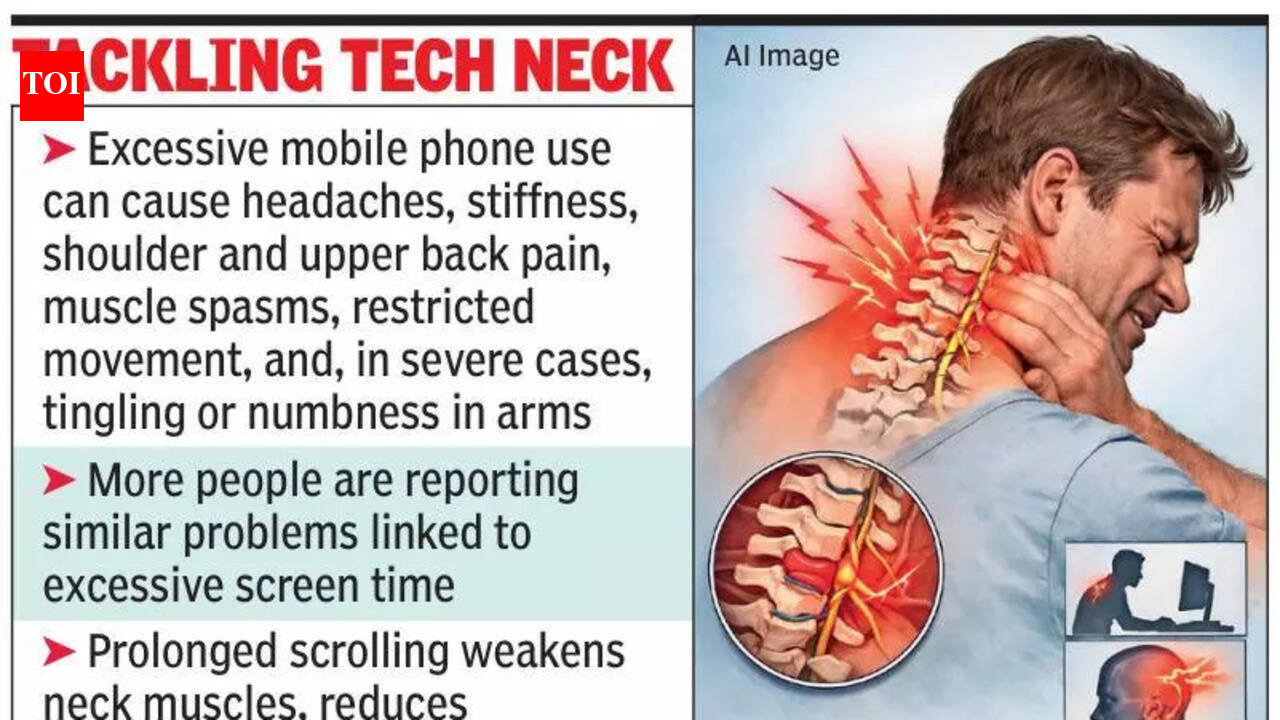
Lucknow: For two weeks, 23-year-old Fahim Rizvi from Chowk battled persistent headaches, stiff neck and shoulder pain. When painkillers failed to help, he consulted a doctor.An X-ray revealed misalignment of cervical spine (neck region), following which he was referred to the orthopaedics department at KGMU.Doctors learned that Rizvi spent 7 to 8 hours daily watching reels and short videos on his phone. The constant forward tilt of his neck strained his cervical spine, leading to a posture-related condition commonly known as “text neck”.The condition can cause headaches, stiffness, shoulder and upper back pain, muscle spasms, restricted movement, and, in severe cases, tingling or numbness in the arms.Doctors say increasing number of young adults, teenagers and schoolchildren are reporting similar problems linked to excessive screen time. Prolonged scrolling weakens neck muscles, reduces flexibility, and strains ligaments, sometimes disturbing sleep and concentration.KGMU officials are now seeing 150 to 200 such cases every month, compared to just 10 to 20 5 years ago. Ram Manohar Lohia Institute of Medical Sciences reported similar rise. Private hospitals, including Max Super Speciality Hospital and Apollomedics Hospitals, report 15 to 20 comparable cases each month in their orthopaedics and ophthalmology OPDs.KGMU orthopaedic surgeon Prof Shailendra Singh explained how human head weighs about 4 to 5 kg in a neutral position, but the load on the cervical spine can increase to nearly 25 to 27 kg when bent forward at a 60-degree angle. If ignored, this strain may reduce blood flow to the brain and damage neck muscles, causing headaches and stiffness.Dr Divyanshu Dutt Dwivedi of Max Hospital warned that it can also lead to disc damage, nerve compression, flattening of natural neck curve and early degenerative changes. He advised limiting recreational screen time to 2 hours for adults and less than 1 hour for children, keeping devices at eye level and performing regular neck exercises.Neurosurgeon at Apollomedics Dr Chhitij Srivastava said cases surged among teenagers and young professionals. “Excessive scrolling affects not just the spine but also sleep, concentration, and mental well-being,” he said, advising breaks every 15 to 20 minutes.RMLIMS orthopaedic surgeon Dr Swagat Mahapatra, at , warned that growing smartphone dependence could make “text neck” one of the most common lifestyle disorders among urban youth unless preventive steps are taken early.
