



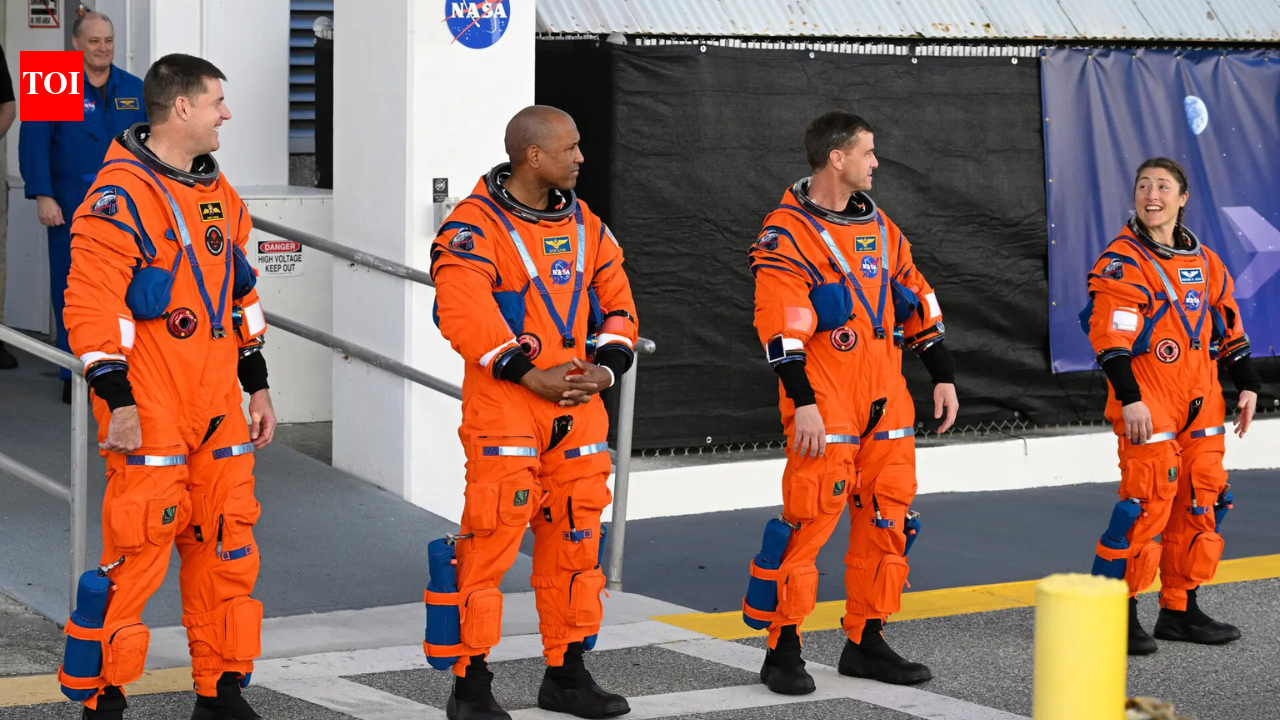
The four astronauts aboard Nasa’s Artemis II mission entered the moon’s gravitational sphere of influence early Monday morning, moving toward a key milestone in the first crewed test flight of Nasa’s Artemis program.Flying in the Orion capsule since launching from Florida last week, the crew is expected to wake around 10.50 am ET Monday for their sixth day in space. Later in the day, they will reach one of the mission’s most significant moments as they travel around the moon’s far side.By 7.05 pm ET, Artemis II is due to reach its maximum distance from Earth, about 252,757 miles, placing the crew 4,102 miles farther than the Apollo 13 astronauts and setting a new record for the farthest-flying humans in history.As Nasa astronauts Reid Wiseman, Victor Glover and Christina Koch, along with Canadian astronaut Jeremy Hansen, approach that record, they will be flying about 4,000 miles above the moon’s darkened far side. From there, they are expected to see the moon eclipse a basketball-sized Earth in the distance.The lunar flyby, officially beginning at 2.34 pm ET, will last about six hours. During that time, the astronauts will pass into darkness and experience brief communications blackouts as the moon blocks contact with NASA’s Deep Space Network, the global system of giant radio antennas used to communicate with the spacecraft.The crew will use professional cameras to capture detailed images through Orion’s window, including views of the moon in silhouette with sunlight filtering around its edges in what will effectively appear as a lunar eclipse.They are also expected to photograph a rare view of Earth rising above the lunar horizon as the capsule emerges from the far side — a reversal of the familiar moonrise seen from Earth.The moment marks a climactic point in the nearly 10-day Artemis II mission, which is the first crewed test flight in Nasa’s broader Artemis campaign. The multibillion-dollar program aims to return astronauts to the moon’s surface by 2028 before China and establish a long-term US presence there over the next decade, with a future moon base intended to help prepare for possible missions to Mars.Back on Earth, dozens of lunar scientists gathered in the Science Evaluation Room at Nasa’s Johnson Space Center in Houston will closely follow the flyby. The astronauts, who studied a range of lunar phenomena during training, are expected to describe what they see in real time.
