



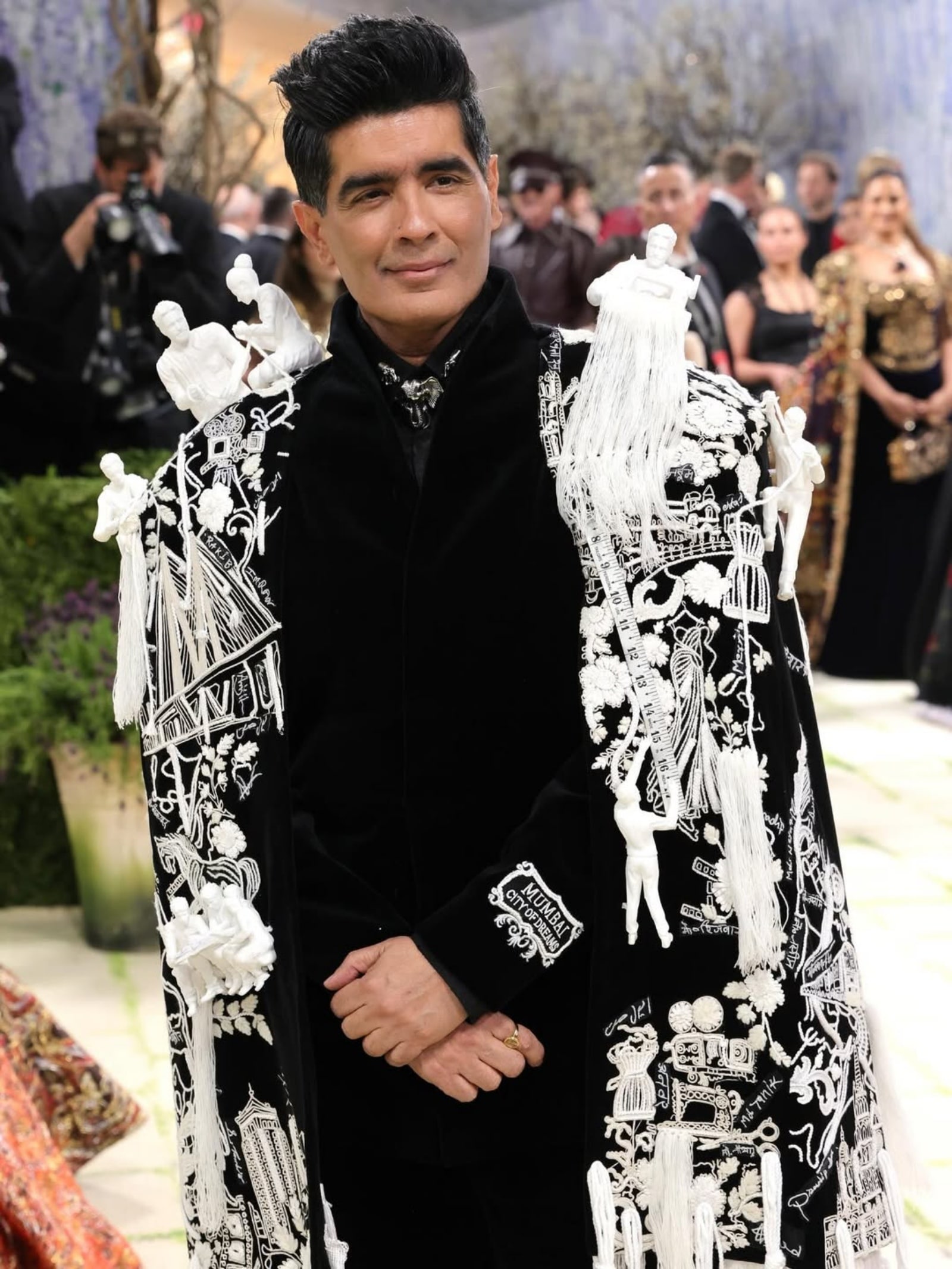
Luxury fashion has perfected a paradox: It celebrates craftsmanship while depending on the invisibility of the craftspeople. At the 2026 Met Gala — where the theme invited fashion to be seen as art — this contradiction was not hidden. It was staged, illuminated, and, in one rare moment, disrupted. At this year’s event, an Indian designer did something the global fashion system rarely allows: He made labour visible.
When filmmaker Karan Johar appeared in a Raja Ravi Varma-inspired ensemble, he did more than make a debut. He translated Indian visual culture into the language of global couture. The garment functioned as a canvas, layering history, mythology, and identity into a form legible to the West’s most exclusive fashion audience.

But if Johar’s appearance expanded what could be seen as fashion, designer Manish Malhotra used his appearance to question who gets to be seen within it.
His now widely discussed “Mumbai” cape did something the global fashion system rarely permits: It named its makers. The artisans behind the garment — usually absorbed into the anonymity of luxury — were credited directly on the piece. In an industry built on singular authorship, this was not a design detail. It was a structural interruption.
For decades, fashion has relied on a carefully maintained illusion. Craft is elevated as heritage, skill, even artistry. But the artisan is kept at a distance — present in narrative, absent in recognition. Embroidery is celebrated; embroiderers are not. The value of luxury depends not just on labour, but on its invisibility.
This is not incidental. It is systemic. In global fashion, visibility is curated — and labour is what gets edited out.
Global fashion operates through a separation of seeing and making. What is visible is the finished object, the designer, the spectacle. What remains hidden is the network of labour that produces it. This is a network that is often dispersed across geographies like India, where craft is abundant but authorship is not.
Events like the Met Gala do not produce fashion, but they define how fashion is understood. They are stages of symbolic power, where garments are detached from their conditions of production and reintroduced as art, fantasy, or cultural capital. In this translation, labour disappears.
In recent years, the industry has increasingly adopted the language of sustainability, craft revival, and ethical fashion. Yet much of it remains aesthetic. The language has evolved faster than the system itself. Craft becomes a signifier of authenticity; sustainability becomes a visual cue. The deeper structures — wages, attribution, and working conditions — rarely enter the frame.
This is not always outright deception. It is something more insidious: A system in which ethics can be performed without being redistributed.
Seen this way, Malhotra’s gesture acquires a significance that exceeds the red carpet. By naming artisans, he collapses the distance between creation and creator. He challenges the idea that design belongs to a single author. And in doing so, he exposes a deeper truth: That the global fashion system is structured to separate recognition from labour.
India’s presence at this year’s Met Gala was therefore not just representational — it was diagnostic.
On one hand, it marked a shift in cultural power. Indian designers and celebrities are no longer peripheral participants; they are shaping the narrative itself, bringing textile histories and artistic vocabularies into the centre of global fashion discourse.
On the other, it revealed the limits of this visibility. India may export craft at scale, but it has yet to export the right to authorship that should accompany it.
If the future of fashion is to be sustainable — not just environmentally, but socially — it will require more than the celebration of craft. It will require a redistribution of credit, visibility, and value.
Until then, fashion will continue to display craft, without ever truly acknowledging the hands that make it possible.
The writer is associate professor and programme coordinator for fashion design at IILM University, Gurugram
