



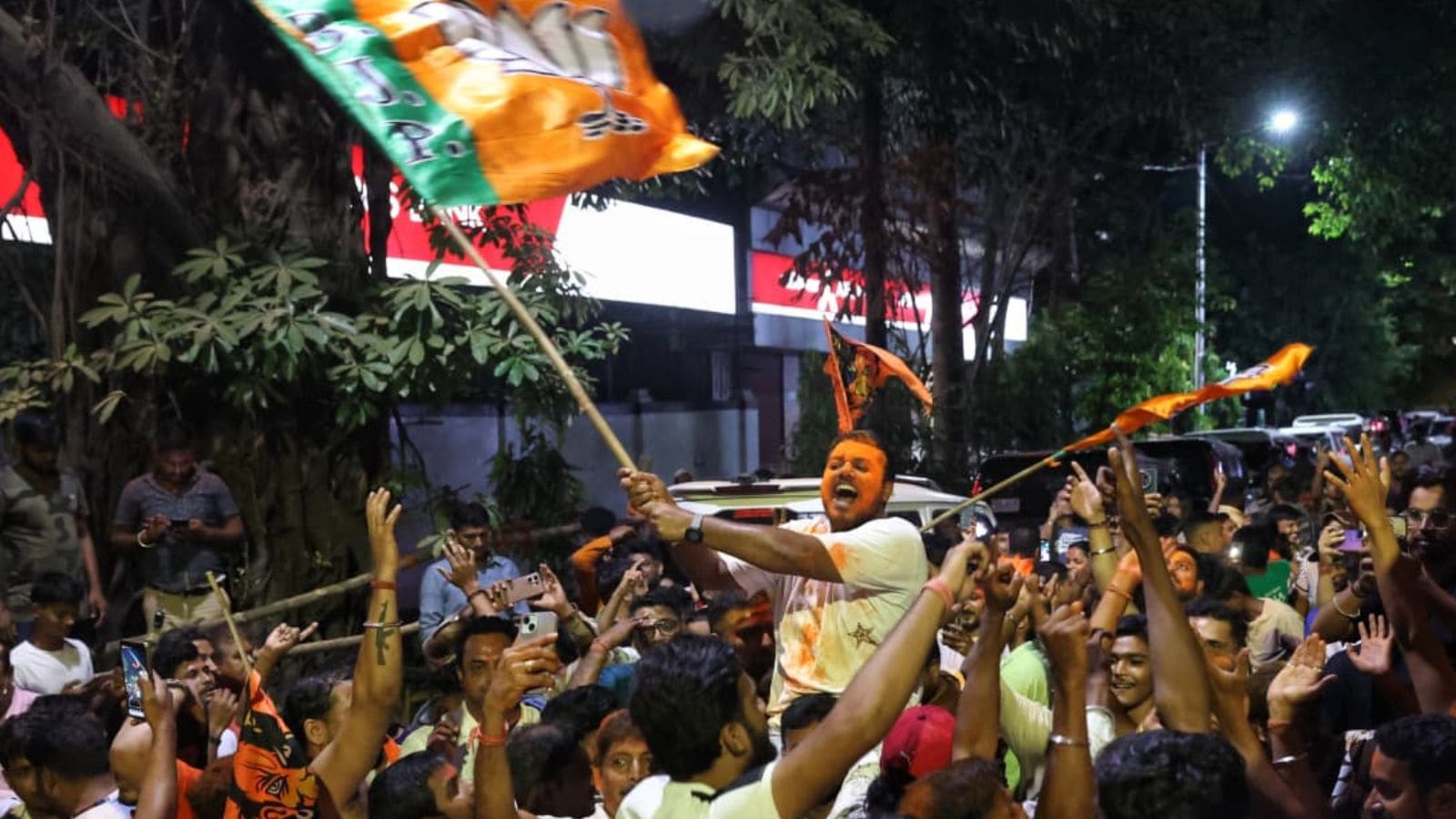
After years of trying, Hindutva forces have finally breached the fortress of West Bengal. The saffron lotus appears poised to bloom where it was born but never truly took root. But what made the fortress crumble?
A preliminary analysis of the results points to five interconnected factors.

Hindu consolidation
The BJP’s victory can largely be attributed to a significant consolidation of Hindu voters, who make up about 70 per cent of the electorate. Given that only a small fraction of Muslims — around 30 per cent of the population — are likely to have supported the party, its current vote share of roughly 46 per cent, points to an unusually high level of Hindu consolidation, estimated at nearly 65 per cent. This is comparable to the level of Hindu consolidation that the BJP typically achieves in its traditional strongholds, such as Gujarat and Madhya Pradesh.
In the run-up to the elections, many felt that the TMC government was “appeasing” Muslims to the detriment of Hindus. This impression was partly shaped by Mamata Banerjee’s highly visible participation in Muslim festivals and her performance of symbolic religious gestures. Additionally, the last few years have seen the emergence of several riot hotspots experiencing communal disturbances with alarming frequency.
Political opponents and affected individuals often accused the state administration of inaction, bias, or even complicity whenever such incidents occurred. Media coverage — such as images of people fleeing Murshidabad by boat to seek refuge in Malda, and reports of the lynching of idol makers Harogobind Das and Chandan Das during communal disturbances in Murshidabad in April 2025 — further fuelled concern and anger.
The perception of victimhood was further intensified by reports of repeated attacks on Hindus in Bangladesh following the fall of the Sheikh Hasina government. As the deteriorating communal situation in Bangladesh became a common topic of discussion across Bengal, the TMC, constrained by political considerations, maintained an unpopular silence on the issue.
The anxiety and anger were especially evident among East Bengali refugee communities in border districts — particularly the Dalit Matua-Namasudra population, many of whom have family ties across the border. Incidents such as the lynching of Dipu Chandra Das, a Namasudra garment worker in Bangladesh, and the circulation of a video showing the brutal killing and burning of his body, sparked widespread outrage.
I was quite surprised to learn from some of my ground informants that even people whose names had been deleted due to the SIR had been actively participating in the BJP’s election campaign, with the hope that the BJP, due to its pro-Hindu stance, would ultimately deliver on its promise of securing citizenship status and voting rights for the Matuas.
SIR
The SIR seems to have worked in the BJP’s favour at two levels — narrative and arithmetic.
In terms of narrative, the SIR exercise has provided a concrete political outlet for long-standing concerns about socio-economic insecurity linked to illegal migration from Bangladesh. The rationale behind SIR seamlessly fits into the larger narrative of Hindutva politics, which in West Bengal has primarily been framed around the allegation that the TMC, as a matter of political strategy, is soft on illegal infiltration from Bangladesh.
On the arithmetic side, two probable yet speculative assertions can be made. First, the deletion of dead and shifted voters has helped the BJP by eliminating the possibility of proxy voting. Second, 27 lakh voters who are under adjudication are predominantly from TMC strongholds.
However, what is not speculative is the fact that the TMC’s strategy of making SIR its principal poll issue has failed to find any resonance among the electorate. It appears that the party did not pay sufficient attention to two crucial aspects.
First, the SIR issue failed to gain any meaningful traction in the Bihar elections a few months ago. Second, West Bengal is not an outlier in the proportion of voters removed from electoral rolls. In West Bengal, about 90 lakh names were deleted from a total electorate of 7.69 crore (12 per cent), while the corresponding figures are 74 lakhs out of 6.41 crore in Tamil Nadu (11.5 per cent), 8.57 lakh out of 2.78 crore (3 per cent) in Kerala, and 2.05 crore out of 15.44 crore in Uttar Pradesh (13 per cent).
Anti-incumbency
If one takes the scale of the victory into account, the influence of the secular logic of anti-incumbency also becomes evident. Over the past 15 years, a combination of factors — declining law and order, concerns about women’s safety, high unemployment, entrenched corruption, syndicate dominance, increasing hooliganism and lumpen behaviour, and the curbing of dissent — has steadily built a strong wave of anti-incumbency. The R G Kar incident likely acted as the tipping point.
The appalling level of corruption that led to the dismissal of 26,000 school teachers not only destroyed the careers of those directly affected but also had wider repercussions. In a state marked by limited job opportunities and declining industrial growth — where teaching positions and lower- and mid-level government jobs serve as key avenues of social mobility — such institutionalised corruption shattered the hopes of an entire generation of rural and semi-urban youth.
In this context, the BJP’s promise of a “double-engine” government and of doubling direct cash transfers to women and unemployed youth blunted the appeal of the TMC’s welfare schemes.
Breakdown of the coalition of extremes
The TMC’s social base was embedded in a coalition of extremes — the upper-caste Bhadralok and Muslims. While some cracks in its Muslim vote bank seem visible in Muslim-dominated districts, the party’s performance in the traditional Bhadralok strongholds of South Bengal has been nothing short of miserable.
The famed Bhadralok social constituency, known for its liberal and secular outlook, had resisted the BJP in the past through its own version of Bengali regionalism. In 2021, the BJP’s heavy dependence on central leadership allowed the TMC to play the Bengali asmita card by branding the BJP as a party of outsiders. This time, however, the BJP delegated greater responsibilities to state-level leaders.
Additionally, by fielding a Bhadralok intellectual like Swapan Dasgupta in Kolkata’s elite Rashbehari constituency and appointing Samik Bhattacharya, known for his strong oratory, as the state party president, the BJP sent the right signals to the urban middle classes. Further, the BJP’s campaign claim that Kolkata increasingly resembles an extended old-age home — driven by the migration of educated youth to other states in search of better career opportunities — appears to have resonated with segments of the urban middle class.
Limits of anti-Centre politics
Although anti-Centre rhetoric has long been a central feature of Bengal’s political culture, the perception that the TMC was pushing it beyond acceptable limits steadily gained ground as the elections drew closer.
Unlike the CPI(M), whose anti-Centre approach was largely restricted to issues of financial federalism with only occasional overreach, the TMC has increasingly engaged in sharp diatribe against a range of central institutions — from the Election Commission and the armed forces to individual members of the judiciary. Incidents such as Mamata Banerjee seizing documents from Enforcement Directorate officials during a raid, and the detention of judicial officers by a mob during an SIR hearing in Malda, contributed to damaging and avoidable optics.
The verdict against the TMC appears to reflect an intense appetite for change, driven by concerns over law and order, corruption, and economic stagnation. At the same time, there is an expectation that Bengal’s long-standing inclusive and secular cultural ethos will be reflected in governance, in line with the BJP’s stated slogan of sabka saath, sabka vikas, sabka vishwas.
The new dawn should begin with the consensus that the Bengalis, irrespective of caste, class and religion, will swim and sink together.
Guha is a British Academy International Fellow, School of Global Studies, University of Sussex. He is the author of The Curious Trajectory of Caste in West Bengal Politics: Chronicling Continuity and Change (Brill/Manohar)
