



Few public intellectuals in the country command attention across ideological lines the way Shashi Tharoor does. Whether one agrees with him or not, his writing compels engagement, and his arguments invite reflection. That is why his recent article on Pakistan in a national newspaper is particularly disappointing. Not because it lacks goodwill or rhetorical finesse, but because it rests on false, make-believe assumptions.
Tharoor begins by stating that for more than two decades, “the trajectory of India-Pakistan relations has followed a grimly familiar pattern: cautious overtures, hopeful summits, and then, inevitably, a terrorist attack that derails the process”.
This seems to be a largely correct assessment of the Bharat-Pakistan saga, but for one crucial omission. While the pattern has been more or less this way since Independence, and not just 20-odd years, it has ceased to be so in the past decade. By presenting this trajectory as continuous and unbroken, Tharoor ignores a decisive shift in Delhi’s strategic thinking vis-à-vis Islamabad.
Until 2016, Delhi indeed persisted with dialogue despite repeated and persistent betrayals. Narendra Modi himself followed this inherited policy for nearly two years, extending goodwill gestures — from inviting Pakistan’s Prime Minister to his swearing-in to making an unscheduled stop in Lahore. That experiment ended not in peace but in violence, with the Pathankot terror attack in January 2016. Any analysis that fails to acknowledge this rupture risks misdiagnosing the Pakistan problem.
The larger issue, however, lies not in chronology but in philosophy. Tharoor argues that “no dialogue” cannot be a “permanent answer”. He adds, “Silence is not strategy, it is stasis. In a region as volatile as our Indian subcontinent, stasis is dangerous. The absence of communication does not freeze tensions; it allows them to fester.”
In an abstract, value-neutral world, these are sensible propositions. Between two normal states, dialogue is indeed a stabilising mechanism. But Pakistan is anything but a normal state, and treating it as one has been among Delhi’s most enduring strategic blunders.
Pakistan’s hostility towards Bharat is neither accidental nor episodic; it is structural, ideological and civilisational. It is not the outcome of misunderstanding but of self-definition. The Pakistani state was born in opposition to Bharat, sustained through antagonism, and legitimised its very existence by projecting its eastern neighbour as a permanent adversary. In such a framework, dialogue is not interpreted as maturity or goodwill but instead as weakness.
No wonder Delhi’s commitment to dialogue, irrespective of provocation, could not moderate, far less negate, Pakistan’s behaviour; instead, it incentivised duplicity and encouraged it to incorporate terror as a state policy. Parliament in 2001, Mumbai in 2008, and Pathankot in 2016 — all took place when diplomatic channels were wide open. Dialogue became a confidence-building measure not for the so-called civil society, but for terror elements.
Tharoor, in his article, places particular emphasis on the role of human relationships. “In the long run, the most effective deterrent to cross-border hostility may not be military might or diplomatic isolation, but the presence of human relationships that resist the logic of enmity,” he writes.
Such noble-sounding ideas have long captivated policymakers in Delhi, who repeatedly searched for “good Pakistanis” — liberals, secularists and civilians — hoping they would be a natural antidote against Islamist extremism. That search has been as persistent as it has been elusive.
Indira Gandhi’s misplaced faith in Zulfiqar Ali Bhutto during the 1972 Shimla talks remains a cautionary tale. Despite explicit warnings from the then RAW chief, RN Kao, to “count her fingers” after shaking hands with Bhutto, she chose sentimentalism over realpolitik, releasing Pakistani prisoners without securing the return of her own soldiers in Pakistani captivity, and returning captured territories without seeking concessions on Kashmir. The belief was that Bhutto, being a civilian prime minister, with the added qualification of being a socialist and a liberal, was the best person for Delhi to deal with.
The outcome, as Husain Haqqani writes in his book India Vs Pakistan, was that “Indira Gandhi thought she had finally been magnanimous at Shimla, but the Pakistanis saw the absence of pressure for a full settlement of Kashmir as an opportunity to keep conflict alive”.
The search for “human relationships” incessantly pushed Delhi to look for “people like us” — liberals, secularists and democrats — within Pakistan. The assumption that a person with such attributes, especially in Pakistan, is inherently more rational and peace-loving has consistently proven false. Personal liberalism has never translated into strategic moderation.
No wonder Zulfiqar Bhutto, way back in 1965, while addressing the UN Security Council, called for “a thousand-year war” with Bharat. Such was the Islamist fervour in liberal Bhutto that even representatives of other countries were surprised to hear him say that “for 700 years we sought to achieve equilibrium between the people of the two major communities”, given that Pakistan had existed for only 18 years at the time!
His daughter, Benazir Bhutto, again hailed in the West and in certain quarters in Bharat as liberal, presided over the Taliban’s rise in the 1990s. Likewise, Nawaz Sharif, a civilian prime minister, was at the helm during the Kargil War. The list is long…
The roots of such doublespeak lie in Pakistan’s founding ideology itself. The state was not merely created as a homeland for Muslims but as a negation of Bharat’s civilisational continuity. The two-nation theory was not an electoral slogan; it was a fundamental claim — that Hindus and Muslims were so fundamentally different that coexistence was impossible.
In his historic Lahore address of 1940, Mohammed Ali Jinnah bracketed Hindus and Muslims as “two different philosophies, social customs and literatures… Very often the hero of one is a foe of the other, and likewise their victories and defeats overlap”. Now compare this with Asim Munir’s much-derided statement last year — reminding his fellow citizens that they are “different from Hindus in every possible aspect of life”—and one finds commonality in their larger worldview.
It is here that Bharatiya understanding often falters, confusing tone with substance. Jinnah is often invoked as a secular, liberal figure, citing his personal habits as evidence of liberalism but ignoring the harsher truth of how he single-handedly created a nation in the name of Islam, resulting in the killing of lakhs of people and the displacement of millions. In Pakistan, one can drink whisky, eat pork, quote Marx, and still believe in Islamist supremacism — as author Aatish Taseer found out much to his discomfort while interacting with his father, Salman Taseer, the Governor of Pakistan’s Punjab province, who was assassinated by his own bodyguard in 2011 for seeking reforms to the blasphemy laws.
Salman Taseer, for all his libertarian traits, saw himself as a defender of Islam. Aatish Taseer writes in his book Stranger to History: “I felt sure that none of Islam’s once powerful moral imperatives existed within him, but he was a Muslim because he doubted the Holocaust, hated America and Israel, thought Hindus were weak and cowardly, and because the glories of the Islamic past excited him.”
The virus of Islamism has infected Pakistan so deeply that it may, on the surface, appear a normal society, but scratch the surface and its tendency to be the “vanguard of Islam” becomes obvious. There exists an eerie consensus among fundamentalists and secularists, sectarians and liberals, civilians and military alike, on how to deal with the other: their methods may differ, but the objective remains constant.
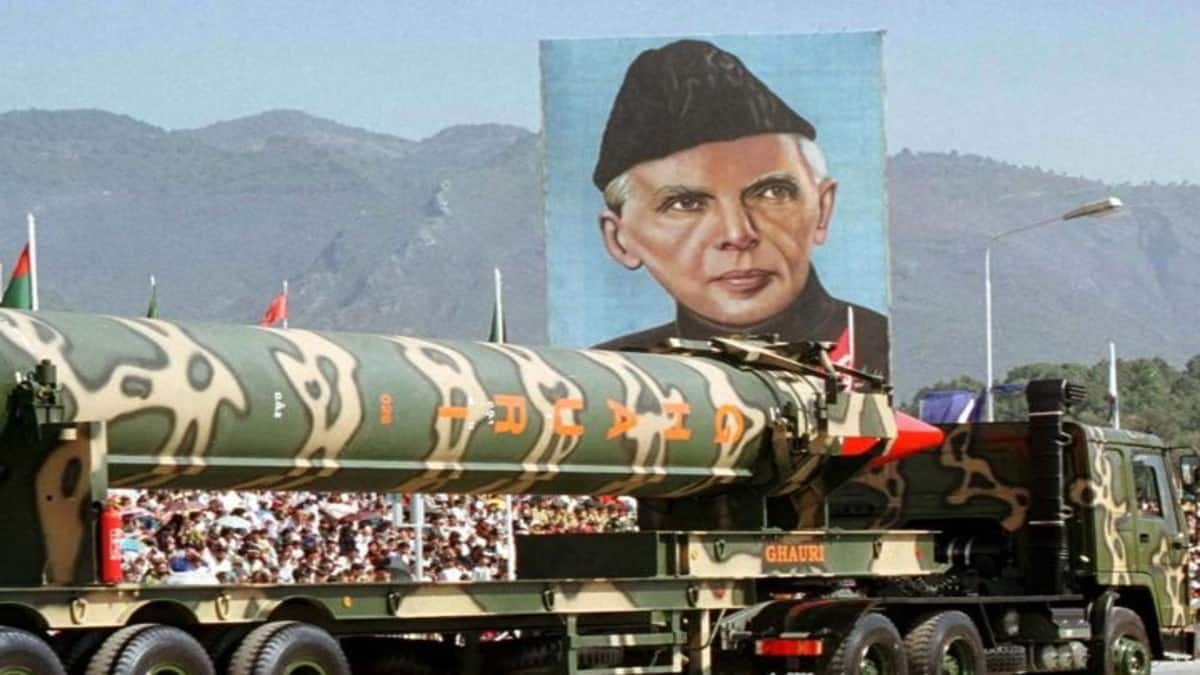
American journalist Peter Landesman recalls seeing a painting at former Prime Minister Benazir Bhutto’s Islamabad residence depicting “Jinnah’s arm pointed to the vast plain beyond the city, where a rocket was lifting out of billowing clouds of vapour and fire into the sky”. A Pakistani brigadier explained the painting as “a nuclear warhead heading towards India”. Landesman initially took it as a joke, soon realising it was not.
If one thought this was just an aberration, read former ambassador Rajiv Dogra’s book, Where Borders Bleed. Among several such disturbing incidents, it recounts the author meeting a Pakistani minister, by no means a hardliner, who stretched both arms forward, palms facing upwards, and said: “If God were to grant me a wish, I would ask Him to place a nuclear bomb on each of my palms.” Then, with a smile, he turned his palms downwards and added, “One I would drop on Bombay, the other on Delhi.”
This is the ultimate Pakistani wish. There is no liberal or fundamentalist distinction here. No civilians or military. No men or women.
Against this backdrop, Tharoor’s insistence that “permanent disengagement is not a solution” sounds less like a realistic assessment and more like an argument born of emotion and nostalgia. Talking for the sake of talking is not engagement; it is ritual, a dogma. For years, citizens were taught to believe that dialogue itself was diplomacy, that refusing to talk was irresponsible. What was forgotten was that restraint can also be a strategy, and the decision not to talk can at times be the most prudent form of diplomacy.
The evidence is telling. Since Bharat decisively refused to resume unconditional talks — talking just for the sake of talking — the frequency of major terror attacks has declined. This does not mean Pakistan has changed its character, but it does suggest that clarity, deterrence and consequences are more effective than talks without accountability.
Tharoor’s heart may be in the right place, and his desire for peace sincere and well-intentioned. But Pakistan is not a normal state — and normal rules do not apply to it. Talking to an arsonist, after all, isn’t diplomacy. It took Delhi more than six decades to arrive at this simple but pragmatic Pakistan policy. To revert to the Nehruvian mirage would be self-defeating.
(Views expressed are personal and solely those of the author. They do not necessarily reflect Firstpost’s views.)
End of Article
