



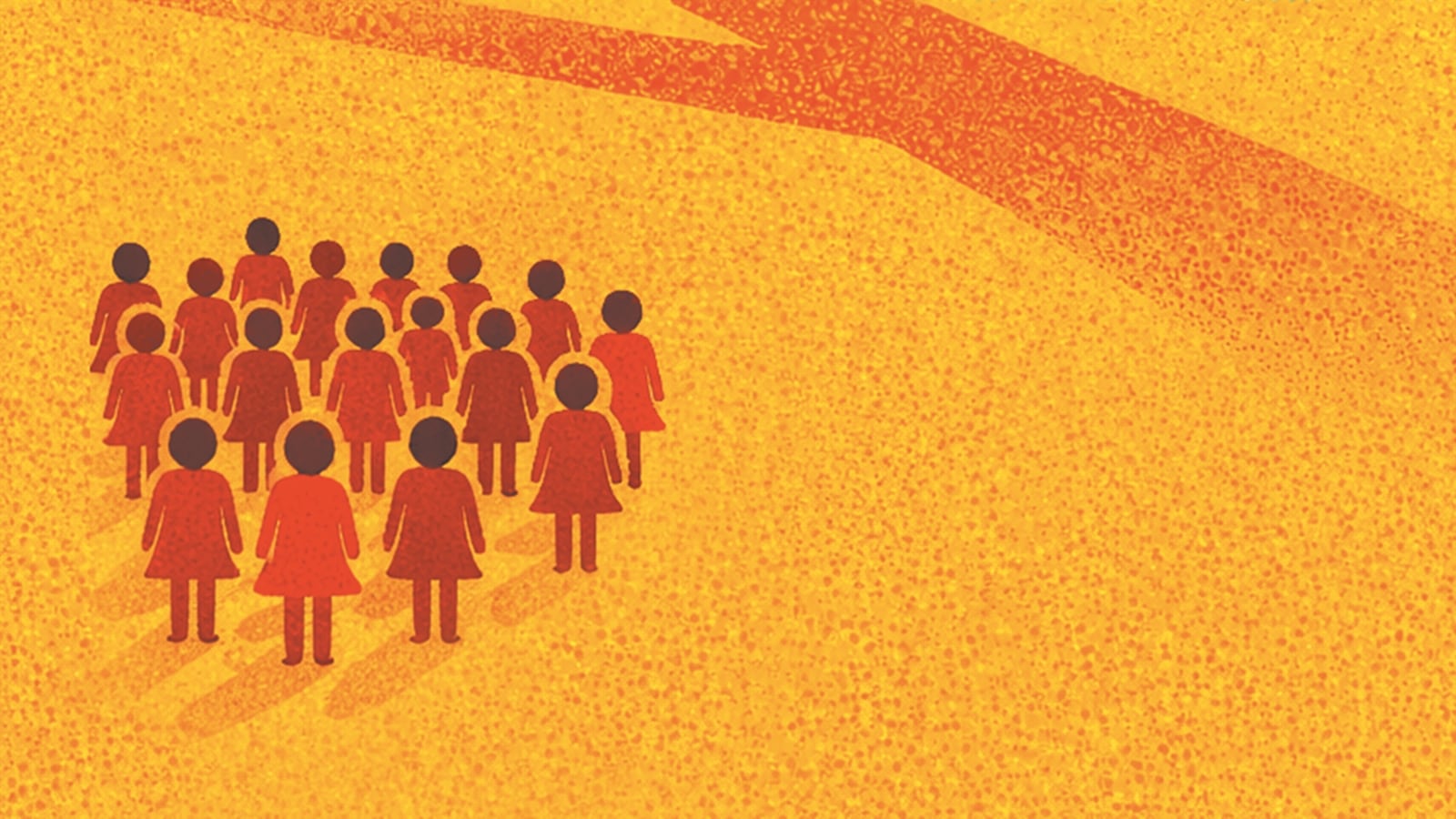
The Nari Shakti Vandan Adhiniyam, and the fresh legislative moves now associated with it, ask India to confront a long-postponed question: Who gets to sit in the rooms where the country makes its most consequential decisions?
The proposal is simple in principle, even if complex in execution: Reserve one-third of seats in the Lok Sabha and state assemblies for women. This is a structural intervention in a political order that has treated male dominance as natural, inevitable, and often indistinguishable from merit.

India’s Parliament has long remained overwhelmingly male. Women form nearly half the population, yet they have hovered around 14 per cent in the Lok Sabha, with even weaker representation in many states.
For years, women’s reservation moved in and out of national debate. Governments introduced bills, praised the idea, but delayed execution. The objections are familiar: Rotation of seats would unsettle incumbents; sub-quotas for Other Backward Classes and others change the arithmetic; implementation should wait for the next Census or delimitation exercise. While these debates continue, women remain largely outside the institutions that decide on labour, violence, health, land, welfare, and economic policy.
The Constitution (131st Amendment) Bill, 2026 has still not passed muster in Parliament. This fact matters. It means the promise remains unfinished. But the Prime Minister’s renewed push has reopened the central question with urgency: Should India continue to wait for perfect conditions before correcting a deep democratic imbalance?
The answer is a firm no.
Concerns around delimitation and federal balance deserve serious attention. They are not imaginary. Any redrawing of seats can sharpen anxieties between regions. These risks should be managed, not used as excuses for indefinite delay. A country of 1.4 billion people cannot keep treating women’s political exclusion as a technical inconvenience. Delimitation may carry costs, but so does postponement. India has already paid the price for generations.
The need is immediate; the pandemic exposed how unevenly crisis falls on women. Women lost jobs disproportionately, absorbed more unpaid care work, and faced rising violence behind closed doors. Climate stress, agrarian distress, education gaps, public health, nutrition, migration, and informal labour all demand perspectives that male-dominated legislatures have too often narrowed or ignored.
India already has experience with women’s reservation in panchayats, where one-third, and in many states nearly half, of the seats have been reserved for women since the 1990s. Women sarpanchs have often prioritised water, sanitation, schools, nutrition, roads, and local accountability. Their presence has not solved every problem. Proxy politics, caste hierarchies, and patriarchal control persist. But the experience shows that when women enter institutions in meaningful numbers, the agenda changes.
Scaling that presence to Parliament will not automatically transform India. It will, however, expand what Parliament sees and hears.
International experiences show both the promise and the limits of quotas. Rwanda, after the 1994 genocide, used constitutional quotas to increase women’s representation dramatically. Women legislators helped advance laws on gender-based violence and land rights. Yet numbers did not remove every barrier. Questions remained about party control, elite networks, and whether all women, especially the most marginalised, gain meaningful power.
Nordic countries — Sweden, Norway, and others — used voluntary party measures and cultural shifts to bring women’s representation to high levels. Their parliaments have shaped policies on parental leave, work-life balance, and equity. Still, even these countries have not escaped sexist political cultures, harassment, informal exclusion, or the movement of real decision-making into less visible spaces.
New Zealand and Germany tell a similar story. Greater inclusion changed politics, but it did not end bias, work-life tensions, or unequal leadership. Representation did not dilute merit. It expanded the understanding of merit. But numbers alone did not dissolve imbalances.
India should learn from this complexity. Quotas are not a cure-all. They must come with stronger inner-party democracy, fairer candidate selection, campaign finance reform, and real pathways for women from Dalit, Adivasi, backward, minority, and poorer communities. Parties must not treat women as placeholders for male relatives or as candidates only in weak seats.
The Bill’s proposed 15-year sunset clause also invites review. This is appropriate. Any major democratic reform should be judged by what it achieves, whom it includes, and how it changes political practice. But imperfection is not a reason to reject the reform. It is a reason to co-design and monitor it carefully.
A critical mass of women can change the culture of Parliament, the priorities of parties, and the expectations of voters. Their voices may not always be heard clearly at first. Some may be constrained by party lines, family networks, or institutional habits. But their presence still matters. Over time, it can shift the boundaries of the possible.
The country should surely debate delimitation, federal balance, sub-quotas, rotation, and implementation with care. But it should also recognise that women have waited through decades of speeches, promises, and procedural hesitation. It’s time they enter legislatures as co-authors of the republic. A Parliament that looks more like India will not weaken democracy. It will make democracy more honest.
The writer is an IFS officer
