



“Catch them young” seems to be the mantra in China for nurturing technical talent, as a recent Financial Times report reveals how the country is running a massive ‘Genius Plan’ to power its ambitions in emerging technology sectors such as AI, robotics, advanced manufacturing and semiconductors. As part of this, more than one lakh talented teenagers are selected through an extremely competitive exam and placed into accelerated modules focused on STEM disciplines. Here, they are not only trained to crack various Olympiads, but the programme also serves as a direct pipeline to China’s elite universities.
Although the programme has existed for decades, it has gained global attention only recently. Originally launched after the Cultural Revolution in China—a communist attempt that misfired and ruined an entire generation of scientists and engineers—this programme has today become a laboratory for preparing future engineers, scientists and even founders. In fact, many Chinese start-up founders and CEOs, including Zhang Yiming, the founder of ByteDance (TikTok fame), robotaxi start-up founder Lou Tiancheng, Dai Wenyuan, founder of Fourth Paradigm, an AI software company, and the founders of Cambricon, a leading Chinese AI chip company and rival to Nvidia, were part of this programme. Along with this, much of the top talent behind DeepSeek, a Chinese low-cost alternative giving tough competition to global AI giants, has also come from the Genius Plan.
Now contrast this with what is happening in India, an equally talented country that is also home to one of the youngest populations in the world. If the Financial Times report on China is a toast to what the country is getting right in nurturing its STEM talent, then India’s AI talent is also making headlines. As per reports, India is fast emerging as the top source country for global AI recruitment, with many companies viewing Indian engineers as a low-cost alternative for entry-level and mid-level skilled jobs. Indian AI talent costs just 15-20 per cent of what someone in the US would cost companies, thus providing fresh impetus to the offshoring of these jobs to India.
This does not mean that Indians are not talented enough to play a greater role in the AI story, because many top contributors and researchers in frontier AI labs incidentally come from an Indian background. However, to claim their achievements as “Indian” would be misplaced, as they were nurtured and trained for frontier-level work within Western university systems. Thus, top AI talent of Indian origin such as Ashish Vaswani of Essential AI, Trapit Bansal of Meta, or Niki Parmar of Google’s AI research team—who is interestingly a self-taught AI engineer who moved to the US to pursue a Master’s degree, but destiny had other plans—are essentially products of the American ecosystem that thrives on innovation and research.
Despite all the claims of India becoming an AI leader, the country’s start-up ecosystem is not yet able to compete with the world’s cut-throat AI research environment. Among the many problems that plague our ambitions, the talent flow opting for US labs is certainly one of them.
After the Financial Times report on China’s Genius Plan, many are asking why India cannot do something similar. But this is actually the wrong question to ask. India already has something known as the IIT-JEE examination, for which teenage STEM talent often takes a break from everything else, including regular schooling, just to prepare for and crack it in order to land a seat at the prestigious IITs. However, from there onwards, the story takes a very different turn compared to their Chinese counterparts.
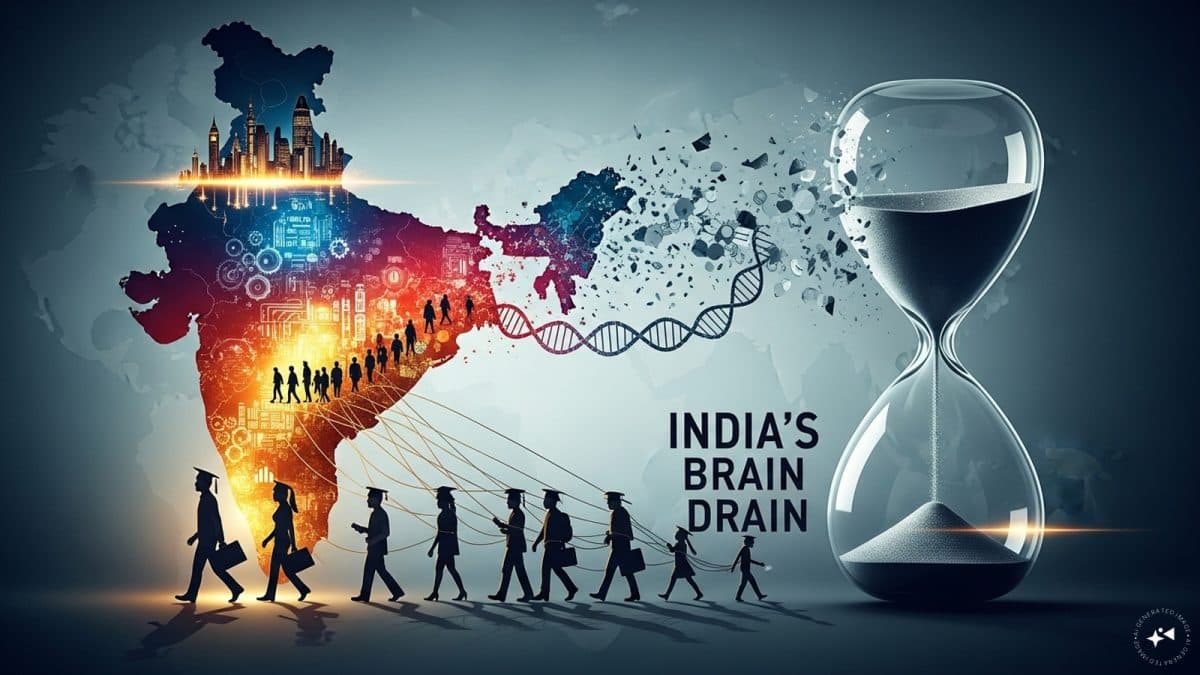
Speaking to friends at IITs over the years, I am informed that the curriculum at these institutions actively discourages innovation. After graduating from the IITs, the best students leave the country to pursue Master’s degrees or PhDs in STEM disciplines abroad—and never return. What we are then left with is a large pool of engineers who once had the fire to innovate but, due to the lack of a supportive ecosystem, fall back into mediocre engineering jobs, diversify into non-STEM pursuits such as management, or, in the worst-case scenario, become part of the IT sector’s coding sweatshops.
In complete contrast, China created a thriving ecosystem for its young STEM talent as early as the 1980s, the rewards of which are now becoming visible. Beyond identifying and nurturing young STEM talent, China also executed the famous Project 211 and Project 985 in the 1990s, transforming Chinese universities into world-class institutions through generous funding and the adoption of international best practices. In comparison, India does not have a single university in the top 100—forget the top ten—in this year’s rankings.
India’s university system continues to operate in isolation from global best practices, with the UGC pursuing priorities that diverge sharply from international counterparts. Even in non-STEM disciplines that do not require heavy laboratory investment, India still operates under the NAAC rating system, which has no global equivalent but nonetheless forces PhD scholars into administrative tasks instead of meaningful research.
Then there is the question of research and development as a national priority. Unlike China, which spends around 2.5 per cent of its annual GDP through a mix of central government, local government and corporate funding, India still does not spend even 1 per cent of its GDP on R&D. Chinese leaders, unlike their Indian counterparts of the past, displayed foresight. In addition to programmes such as the Genius Plan and Projects 211 and 985, they invested heavily in building a home-grown technology ecosystem to compete with the West by consistently increasing R&D commitments.
Just as China mastered low-cost manufacturing, it has also gamed high-end technology through massive subsidies, tax breaks, low-interest loans and active state involvement. Local and provincial governments compete aggressively to attract companies, talent and projects. Even companies in strategic sectors take R&D seriously, investing at least 10–20 per cent of their annual revenues into innovation—well above global standards. In contrast, Indian corporates fall far short of these figures. Even the most celebrated Indian IT giants—Infosys, TCS and Wipro—barely spend 1 per cent of their revenues on research.
Their leadership paints a rather sorry picture. While top executives are infamous for telling young Indians to hustle and work unearthly hours, their own commitment to innovation is conspicuously absent. No wonder technically gifted Indians surrender to their fate by working in these sweatshops.
China, on the other hand, not only runs a structured pipeline through the Genius Plan—placing students in top universities and high-tech jobs within what can be called its innovation laboratories—but also operates the ‘Thousand Talents’ Plan, which incentivises top Chinese talent trained in the West to return home and contribute to China’s technology ambitions. China treats returning talent as a national strategic priority.
India, in contrast, treats skilled professionals as an export commodity. Mobility agreements or H1B concessions are often flaunted as achievements of our technical prowess. It is one thing to take pride in the fact that many global CEOs are of Indian origin; it is quite another to realise that not a single Indian company can claim global leadership in emerging technology sectors.
China undoubtedly enjoys a first-mover advantage in emerging technologies. However, what must also be acknowledged is the seriousness with which it confronts global competition, while India remains entangled in internal quagmires. China reformed its economy before India, became a global manufacturing hub before India, and is now a serious challenger to the US in emerging technologies.
China understood early that national comprehensive power rests on indigenous capability. In the late 2000s, when Western technology companies such as Google began raising national security concerns—particularly during the Urumqi riots—China banned Western social media platforms and built its own ecosystem of apps such as WeChat and Douyin. This restriction of foreign competition created a vast domestic market for returnees to experiment and innovate.
India, now the fourth-largest economy in the world, has much soul-searching to do. If talent abroad does not wish to return, and talent at home is desperate to leave at the first opportunity, it is a damning commentary on how merit is treated within the system.
For now, India remains a source of cheap labour—unskilled, semi-skilled, fully skilled and even technically advanced. But how long will we continue to celebrate the opening of new markets for this labour? When will Indian minds be meaningfully incentivised to contribute to India’s emerging technology story? That is the question that must finally be asked.
(The author is a New Delhi-based commentator on geopolitics and foreign policy. She holds a PhD from the Department of International Relations, South Asian University. She tweets @TrulyMonica. The views expressed in the above piece are personal and solely those of the author. They do not necessarily reflect Firstpost’s views.)
End of Article
