



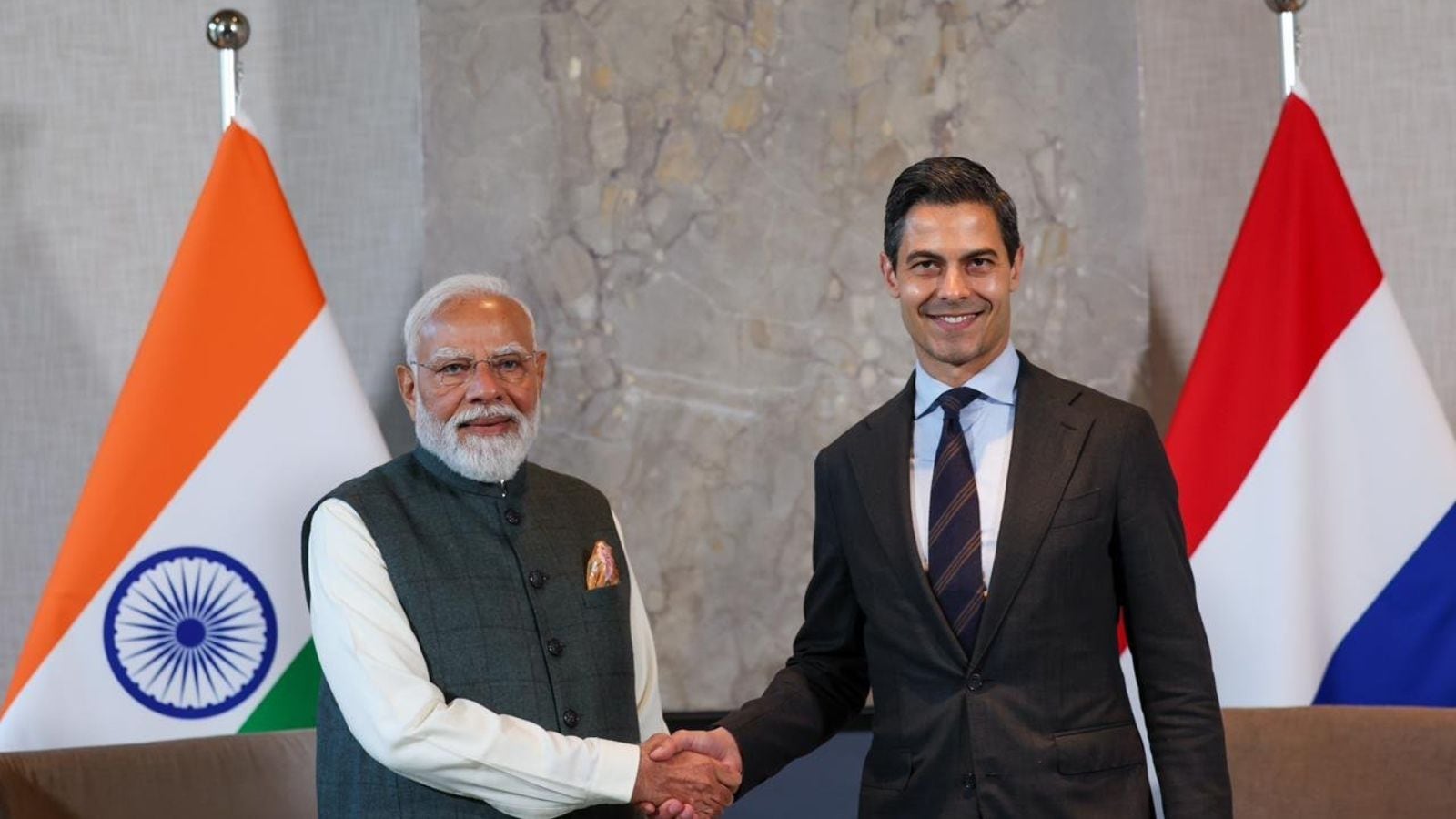
What made PM Modi’s visit to the Netherlands particularly consequential was not merely the symbolism of diplomatic engagement, but the growing convergence between India’s technological ambitions and the Dutch dominance in the semiconductor ecosystem. The visit came at a time when semiconductors have become the new geopolitical currency of power, shaping economic competitiveness, military capability, AI, and digital sovereignty.
At the centre of this emerging partnership lies ASML, the Dutch technology giant that occupies a near monopoly position in the global chip ecosystem. ASML is the world’s only producer of extreme ultraviolet (EUV) lithography machines, the highly sophisticated systems required to manufacture advanced semiconductors. Without its machines, the production of cutting-edge chips becomes virtually impossible. This has transformed the Netherlands from a relatively modest European power into a critical node in the global technology rivalry between the United States and China.

India understands this strategic reality. It has identified semiconductors as central to the country’s broader push for technological self-reliance under initiatives such as Make in India, Digital India, and the India Semiconductor Mission. New Delhi has committed billions of dollars in subsidies and incentives to build a domestic semiconductor ecosystem, including fabrication plants, packaging facilities, chip design centres, and semiconductor research infrastructure. The proposed Tata semiconductor fabrication facility in Dholera, Gujarat, with a planned total investment of $11 billion, for instance, represents India’s most ambitious attempt yet to enter the advanced manufacturing segment of the global chip-supply chain.
The global semiconductor industry is undergoing a profound restructuring because of the US-China technological competition, export controls, and supply-chain vulnerabilities exposed during the Covid pandemic. Dutch companies, including ASML, now face increasing restrictions on exports to China under pressure from Washington. Consequently, India appears increasingly attractive as a democratic, politically stable, and strategically aligned alternative manufacturing destination within the broader “China-plus-one” framework. Reports say that Dutch semiconductor firms are actively exploring diversification opportunities outside China, while Indian officials are encouraging the Netherlands to view India as a long-term production and innovation base.
There are now already visible signs of momentum. Earlier this year, Electronics and IT Minister Ashwini Vaishnaw visited ASML headquarters in Veldhoven, where discussions focused on lithography technologies and India’s semiconductor ambitions. During PM Modi’s trip, Tata Electronics signed an MoU with ASML to support the establishment and ramp-up of its upcoming 300 mm (12-inch) semiconductor fabrication plant in Dholera, marking a giant step in India’s semiconductor manufacturing ambitions.
Yet the significance of this partnership extends beyond hardware and manufacturing. The Netherlands offers India access to an entire ecosystem of semiconductor innovation involving research universities, photonics clusters, precision engineering firms, and advanced design capabilities. Such collaboration could help India avoid the mistake of becoming merely a low-cost assembly base. Instead, India aims to move up the value chain toward chip design, semiconductor R&D, advanced materials, and AI-integrated manufacturing systems. Modi’s visit therefore reflected a broader evolution in Indian foreign policy which is from traditional diplomacy centred on trade and politics towards what may be called “technology diplomacy”.
There are reasons for caution. Semiconductor manufacturing is among the most capital-intensive and technologically complex industries in the world. Even with subsidies and political support, India still faces significant structural challenges, including infrastructure gaps, power reliability issues, shortages of highly specialised manufacturing talent, and dependence on imported semiconductor-grade materials. Moreover, export-control politics surrounding advanced technologies could complicate deeper technology transfers. The Netherlands itself remains closely tied to American strategic preferences in semiconductor controls.
Nevertheless, India and the Netherlands increasingly view each other as essential partners in an era where technology, economics, and geopolitics are deeply intertwined. Modi’s trip could accelerate India’s transition from being primarily a consumer of advanced technologies to becoming an active participant in shaping the global semiconductor ecosystem.
The writer is assistant professor, Centre for European Studies, School of International Studies, JNU
