



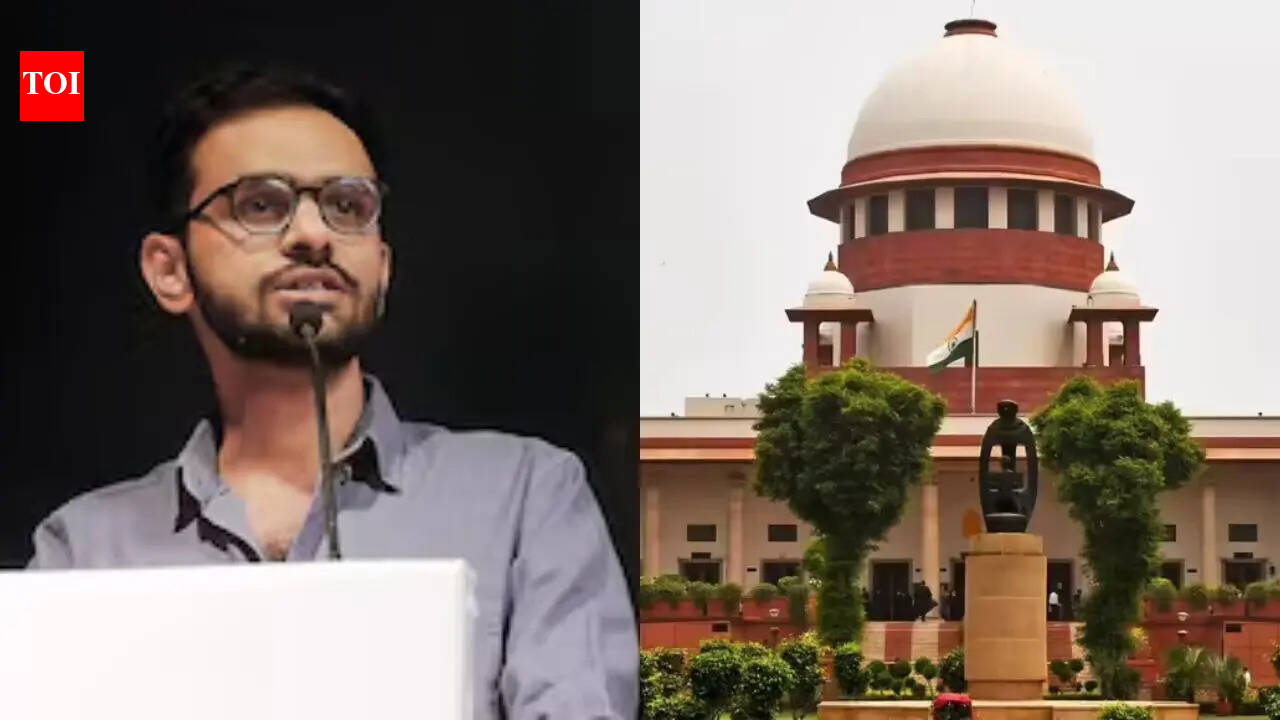
The Gulfisha Fatima ruling had been cited in cases where activists such as Umar Khalid and Sharjeel Imam were denied bail in connection with the 2020 Delhi riots conspiracy case.
NEW DELHI: The Supreme Court on Monday said that “bail is the rule and jail is the exception” even in cases under the Unlawful Activities (Prevention) Act (UAPA), while granting bail to a Jammu and Kashmir man accused in a narco-terror case, as per a report by PTI news agency.A bench comprising Justices BV Nagarathna and Ujjal Bhuyan granted bail to Handwara resident Syed Iftikhar Andrabi, who is accused of involvement in cross-border heroin smuggling and terror financing allegedly linked to Lashkar-e-Taiba. The Court directed him to surrender his passport and report to the local police station once every 15 days. The court emphasised that the stringent bail restrictions under Section 43D(5) of the UAPA cannot be used to justify endless imprisonment without trial, according to PTI report.The bench further disapproved an earlier ruling in the Gulfisha Fatima case (which denied bail to Umar Khalid and Sharjeel Imam in the Delhi riot conspiracy case), observing that it failed to properly follow the binding precedent laid down in the landmark KA Najeeb judgment regarding prolonged incarceration and delay in trial.What did the Supreme Court say?The bench strongly underlined the constitutional principle that personal liberty cannot be indefinitely curtailed just because a person is charged under anti-terror laws.“Bail is the rule and jail the exception is a constitutional principle flowing from Articles 21 and 22 and the presumption of innocence is the cornerstone of any civilised society governed by rule of law,” the apex court observed, according to PTI.“We have no manner of doubt in stating that even under the UAPA, bail is the rule and jail is the exception,” the court further added.However, the bench clarified that bail can still be denied in appropriate cases depending on the facts and seriousness of allegations.The Supreme Court rejected the bail plea of Umar Khalid and Sharjeel Imam in January this year, with both having been incarcerated for over five years in connection with the 2020 Delhi riots conspiracy case.What is Section 43D(5) of the UAPA?Section 43D(5) is one of the strictest bail provisions in Indian criminal law. It places severe restrictions on granting bail in UAPA cases if the court finds that accusations against the accused appear “prima facie true.” In practice, this provision has often resulted in prolonged incarceration of accused persons before trial begins or concludes.The Supreme Court, however, said that this provision cannot override constitutional protections under Articles 21 and 22, which guarantee personal liberty and protection against arbitrary detention.According to the bench, anti-terror laws must still operate within constitutional limits.Why is the KA Najeeb judgment important?The Court relied heavily on its 2021 judgment in Union of India vs KA Najeeb, which is considered a landmark ruling on bail under the UAPA.In KA Najeeb, the Supreme Court held that constitutional courts can grant bail in UAPA cases when there is prolonged delay in trial and the accused has already spent a significant period in custody.The ruling recognised that undertrial detention cannot become punitive in nature merely because the case involves stringent anti-terror provisions.However, the Supreme Court made it clear that the KA Najeeb ruling remains binding law.“The judgment in KA Najeeb is binding law and cannot be diluted, circumvented or disregarded by trial courts, high courts or even benches of lower strength of this court,” the bench said, as quoted by PTI.Why did the court refer to the Gulfisha Fatima case?The Court specifically disapproved the reasoning adopted in the Gulfisha Fatima case, which arose from the Delhi riots prosecutions.The bench observed that the earlier ruling did not properly apply the principles laid down in KA Najeeb. The Gulfisha Fatima ruling had been cited in cases where activists such as Umar Khalid and Sharjeel Imam were denied bail in connection with the 2020 Delhi riots conspiracy case, as per a report by LiveLaw.The Supreme Court’s observations are likely to prove significant in future UAPA bail hearings, particularly in cases involving long incarceration and delays in commencement or completion of the trial.What is the case against Andrabi?The National Investigation Agency (NIA) is investigating the case registered in 2020 under provisions of the UAPA and the Indian Penal Code (IPC).According to the NIA, police intercepted a vehicle at Kairo Bridge in Handwara on June 11, 2020, and allegedly recovered Rs 20.01 lakh in cash and two kilograms of heroin. The driver, Abdul Momin Peer, was arrested. Based on his disclosures, Andrabi and another accused, Islam-Ul-Haq Peer, were later arrested.The agency alleged that the accused were part of a cross-border heroin smuggling network operating in Jammu and Kashmir and other parts of the country, allegedly sourcing narcotics from Pakistan-based associates.The charge sheet further alleged that money generated through heroin sales was used for funding terror activities linked to Lashkar-e-Taiba and Hizbul Mujahideen. The NIA also claimed that Andrabi and co-accused Abdul Momin Peer had travelled to Pakistan multiple times between 2016 and 2017 to meet operatives of terror organisations, according to a PTI news agency report.
